
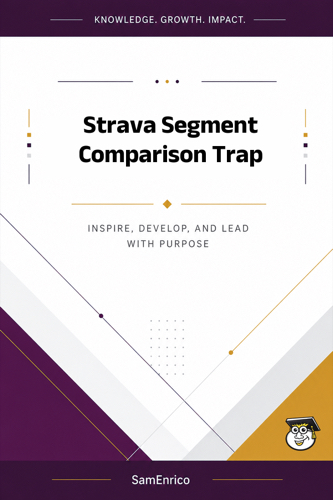
Non-FictionSelf-HelpFitnessCompetition
Strava Segment Comparison Trap eBook
Release the need to rank on public leaderboards fo
Release the need to rank on public leaderboards for running and cycling routes.
Formats
Free sample
Chapter 1: The Silent Ping...--It begins, as most addictions do, not with a bang but with a whisper. For you, it might have started on a Tuesday. A routine evening ride home from work, unremarkable except for the way the tailwind pushed you up Maple Avenue faster than usual. You weren't trying for anything. You were just riding.
Then, hours later, you opened the Strava app on your phone to log the miles, and a small grey notification appeared: “You got 3rd place on Maple Avenue Climb (View)”.Your thumb hovered. You tapped.And there it was. A silver trophy. A crown icon next to your name. A leaderboard showing you sandwiched between two strangers you had never met.
For a moment—maybe just two seconds—you felt a flush of something warm and unexpected. Validation. Speed. Worth.You locked your phone and went to bed.But something had changed. The next Tuesday, you hit Maple Avenue a little harder.
The Tuesday after that, you checked the leaderboard before you left the house. Within a month, you were taking the long way home, adding three extra miles, just to hit two more segments. You told yourself it was training. It was not training. It was hunting.Welcome to the Strava Segment Comparison Trap.
And the silent ping was your first hit.The Slot Machine in Your Shorts To understand why a simple leaderboard can rewire an athlete’s brain, we must first understand the neuroscience of variable rewards. In Atomic Habits, James Clear describes the habit loop: cue, craving, response, reward. Strava segments weaponize every stage of this loop.The cue is the segment itself. A specific stretch of road or trail, often bookmarked with a ghost icon on your cycling computer or watch. The craving is the anticipation of seeing your rank.
Will you be top 10? Did you beat your rival? Did you finally take that crown? The response is the all-out effort—the sprint, the redlined lungs, the legs burning long after you have stopped pedaling. And the reward is the dopamine hit from a trophy, a personal record, or a top-three finish.But here is the devilish design: you do not know the outcome until after you have suffered.This is the exact mechanism of a slot machine.
You pull the lever (ride the segment). The wheels spin (your GPS uploads). Then, with a click, the result appears. Sometimes you win a little (top 10). Rarely, you win big (KOM/QOM).
Most of the time, you lose (47th place, or a “-11” next to your name indicating you were slower than last week). Yet, like a gambler at a casino, you keep pulling the lever. Why? Because intermittent rewards are more addictive than predictable ones. If you got a trophy every single ride, you would get bored.
But the randomness—the hope that today might be the day—keeps you hooked.This is not a moral failure. It is biology.Eustress vs. Hysterical Stress Not all competition is harmful. Sports psychologists distinguish between two forms of stress: eustress (good stress) and hysterical stress (bad stress). Eustress is the healthy pressure of a race, a group ride, or a personal goal.
It sharpens focus, elevates performance, and leaves you feeling energized afterward. Hysterical stress is anxious, compulsive, and driven by fear of losing status or approval. It leaves you drained, irritable, and often injured.The Strava segment comparison trap turns eustress into hysterical stress by removing three critical boundaries:Time: In a real race, you know when it starts and ends. On Strava, every ride is a potential race. Every hill, every straightaway, every stop sign becomes a threat to your average speed.Context: In a real race, you know the weather, the course, and your competitors’ fitness levels.
On Strava, you are compared against a stranger who may have had a hurricane-force tailwind, a clean draft from a truck, or a GPS glitch that shaved four seconds off their time.Consent: In a real race, you sign up. You pay a fee. You pin on a number. On Strava, you never agreed to compete on that Tuesday commute. But the leaderboard assumed you did.The result is a low-grade, chronic state of anxious comparison that follows you on every run and ride.
It turns movement into measurement. It turns joy into judgment.The Psychology of the False Barometer In Chapter 2, we will explore social comparison theory in depth. But for now, understand this: the Strava leaderboard is a false barometer of athletic worth. A barometer measures atmospheric pressure. It is calibrated, reliable, and indifferent.
The Strava leaderboard is none of those things.Consider three identical athletes: Alice, Ben, and Carla. Each runs a 5k segment on the same flat road. Alice runs at 7:00 AM in calm air, 55 degrees. Her time: 20:00. Ben runs at 12:00 PM in 90-degree heat with a headwind.
His time: 21:30. Carla runs at 6:00 PM with a tailwind, drafting off a cyclist. Her time: 19:30.On the leaderboard, Carla is first, Alice is second, Ben is third. Ben goes home and spends an hour analyzing his heart rate data, convinced he is “slow.” But he is not slow. He was simply measured without context.
The leaderboard did not tell him about the heat, the wind, or the time of day. It told him a number, stripped of meaning.This is the false barometer in action. You stare at a rank and assume it reflects your fitness. In reality, it reflects a chaotic blend of your effort, the weather, your equipment, GPS errors, and the random sampling of who happened to ride that segment that week.The Identity Infection Here is where the trap becomes truly dangerous. After enough weeks of chasing segments, the leaderboard ceases to be a scoreboard and becomes a mirror.
You begin to say, silently or aloud: *“I am a runner who can hold a top-10 on River Road.”* Or worse: “I am the KOM holder of Hillcrest.”This is what psychologists call identity fusion—the merging of a behavior with your sense of self. It is the difference between saying “I ride my bike” (activity) and “I am a cyclist” (identity). The latter is not inherently bad. But when that identity is tethered to a public leaderboard that can change at any moment, you have built your house on sand.One windy afternoon, a younger rider takes your crown. You check Strava on the toilet and feel your chest tighten.
A stranger, someone you have never met, has erased a piece of your identity with a single upload. You refresh the page. Still gone. You check again before dinner. Still gone.
You think about it as you fall asleep.This is not a normal response to exercise. This is a symptom of identity infection. And the only cure is to decouple your sense of self from the leaderboard entirely.The Safety Net of the Unserious Athlete There is an odd paradox in endurance sports: the athletes who improve the most over the long term are often the ones who do not take themselves too seriously. They train hard, yes. But they also skip workouts for happy hour.
They take rest weeks without guilt. They laugh when they get dropped on a group ride.I call these athletes the…
This is the end of the free sample. Get the eBook to keep going. Buy now
About this book
Details
- Author
- Duckett Tesha
- Publisher
- SamEnrico
- Language
- English
- Genre
- Non-Fiction, Self-Help, Fitness, Competition
- Released
- 2026-06-08
- Pages (approx.)
- 93
- Available as
- eBook, Audiobook

Read better in the ZLOADR app
Your eBooks on your phone or tablet. Sign in with your SamEnrico account and start reading.
More by Duckett Tesha
 Trader Morning RoutineDuckett Tesha$11.99
 The Arthritis Biologic GuideDuckett Tesha$11.99
 Remote Company Retreats For Pet OwnersDuckett Tesha$11.99
 The Ayurvedic Taste GuideDuckett Tesha$11.99
 The Unstoppable Comeback: How a Broken Record Made HistoryDuckett Tesha$11.99
 Skilled LabourerDuckett Tesha$11.99
 Fixed Rate Lock StrategiesDuckett Tesha$12.99
 Price Evaluation PreferenceDuckett Tesha$12.99
 How to Become a Poleyard SupervisorDuckett Tesha$11.99
 Understanding Short Stature Locking FingersDuckett Tesha$17.99
You may also like
 Hong Kong Handover 1997Dunn Johnnie$11.99
 Zumba For Postnatal Recovery CourseNeal Christian$11.99
 Zumba for BeginnersLadner Nikia$11.99
 YouTube Comment Mining GuideHumes Pandora$12.99
 Worry Box MeditationCarlin Rudy$11.99
 Workplace Stress MeditationNguyen Lynn$11.99
 Workplace Stress and Sleep RepairHawley Ivory$11.99
 Workplace Perfectionism CureDelaney Jeffry$11.99
 Workplace Injustice Anger GuideWallen Isabelle$11.99
 Work Addiction and Burnout LinkGreenwood Ester$11.99
 Women in Yoga and WellnessBeattie Galina$11.99
 Women in Stand Up ComedyChun Evangeline$11.99