
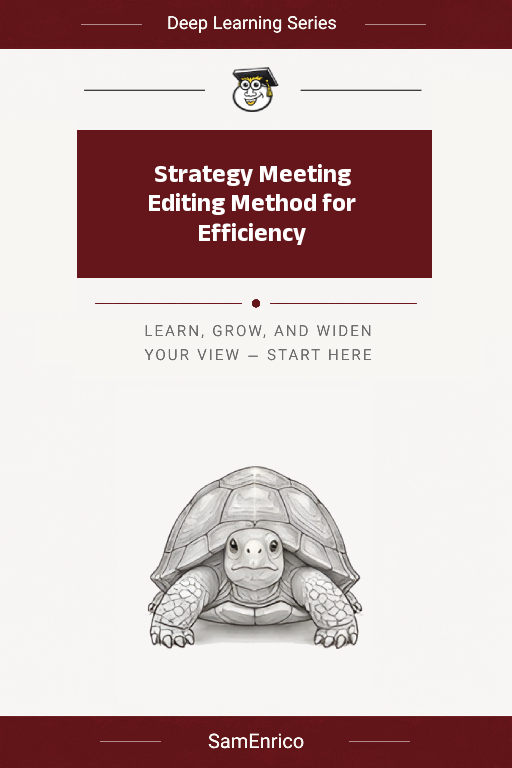
Non-FictionMeeting EfficiencyTime Optimization
Strategy Meeting Editing Method for Efficiency eBook
Cut meeting time by forty percent without losing d
by Knight Lee
Cut meeting time by forty percent without losing decision quality. Apply the outcome-first agenda design, the pre-work consolidation technique, and the asynchronous deliberation protocol for non-urgent topics.
Formats
Free sample
Chapter 1: The $0.5 Trillion Hour--–- Sarah Chen had just been promoted to Vice President of Product at a mid-sized software company. She was thrilled. Then she looked at her calendar for the following week. Forty-seven hours of meetings. Forty-seven.
On a Monday morning, she called her mentor in tears. "I don't understand," she said. "I thought getting promoted meant I'd have more control over my time. Instead, I have back-to-back meetings from 8 AM to 6 PM every single day. When am I supposed to actually think?
When am I supposed to lead?" Her mentor, a seasoned executive who had survived three IPOs, laughed—not cruelly, but with recognition. "Welcome to the trap," she said. "The higher you climb, the more your job becomes sitting in rooms listening to other people talk. The secret is that most of those rooms don't need you in them. And most of those meetings don't need to happen at all."This chapter will change how you see every meeting invite you receive.
It will quantify the hidden cost of "meeting culture" in your organization. It will introduce the fundamental distinction between coordination and collaboration. It will define what decision quality actually means—because cutting meeting time is only valuable if you don't cut decision quality. And it will give you a single question to ask before every meeting you schedule or attend. By the end of this chapter, you will never look at a 60-minute calendar block the same way again.The Strange History of the 60-Minute Meeting Why are most meetings exactly one hour long?
The answer is not rooted in cognitive science, organizational psychology, or any research on how long humans can effectively deliberate. The answer is much dumber than that.In the early 1980s, when personal computers were still novelties, calendar software was a luxury. The first digital calendars—like the ones on early Macintosh computers and later Microsoft Outlook—had to make a choice about default meeting lengths. Engineers chose 30 minutes and 60 minutes because those were round numbers that fit neatly into the 8-hour workday. There was no research behind this decision.
No one studied whether 60 minutes was optimal for decision-making. No one asked whether 45 minutes might be better. The engineers just picked a number that looked tidy.That number became the default. And defaults become habits. And habits become unexamined assumptions.By the 1990s, the 60-minute meeting was so entrenched that no one questioned it.
When you sent a meeting invite, you clicked "60 minutes" without thinking. When you received an invite for 60 minutes, you assumed that was how long the meeting needed to be. The calendar software didn't just record time—it shaped it. This is what cognitive psychologists call the "sunk cost fallacy" applied to time: if a meeting is scheduled for 60 minutes, participants feel obligated to fill 60 minutes. They stretch discussions.
They repeat points. They let tangents breathe. They look at the clock with 15 minutes remaining and think, "Well, we have time, so let's keep talking."The result is that most meetings could end in half the time—or never start at all. A study by the Harvard Business Review analyzed 1,000 executive calendars and found that the average meeting could have accomplished its stated objectives in 42% less time if participants had simply stopped talking when the decision was made rather than when the clock ran out. Forty-two percent.
That is not a rounding error. That is a revolution hiding in plain sight.The Meeting Tax: Calculating What You Cannot Afford to Waste Let us put a number on this problem. Not a fuzzy, conceptual number. A real, dollars-and-cents, boardroom-attention-getting number.The Meeting Tax Formula is simple:(Average fully-loaded hourly salary of participants) × (Hours spent in meetings per week) × (Number of employees in the meeting)Let us walk through an example. A mid-sized technology company has 200 employees.
The average fully-loaded hourly salary (including benefits, bonus, and overhead) is 75perhour.Thatisconservativeforatechcompany—manywouldbecloserto75 per hour. That is conservative for a tech company—many would be closer to 75perhour.Thatisconservativeforatechcompany—manywouldbecloserto100 or $125. Now calculate:Each employee spends 10 hours per week in meetings (again, conservative—many knowledge workers report 15-20)200 employees × 10 hours = 2,000 meeting-hours per week2,000 hours × 75=75 = 75=150,000 per week in meeting costs150,000×50workingweeks=150,000 × 50 working weeks = 150,000×50workingweeks=7.5 million per year Seven and a half million dollars. On meetings. And that is just the direct salary cost.
It does not include the opportunity cost of work not done during those hours—the product features not built, the customer emails not answered, the strategic thinking not done. Most organizations underestimate the Meeting Tax by a factor of 3 to 5 because they only count direct salaries and forget that every hour in a meeting is an hour not doing the work the meeting is supposedly about.Here is a more visceral example. Consider a single weekly status meeting. Twelve people attend. They earn an average of 120,000peryear(about120,000 per year (about 120,000peryear(about60 per hour).
The meeting runs for 60 minutes. The direct cost of that one meeting is 12 × 60=60 = 60=720. Over the course of a year (assuming 50 meetings), that is 36,000.Foronemeeting.Onerecurringhourperweek.Ifyouhavetensuchmeetingsonyourcalendar—andmanyexecutiveshavefarmore—youarespending36,000. For one meeting. One recurring hour per week.
If you have ten such meetings on your calendar—and many executives have far more—you are spending 36,000.Foronemeeting.Onerecurringhourperweek.Ifyouhavetensuchmeetingsonyourcalendar—andmanyexecutiveshavefarmore—youarespending360,000 per year just on status updates that could be emails.The chapter includes a simple spreadsheet template (available for download) that calculates your organization's Meeting Tax in 60 seconds. When managers run this calculation for the first time, their reaction is usually some variation of shock, denial, and then anger. The anger is productive. Use it.The Fundamental Distinction: Coordination vs. Collaboration Why do meetings cost so much?
Because we use them for everything. And most of those uses are wrong.Meetings serve two fundamentally different purposes. Most meetings try to serve both at once, and succeed at neither. The distinction between coordination and collaboration is the single most important lens you will learn in this book.Coordination is the sharing of information to align people toward a common goal. Examples include:Status updates: "Here is what I did yesterday."Calendar alignment: "When can we schedule the client call?"Information distribution: "Here are the new sales numbers."Task assignment: "You do X, you do Y, you do Z."Coordination does not require real-time interaction.
In fact, real-time interaction is often worse for coordination because it forces everyone to listen to information that only a few people need. Coordination can—and should—be done asynchronously. A shared document. An email digest. A project management tool.
A recorded video. Anything that allows people to consume information on their own schedule, at their own pace, and only when relevant to their work.Collaboration is the process of creating something that cannot be created alone. Examples include:Resolving ambiguity: "We have three possible interpretations of the client's requirement—which one is correct?"Making trade-offs: "If we invest in feature A, we cannot invest in feature B. Which one do we choose?"Brainstorming complex solutions: "We have a novel problem that no one has solved before. Let us generate possibilities."Negotiating competing interests: "Marketing wants X, engineering wants Y, sales wants Z.
How do we balance them?"Collaboration benefits from real-time interaction because ideas build on ideas, questions spark new angles, and the…
This is the end of the free sample. Get the eBook to keep going. Buy now
About this book
Details
- Author
- Knight Lee
- Publisher
- SamEnrico
- Language
- English
- Genre
- Non-Fiction, Meeting Efficiency, Time Optimization
- Released
- 2026-06-01
- Pages (approx.)
- 151
- Available as
- eBook, Audiobook

Read better in the ZLOADR app
Your eBooks on your phone or tablet. Sign in with your SamEnrico account and start reading.
More by Knight Lee
 Cali Cartel Phone NetworkKnight Lee$11.99
 Innovation Portfolio Management GuideKnight Lee$11.99
 Stress and Hair Loss HandbookKnight Lee$11.99
 Laundry Room Detox HandbookKnight Lee$11.99
 Antwerp Police InvestigationKnight Lee$11.99
 The Phantom of the Opera House: The Untold Story of the First Rock StarKnight Lee$11.99
 Icebreaker Pioneers: The Soviet Engineers Who Tamed the ArcticKnight Lee$11.99
 Ultimate Handbook Guide to Sakai : (Japan) Travel GuideKnight Lee$11.99
 Understanding Farber's DiseaseKnight Lee$17.99
 Sales Support SupervisorKnight Lee$11.99
 UAE Tax Digital Systems GuideKnight Lee$12.99
You may also like
 Hong Kong Handover 1997Dunn Johnnie$11.99
 Zumba For Postnatal Recovery CourseNeal Christian$11.99
 Zumba for BeginnersLadner Nikia$11.99
 YouTube Comment Mining GuideHumes Pandora$12.99
 Worry Box MeditationCarlin Rudy$11.99
 Workplace Stress MeditationNguyen Lynn$11.99
 Workplace Stress and Sleep RepairHawley Ivory$11.99
 Workplace Perfectionism CureDelaney Jeffry$11.99
 Workplace Injustice Anger GuideWallen Isabelle$11.99
 Work Addiction and Burnout LinkGreenwood Ester$11.99
 Women in Yoga and WellnessBeattie Galina$11.99
 Women in Stand Up ComedyChun Evangeline$11.99