
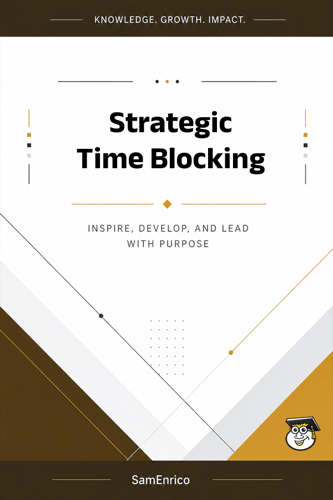
Strategic Time Blocking eBook
Align blocks with your highest priorities using th
Align blocks with your highest priorities using this practical leadership guide.
Formats
Free sample
Chapter 1: The Calendar Lie--–- Elena Vasquez stared at her calendar and felt a familiar sickness in her stomach. It was 7:45 PM on a Tuesday. She had just finished her seventh meeting of the day. Her email inbox showed 142 unread messages. Her teenage daughter had texted her four hours ago: “Mom, are you coming to my game?” Elena had not replied.
She had not attended. She had been in a budget review for a department she barely understood, listening to a finance manager explain variances that someone else could have handled.Elena was the CEO of a 200-person Saa S company called Lumina. By every external metric, she was successful. Revenue had grown 40 percent year over year. Her board was pleased.
Her investors were patient. Her employees respected her. And yet, as she scrolled through her calendar for the past month, she could not find a single block of time longer than thirty minutes that was not a meeting, a call, or a crisis. She had not spent an uninterrupted hour thinking about Lumina’s strategy in ninety-one days. The company’s three-year growth plan—the one she had presented to the board with such confidence—had not been touched in six months.Elena was not lazy.
She was not incompetent. She was not disorganized. She was, by every measure, a textbook case of the Leadership Time Paradox.The Problem That Has No Name The Leadership Time Paradox is simple to state and devastating in its consequences: the vast majority of leaders know that strategic thinking is their primary job, yet they cannot find time for it. According to research published in the Harvard Business Review, 85 percent of senior leaders admit that strategic thinking is essential to their role, but only 10 percent report having sufficient time for it. This is not a gap in awareness.
It is a structural failure of how leadership calendars are designed.The problem is not that leaders are lazy. The problem is that the urgent consistently defeats the important. The short-term consistently consumes the long-term. The firefighting consistently displaces the fire prevention. And the structure of modern leadership work—with its back-to-back meetings, its always-on email culture, its expectation of immediate responsiveness—is explicitly designed to produce this outcome.
A leader who wants to think strategically is swimming against the current of organizational gravity.Elena’s story is not unique. Across every industry, at every level of leadership, the same pattern repeats. A leader rises through the ranks by being good at execution. They are promoted because they can solve problems, manage teams, and deliver results. Then, at the moment they become responsible for strategy—for setting direction rather than following it—the very skills that brought them success become traps.
They continue to fill their calendars with execution work because it feels productive. They continue to say yes to meetings because it feels responsive. They continue to prioritize the urgent because it feels urgent.And somewhere, in the margins of their overstuffed calendars, their strategic priorities die quietly. Not because they were bad priorities. Not because the leader lacked vision.
But because the leader never had the one thing strategy requires above all else: uninterrupted time to think.The Mc Kinsey Discovery That Should Have Changed Everything In 2018, Mc Kinsey & Company conducted a multi-year study of how C-suite executives actually spend their time. The researchers tracked executives across seventeen companies, analyzing calendar data, email logs, and self-reported priorities. The findings were sobering. On average, executives spent only 9 percent of their time on strategic thinking and long-term planning. The remaining 91 percent went to operational tasks, internal coordination, reporting, and reactive firefighting.Even more troubling, the researchers found that the gap between stated strategic priorities and actual time allocation widened as leaders became more senior.
Entry-level managers spent 15 percent of their time on strategy. Directors spent 12 percent. VPs spent 8 percent. C-suite executives spent 5 percent. The people with the most responsibility for setting organizational direction had the least time to think about it.This is not a failure of individual time management.
It is a failure of organizational design. The same systems that demand leaders be available, responsive, and hands-on are the systems that prevent them from being strategic. The same cultural norms that celebrate busyness and punish empty calendar space are the norms that ensure strategic thinking never happens.When the Mc Kinsey report was published, it generated brief discussion. Consultants wrote blog posts. Leadership trainers added slides to their presentations.
And then, almost immediately, everyone returned to their meetings. The pattern repeated. The paradox endured.Elena had never seen the Mc Kinsey report. But she had lived it. As she scrolled through her calendar, she calculated her own strategic time allocation.
In the past thirty days, she had spent exactly 270 minutes—four and a half hours—on work she would classify as strategic thinking. That was less than 2 percent of her working time. She was spending more time on internal reporting than on the future of her company.“This is insane,” she said aloud, to no one. Her office was empty. Everyone else had gone home.The Two Agendas That Cannot Both Win To understand why Elena’s calendar looked the way it did—and why your calendar probably looks similar—we need to understand the fundamental tension at the heart of leadership work.
Every leader, at every level, is responsible for two distinct agendas. Most leaders never consciously distinguish between them. That is the source of the problem.The first agenda is the Management Agenda. This is the work of running the business as it exists today. It includes operations, reporting, budget management, human resources, customer support, internal coordination, and crisis response.
The Management Agenda is necessary. Without it, the organization would collapse. But it is also reactive, tactical, and structurally infinite. There is always another email. There is always another meeting.
There is always another fire to put out.The second agenda is the Leadership Agenda. This is the work of growing the business for tomorrow. It includes innovation, market positioning, talent development, long-term strategy, competitive analysis, and organizational design. The Leadership Agenda is optional in the short term. Skipping it today produces no immediate consequences.
But skipping it for months or years produces slow, catastrophic failure—the kind where a leader looks up one day and realizes their industry has passed them by.Here is the paradox: the Management Agenda is urgent but rarely important. The Leadership Agenda is important but rarely urgent. And because human beings are wired to respond to urgency, the Management Agenda consistently consumes the Leadership Agenda. Not because leaders are bad at their jobs. Because leaders are human.Elena had spent the past six months running Lumina.
She had not been leading it. The distinction felt subtle, but its consequences were not. Lumina’s product roadmap was stale. Its competitors had launched two features that Elena’s team had discussed eighteen months ago and never prioritized. Its best engineers were bored.
Its chief technology officer had begun taking calls from recruiters.Elena knew all of this. She had the data. She had the reports. She had the meetings about the meetings. But she did not have the one…
This is the end of the free sample. Get the eBook to keep going. Buy now
About this book
Details
- Author
- Shively Larue
- Publisher
- SamEnrico
- Language
- English
- Genre
- Non-Fiction, Self-Help, Strategic Planning
- Released
- 2026-06-08
- Pages (approx.)
- 138
- Available as
- eBook, Audiobook

Read better in the ZLOADR app
Your eBooks on your phone or tablet. Sign in with your SamEnrico account and start reading.
More by Shively Larue
 Focus For Health ProfessionalsShively Larue$11.99
 Forensic Mapping Techniques HandbookShively Larue$11.99
 Imposter For New ParentsShively Larue$11.99
 Education Talent ShortagesShively Larue$11.99
 The Startup Inventory AccountingShively Larue$11.99
 Job Seeker Time BlockingShively Larue$11.99
 Walking Hypnosis ListeningShively Larue$11.99
 The Great Escape of the Cape Town Convicts: A Colonial Justice ScandalShively Larue$11.99
 The Velvet Underground: Exploding the Myth of the UndergroundShively Larue$11.99
 Carrot: When to Harvest CarrotsShively Larue$11.99
 College Application Essays That Work GuideShively Larue$12.99
 New Zealand Stock Option Tax RulesShively Larue$12.99
You may also like
 Strategic Relationship Mapping GuideEdmond Jesenia$11.99
 Planning Morning RoutineCopley Lupita$11.99
 Quadrant Two Productivity GuideOjeda Cassie$11.99
 The Quadrant Two Time Management GuideBerg Deneen$11.99
 Stress and Relationship Future PlanningSchell Tonda$11.99
 Quarterly Review Reset GuideDurr Dione$11.99