
Non-FictionMental WealthAnti-Stigma
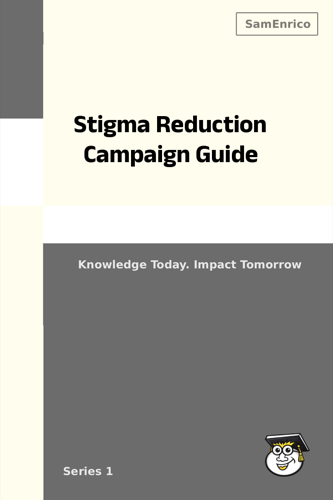
Stigma Reduction Campaign Guide eBook
Design mass media campaigns using local celebritie
Design mass media campaigns using local celebrities and testimonies to normalize therapy-seeking.
Formats
Free sample
Chapter 1: The Empathy Lie--–- For the past three decades, public health campaigns have been built on a well-intentioned but fundamentally flawed assumption. The assumption is this: if people knew more about mental health, if they understood the statistics, if they could recite the symptoms of depression or the success rates of cognitive behavioral therapy, they would stop stigmatizing therapy-seekers and start seeking help themselves. This assumption has guided the investment of billions of dollars into awareness campaigns, educational pamphlets, celebrity PSAs, and school-based mental health literacy programs. And by almost every meaningful measure, it has failed.The failure is not for lack of effort or funding. The failure is not because the messengers were untalented or the creative work was poor.
The failure is structural and psychological. It stems from a misunderstanding of how stigma actually operates in the human mind. Stigma is not primarily an information deficit. It is not solved by adding data to a brain that was previously empty of data. Stigma is a social emotion, wired deep in the limbic system, shaped by evolution to protect the tribe from outsiders and the self from shame.
You cannot Power Point your way out of a million years of social wiring.This chapter dismantles the most persistent and dangerous lie in mental health communication: the lie that empathy can be taught through facts. It then introduces the alternative framework that will guide every subsequent chapter of this book—a framework built not on information transmission but on social contact, emotional identification, and the strategic use of trusted voices to rewire the unconscious associations that drive stigma.The Billion-Dollar Mistake Let us begin with a thought experiment. Imagine you are afraid of flying. The fear is not rational; you know, intellectually, that commercial aviation is statistically safer than driving to the grocery store. You have read the NTSB reports.
You have memorized the odds. But when the plane begins to taxi toward the runway, your palms sweat, your heart races, and your rational mind shuts down. Would handing you another pamphlet about aviation safety cure your fear? Of course not. Your fear was never caused by a lack of information.
It was caused by a visceral association—between flying and danger, between loss of control and catastrophe—that lives beneath the level of conscious reasoning.Stigma operates the same way. When a person feels disgust or fear at the idea of seeing a therapist, when a parent hesitates to take their teenager to counseling, when a manager assumes that an employee in therapy is unreliable—these reactions are not primarily intellectual. They are emotional and unconscious. They are the result of deeply embedded associations: therapy equals weakness, therapy equals failure, therapy equals something that happens to other people, broken people, people not like me.The public health community has spent decades treating stigma as if it were a factual error. Consider the typical awareness campaign.
It features a somber voiceover, soft piano music, and a list of statistics: "One in five adults experiences a mental health condition. Treatment is effective for eighty percent of cases. Yet nearly half of those suffering do not seek help." The implicit logic is that viewers, upon learning these facts, will update their beliefs and change their behavior. But study after study has shown that these campaigns produce at best trivial effects on actual help-seeking, and in some cases, they paradoxically increase stigma by reinforcing the association between mental health struggles and medicalized, clinical, "other" identities.A 2017 meta-analysis of mental health awareness campaigns published in the journal Social Psychiatry and Psychiatric Epidemiology reviewed forty-three separate interventions and found that while knowledge reliably increased, attitudinal change was inconsistent and behavioral change was rare. People learned more about depression without becoming less afraid of admitting they might be depressed.
They could recite the suicide prevention hotline number without being willing to call it themselves. The gap between knowing and doing remained stubbornly wide.This is the Empathy Lie. It is the belief that if you give someone the right information, they will feel the right way and take the right action. It is a lie because the brain does not work that way. Information enters through the neocortex, the seat of rational thought.
Stigma lives in the limbic system, the seat of emotion and automatic response. The two systems are connected, but the connection is not a one-way street. You cannot simply dump facts into the neocortex and expect the limbic system to obediently rewire itself. The limbic system answers to a different logic—the logic of social belonging, tribal identity, and emotional contagion.The Origins of Stigma: A Brief Evolutionary Tour To understand why facts fail, we must understand what stigma actually is and why it exists. The word "stigma" comes from the ancient Greek term for a mark or brand burned into the skin of a slave or criminal—a visible sign of moral taint.
The psychological concept retains this core meaning: stigma is a mark of disgrace that sets a person apart from the tribe and devalues them in the eyes of others.Evolutionary psychologists have argued that stigma emerged as a functional adaptation. Early humans lived in small, interdependent groups where survival depended on cooperation and trust. Individuals who threatened the group—through disease, norm violation, or perceived weakness—posed a danger. The emotional machinery of stigma evolved to detect and distance those individuals. Disgust protected the group from contagion.
Fear protected the group from norm-breakers. Contempt protected the group from those who could not pull their weight.These emotional responses were automatic and unconscious because they had to be fast. A hominid who stopped to rationally analyze whether a sneezing, feverish companion posed a real threat might contract the illness before completing the analysis. Stigma was a cognitive shortcut, and like all shortcuts, it was often wrong—but in the ancestral environment, false positives (shunning someone who was actually safe) were less costly than false negatives (accepting someone who was dangerous).Modern mental health stigma is an evolutionary mismatch. The machinery that evolved to protect us from infectious disease and norm violation now fires at the sight of a therapist's office or the mention of antidepressants.
The person seeking therapy is not a threat. But the ancient circuitry does not know that. It responds to the same cues—difference, vulnerability, admission of struggle—with the same automatic rejection.This is why facts fail. You cannot explain evolutionary mismatch away with a brochure. The limbic system does not read brochures.
It responds to social signals: who is safe, who is like me, who belongs in my tribe. The only language the limbic system fluently speaks is the language of social contact.Social Contact Theory: The Proven Alternative In 1954, the psychologist Gordon Allport published The Nature of Prejudice, a landmark work that synthesized decades of research on intergroup conflict. Allport proposed what became known as the Contact Hypothesis: under the right conditions, direct contact between members of different social groups reduces prejudice more effectively than any other intervention. The conditions included equal status between the groups, common goals, intergroup cooperation, and institutional support.Subsequent research has confirmed and refined Allport's hypothesis across dozens…
This is the end of the free sample. Get the eBook to keep going. Buy now
About this book
Details
- Author
- Booker Deandre
- Publisher
- SamEnrico
- Language
- English
- Genre
- Non-Fiction, Mental Wealth, Anti-Stigma
- Released
- 2026-06-08
- Pages (approx.)
- 129
- Available as
- eBook, Audiobook

Read better in the ZLOADR app
Your eBooks on your phone or tablet. Sign in with your SamEnrico account and start reading.
More by Booker Deandre
 Self Esteem Empty Nest GuideBooker Deandre$11.99
 Commute Energy ManagementBooker Deandre$11.99
 Last Mile Delivery Exception Management GuideBooker Deandre$11.99
 The Great Bitcoin Heist: How a Shadow War Sabotaged a Crypto EmpireBooker Deandre$11.99
 Nefertem's Golden Whisper: The Lotus Sorcerer of the NileBooker Deandre$11.99
 How to Start a Bridgelayer (tracked Military) Business (Beginners Guide)Booker Deandre$11.99
 Understanding Herrmann–opitz Arthrogryposis SyndromeBooker Deandre$17.99
 Defensive DrivingBooker Deandre$11.99
 Five-Year Artificial Intelligence OutlookBooker Deandre$12.99
 Thundafund Africa Crowdfunding ManualBooker Deandre$12.99
You may also like
 Hong Kong Handover 1997Dunn Johnnie$11.99
 Zumba For Postnatal Recovery CourseNeal Christian$11.99
 Zumba for BeginnersLadner Nikia$11.99
 YouTube Comment Mining GuideHumes Pandora$12.99
 Worry Box MeditationCarlin Rudy$11.99
 Workplace Stress MeditationNguyen Lynn$11.99
 Workplace Stress and Sleep RepairHawley Ivory$11.99
 Workplace Perfectionism CureDelaney Jeffry$11.99
 Workplace Injustice Anger GuideWallen Isabelle$11.99
 Work Addiction and Burnout LinkGreenwood Ester$11.99
 Women in Yoga and WellnessBeattie Galina$11.99
 Women in Stand Up ComedyChun Evangeline$11.99