
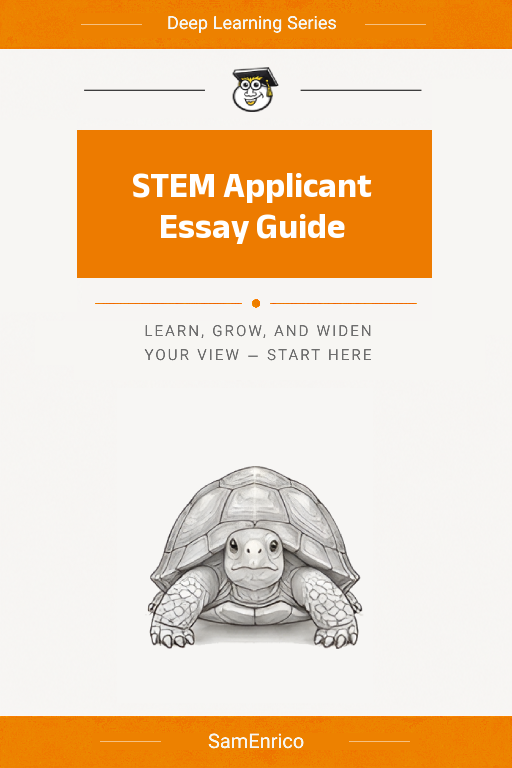
STEM Applicant Essay Guide eBook
Show scientific curiosity and problem-solving skil
Show scientific curiosity and problem-solving skills without listing awards or test scores.
Formats
Free sample
Chapter 1: The Fire That Worked--–- My circuit caught fire on a Tuesday afternoon. The smoke was gray and acrid, curling up from the breadboard like a question mark. I had done everything right—checked the voltage, matched the resistors, followed the diagram twice. And yet there it was: the unmistakable smell of burned plastic and a black scar where the transistor used to be. For a moment, I panicked.
Then I did something that would later become the single most important sentence in my college application essay. I did not say, “I fixed it.” I did not say, “I learned my lesson.” I looked at the smoke and said, out loud, to no one in particular: “Wait… why did that happen?”That question—not the repair, not the grade, not the award—was the moment I became a scientist. And it is the only moment admissions officers at top STEM programs truly care about.The Paradox of the Perfect Applicant Every year, admissions officers at MIT, Caltech, Stanford, and Carnegie Mellon read thousands of essays that begin the same way: “Ever since I was five years old, I have loved science.” They read about students who won the state science fair, scored 800 on the SAT Math section, took every AP STEM course available, and served as president of the robotics team. These essays are not bad. They are simply identical.
And when every applicant looks the same on paper, the admissions committee has no reason to choose one over the other.Here is the truth that most guidebooks will not tell you: your test scores and awards have already done their job by the time someone reads your essay. They got you into the “academically qualified” pile. That pile is enormous—often 20,000 to 30,000 applicants for fewer than 1,500 spots. The essay is not there to prove that you are smart. The essay is there to prove that you are curious.
And curiosity looks nothing like a resume.Curiosity is messy. Curiosity fails. Curiosity asks questions that have no immediate answer. Curiosity burns circuits and then wonders why. The problem is that most students have been trained their entire lives to hide their curiosity behind a wall of accomplishments.
Your teachers asked for the right answer. Your parents asked for the good grade. Your transcript is a monument to getting things right. But an admissions reader is not your teacher or your parent. They are looking for the student who, when something goes wrong, does not reach for the answer key—they reach for a question.This chapter will teach you how to find the most powerful essay you have ever written in the one place you have been taught to hide: your most embarrassing, frustrating, or confusing failure.
Not a failure that made you cry or lose confidence—but a failure that made you genuinely, compulsively curious. A failure that made you say, “Wait… why?”The Three Types of Failure (Only One Works)Before we go any further, we need to distinguish between three very different kinds of failure. Only one of them belongs in your STEM essay.Type 1: The Moral Failure. You cheated on a test. You lied to your parents.
You skipped practice and let your team down. These are important moments for personal growth essays, but they are not STEM essays. They do not demonstrate scientific curiosity. Avoid them here.Type 2: The Performance Failure. You studied for hours and still got a C.
You practiced the piano recital and still messed up. You tried your hardest and still lost the game. These failures show perseverance, but they do not show curiosity. They show effort, not inquiry. The reader learns that you try hard—which is good—but they learn nothing about how your mind works.
Avoid these as well.Type 3: The Assumption Failure. You believed something about how the world works. You acted on that belief. The world behaved differently than you expected. And instead of getting frustrated, you got interested.
This is the only failure that belongs in your STEM essay.An assumption failure happens when your mental model of a system breaks. You thought the circuit would work at 5 volts. It caught fire. You thought the plant needed more water. It died faster.
You thought the algorithm would sort the list in O(n log n) time. It took O(n²). In each case, you did not fail because you were lazy or untalented. You failed because your understanding was incomplete. And that incompleteness is a gift—it is the raw material of scientific discovery.Here is the difference in concrete terms:Performance Failure Assumption Failure“I studied for the physics test and got a D.”“I assumed the heavier ball would fall faster.
Galileo proved me wrong in my own driveway.”“My robot lost the competition.”“My robot’s arm drifted 2 degrees every cycle because I forgot to account for gear backlash.”“I couldn’t get my code to compile.”“I assumed Python passed variables by value. It passes by reference. My function changed the original list without telling me.”Notice the pattern? The performance failure is about you (your effort, your outcome, your rank). The assumption failure is about the world (how it works, how you misunderstood it, how you now see it differently).
One makes the reader feel sorry for you or impressed by your grit. The other makes the reader want to sit next to you in physics class.The Anatomy of a Curious Failure Let us dissect the example from the opening of this chapter: the circuit that caught fire.What I thought was true: A 5-volt power supply, a 220-ohm resistor, and a standard NPN transistor would operate safely within specified limits. I had done the math. V = IR. 5 volts / 220 ohms = 0.0227 amps.
The transistor was rated for 0.2 amps. I had a tenfold safety margin. Everything should have worked.The evidence that broke my assumption: The transistor overheated within three seconds and emitted smoke. The plastic casing cracked. A small burn mark appeared on the breadboard.
My assumption was not slightly wrong—it was catastrophically wrong.The question that emerged: “Why did the transistor overheat when the current was well within its rated limit?”This question is the heart of the essay. Notice what it does not say: “I learned to double-check my work.” “I realized I should use a bigger resistor.” “I will never make that mistake again.” Those are boring. They are about you becoming a better student. The question “Why did the transistor overheat?” is about the physics. It is about the world refusing to behave as expected.
It is scientific curiosity in its purest form.The best STEM essays do not conclude with a lesson learned about yourself. They conclude with a new question about the world.The Four-Step Narrative Arc (The Only Structure You Need)Every great STEM essay about curiosity follows the same four-step narrative arc. You will use this structure not only in this chapter but throughout the book. (We will explore variations in Chapter 4, but the core remains the same.)Step 1: What I thought was true. Describe your mental model—the set of assumptions, formulas, or intuitions you carried into the situation.
Be specific. Do not say “I thought I knew what I was doing.” Say “I believed that 5 volts and…
This is the end of the free sample. Get the eBook to keep going. Buy now
About this book
Details
- Author
- Zimmer Blaine
- Publisher
- SamEnrico
- Language
- English
- Genre
- essays, Student's Shortcut, STEM
- Released
- 2026-05-30
- Pages (approx.)
- 151
- Available as
- eBook, Audiobook

Read better in the ZLOADR app
Your eBooks on your phone or tablet. Sign in with your SamEnrico account and start reading.
More by Zimmer Blaine
 Imposter Overwork FixZimmer Blaine$11.99
 Reconstruction of Asphyxiation DeathsZimmer Blaine$11.99
 Pomodoro for CodingZimmer Blaine$11.99
 Sudden Death Shock RecoveryZimmer Blaine$11.99
 Pain Acceptance GuideZimmer Blaine$11.99
 Inaccessible Website Lawsuit WinZimmer Blaine$11.99
 Memory Palace For Law CasesZimmer Blaine$11.99
 Drew Barrymore Firestarter ChildZimmer Blaine$11.99
 The Bloodstained Letters: The First DNA Breakthrough in a Serial Killer Case (1888)Zimmer Blaine$11.99
 Mastering The Biceps BrachiiZimmer Blaine$11.99
 How to Produce a Portable DVD PlayerZimmer Blaine$11.99
 How to Produce a Drawbar (Haulage)Zimmer Blaine$11.99
You may also like
 YouTube Video Essay DepthLeon Lala$11.99
 TOEFL Independent Essay GuideMintz Alex$11.99
 Music Theory Essay GuideWilkinson Maisha$11.99
 Expository Essay AI PromptsApplegate Dalia$11.99
 Exam Essay MemorizationMcgovern Johna$11.99
 Compare Contrast Essay PromptsOntiveros Marx$11.99
 College Application Essay GuideSisson Aimee$11.99College Application Essay GuideSisson Aimee$11.99
 The 100 Word Essay ChallengeAli Luciana$11.99
 Journalism Essay PromptsThatcher Williemae$11.99
 Finance Essay PromptsShrader Lamont$11.99
 Cause Effect Essay GPT GuideBland Jacelyn$11.99