
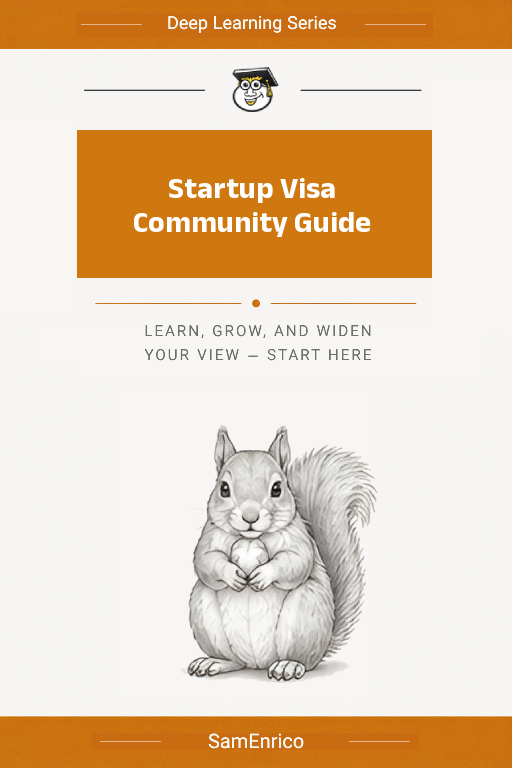
Non-FictionStartup GuideFounder Immigration
Startup Visa Community Guide eBook
Find startup community after visa approval. Cowork
Find startup community after visa approval. Coworking spaces, meetups, and founder networks.
Formats
Free sample
Chapter 1: The Arrival Paradox--Your visa approval email just arrived. You read it three times. You cried. You called your mother. You started looking at flight prices.
And then, somewhere between the celebration and the suitcase, a different feeling crept in: What now?You have permission to land. You have a business plan. You have a few thousand dollars and a dream. What you do not have is a single person in your new country who will pick up the phone when you panic at 2 AM. You do not have a lawyer who actually understands startups.
You do not have a bank account. You do not have a neighborhood. You do not have a coffee shop where the barista knows your name, let alone a founder friend who will tell you which accelerators are worth your time and which ones are scams.This book exists because that gap between visa approval and community anchor is the most dangerous, most lonely, and most overlooked period in the entire immigrant founder journey.Most guides stop at the visa. They teach you how to file paperwork, how to prove your business is viable, how to convince an immigration officer that you are not a risk. But no one teaches you what happens the morning after you land.
No one hands you a map of the invisible social architecture that determines whether you will raise a million dollars or burn out in six months. No one tells you that your foreignness—the very thing you have been trained to hide—is actually your sharpest competitive advantage.This chapter reframes everything you think you know about starting over. It introduces the single most important principle of this entire book. It names the epidemic that no one wants to talk about. And it gives you a self-assessment that will determine whether you spend your first ninety days hiding or hunting.Let us begin with a confession.The Loneliness No One Mentions Three months after landing in San Francisco on an E-2 visa, a founder we will call Priya stopped leaving her apartment.
She had a solid startup, ten years of experience in enterprise software, and two hundred thousand dollars in personal savings. On paper, she was the ideal visa candidate. In reality, she was drowning.She attended thirty meetups in her first sixty days. She collected two hundred business cards. She sent one hundred and forty Linked In connection requests.
And at the end of those sixty days, she had exactly zero warm introductions to investors, zero invitations to speak at events, and zero friends who would text her back within an hour. Her husband was still in India, waiting for his dependent visa. Her co-founder was a three-hour time zone away. She ate dinner alone every night for fifty-three consecutive days.Priya is not an exception. She is the rule.Data collected across twelve startup visa programs in the United States, Canada, and Germany shows that immigrant founders report burnout rates three times higher than native-born founders in their first twelve months.
The causes are not financial. They are not strategic. They are social. Immigrant founders lack what sociologists call ambient belonging—the casual, unearned sense of fitting in that locals take for granted. A native-born founder can call their college roommate for a warm intro.
An immigrant founder cannot. A native-born founder can mention their uncle's friend who invests in Saa S. An immigrant founder cannot. A native-born founder can walk into a coworking space and immediately recognize the unspoken social codes. An immigrant founder is guessing.This loneliness is not a character flaw.
It is not a sign that you are failing. It is a structural feature of immigration. You have been removed from every network you spent your entire life building. You have been dropped into a new country where no one owes you anything. And you are expected to rebuild everything—professional reputation, social capital, emotional support system—from absolute zero, while also building a company.No one can do that alone.But here is what the data also shows: immigrant founders who successfully integrate into a local community within their first ninety days raise money two times faster, hire three times more efficiently, and report significantly higher personal well-being than those who do not.
The difference between Priya's outcome and the success stories in later chapters is not intelligence, work ethic, or luck. It is a repeatable system for turning isolation into leverage.That system starts with a single mental shift.The Job Seeker vs. The Value Giver Walk into any meetup for immigrant founders and watch how people introduce themselves. Ninety percent will say some version of: "Hi, I'm [name]. I'm building [company].
I'm looking for investors, customers, and maybe a lawyer."This is the Job Seeker Mentality. It is a mindset of scarcity. It assumes that the ecosystem has resources (money, intros, advice) and your job is to extract as many of them as possible before your visa runs out. It is honest. It is efficient.
And it is completely wrong.The Job Seeker Mentality fails for a simple reason: everyone else is also seeking. The local investors have been pitched five hundred times this year. The local founders have been asked for intros a thousand times. The ecosystem is exhausted by people who want something. The people who thrive are not the ones who ask the loudest.
They are the ones who give first.This book introduces a different operating system. Call it the Value First Principle. It has only one rule, but it applies to every single action you will take in your first ninety days:Before you ask for anything, offer something. It does not have to be large. It does not have to be expensive.
It just has to be useful.That something could be a five-minute favor: fixing a typo on a founder's website, transcribing a podcast episode they appeared on, sharing a data point from your home country that their startup needs for expansion. It could be a small gift: a bag of coffee from your origin country, a spreadsheet template you built, an introduction between two people who should know each other. It could be your attention: taking notes at a meeting, photographing an event, volunteering to manage the registration desk at a conference.The Value First Principle works because it flips the power dynamic. When you give value first, you are no longer a beggar. You are a peer.
You are someone who contributes. And people remember the person who helped them before they helped themselves.Every subsequent chapter in this book is an application of the Value First Principle. Chapter 4 shows you how to offer note-taking skills to get into private clubs. Chapter 8 teaches the five-minute favor tactic for super-connectors. Chapter 11 argues that mentoring someone six months behind you is the highest-leverage networking move you can make.
But the principle itself lives here, in Chapter 1, because without it the tactics are just manipulation.Here is the hard truth: you cannot fake the Value First Principle. People can smell transactional energy from across a room. If you offer a favor only as a prelude to asking for something bigger, you will…
This is the end of the free sample. Get the eBook to keep going. Buy now
About this book
Details
- Author
- Samples Carie
- Publisher
- SamEnrico
- Language
- English
- Genre
- Non-Fiction, Startup Guide, Founder Immigration
- Released
- 2026-05-29
- Pages (approx.)
- 144
- Available as
- eBook, Audiobook

Read better in the ZLOADR app
Your eBooks on your phone or tablet. Sign in with your SamEnrico account and start reading.
More by Samples Carie
 Elastic Cloud Outage GuideSamples Carie$11.99
 Effortless Transcending TechniqueSamples Carie$11.99
 The Anki Flashcard Memory GuideSamples Carie$11.99
 Selling Inherited Property in RetirementSamples Carie$11.99
 Work Stress Spillover PreventionSamples Carie$11.99
 Starlight Odyssey: The Lost Mission of Pioneer 10Samples Carie$11.99Starlight Odyssey: The Lost Mission of Pioneer 10Samples Carie$11.99
 Queue ManagementSamples Carie$11.99
 Understanding W SyndromeSamples Carie$17.99
 Third Party Links TermsSamples Carie$12.99
 How to Start a Basins Made of Fibre-cement Business (Beginners Guide)Samples Carie$11.99
You may also like
 Hong Kong Handover 1997Dunn Johnnie$11.99
 Zumba For Postnatal Recovery CourseNeal Christian$11.99
 Zumba for BeginnersLadner Nikia$11.99
 YouTube Comment Mining GuideHumes Pandora$12.99
 Worry Box MeditationCarlin Rudy$11.99
 Workplace Stress MeditationNguyen Lynn$11.99
 Workplace Stress and Sleep RepairHawley Ivory$11.99
 Workplace Perfectionism CureDelaney Jeffry$11.99
 Workplace Injustice Anger GuideWallen Isabelle$11.99
 Work Addiction and Burnout LinkGreenwood Ester$11.99
 Women in Yoga and WellnessBeattie Galina$11.99
 Women in Stand Up ComedyChun Evangeline$11.99