
Startup Financial Statements
Understand profit & loss, balance sheet, and cash
by Adame Mayola
undefined
Formats
About this book
Free sample
Chapter 1: The Gut Lie...--–- On a Tuesday morning in March, Alex Chen celebrated what looked like a miracle. His six-month-old Saa S startup, Flowlytics, had just closed its largest deal yet: a 240,000 annual contract with a mid-sized logistics company. The signed contract sat on his desk. His CRM showed the revenue. His co-founder high-fived him.
His investors sent congratulatory Slack messages. The P&L statement, which his part-time bookkeeper prepared each month, would show a stunning 20,000 net profit for March—the first profitable month in company history.By Thursday afternoon of the same week, Alex was on a desperate phone call with his lawyer. A 180,000cloudinfrastructurebillhadcomedue.Thebillwasforservers,datastorage,and APIcalls—theliteralengineof Flowlytics.Itwaspayableimmediately.Alexloggedintothecompanybankaccount.Thebalanceread180,000 cloud infrastructure bill had come due. The bill was for servers, data storage, and API calls—the literal engine of Flowlytics. It was payable immediately.
Alex logged into the company bank account. The balance read 180,000cloudinfrastructurebillhadcomedue.Thebillwasforservers,datastorage,and APIcalls—theliteralengineof Flowlytics.Itwaspayableimmediately.Alexloggedintothecompanybankaccount.Thebalanceread42,000. He had 240,000insignedcontracts,240,000 in signed contracts, 240,000insignedcontracts,20,000 in paper profit, and less than one quarter of the cash required to survive the next thirty days.Flowlytics did not make it to April.Alex's story is not an outlier. It is a ritual sacrifice repeated thousands of times each year in startup ecosystems around the world. Founders confuse contracts with cash.
They mistake revenue recognition for bank deposits. They celebrate P&L profitability while the company bleeds out through a slow trickle of unpaid invoices, delayed customer payments, and the cruel gap between when expenses arrive and when revenue actually hits the account.This book exists because that gap kills more startups than bad products, weak teams, or aggressive competitors combined.The Six-Month Blind Spot Every founder possesses a superpower in the first six months of operations. That superpower is called bootstrapped intuition. When you have three customers, one part-time developer, and a bank account you personally funded, you know exactly where every dollar comes from and where every dollar goes. You feel the cash.
You see the deposits. You remember the day the server bill arrived because you paid it with your personal credit…
This is the end of the free sample. Get the eBook to keep going. Buy now
Contents
- Chapter 1
- Chapter 2
- Chapter 3
- Chapter 4
- Chapter 5
- Chapter 6
- Chapter 7
- Chapter 8
- Chapter 9
- Chapter 10
- Chapter 11
- Chapter 12
Details
- Author
- Adame Mayola
- Publisher
- SamEnrico
- Language
- English
- Genre
- Non-Fiction, Startup Guide, Finance Basics, Startup Guide / Financials
- Released
- 2026-05-30
- Pages (approx.)
- 149
- Available as
- eBook, Audiobook

Read better in the ZLOADR app
Your eBooks on your phone or tablet. Sign in with your SamEnrico account and start reading.
More by Adame Mayola
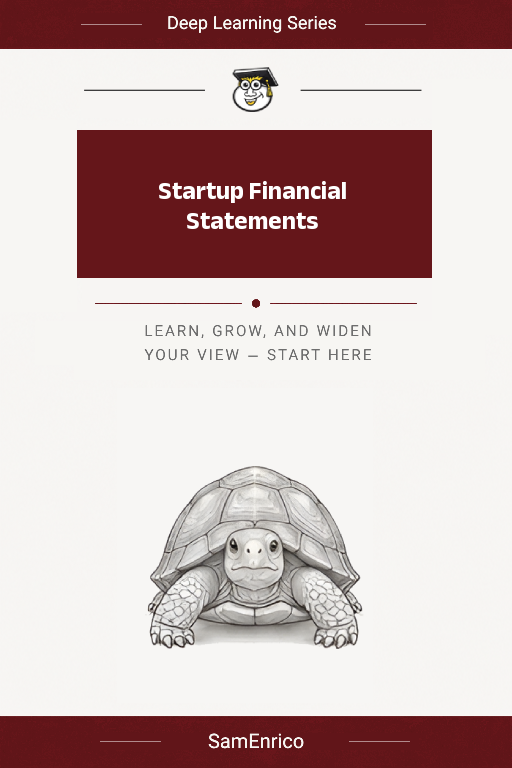 Startup Financial StatementsAdame Mayola$12.99
 Teen Nutrition Self EsteemAdame Mayola$11.99
 MDD History GuideAdame Mayola$11.99
 James Acaster MemoirAdame Mayola$11.99
 Dental Care In Foster SystemAdame Mayola$11.99
 The Antioxidant Skin GuideAdame Mayola$11.99
 The Symphony of the Sun: Black Composers Who Conquered Classical MusicAdame Mayola$11.99
 How to Become a GeneticistAdame Mayola$11.99
 Domain Name Lease GuideAdame Mayola$12.99
 The Breeder's Guide to Sultan ChickensAdame Mayola$11.99