
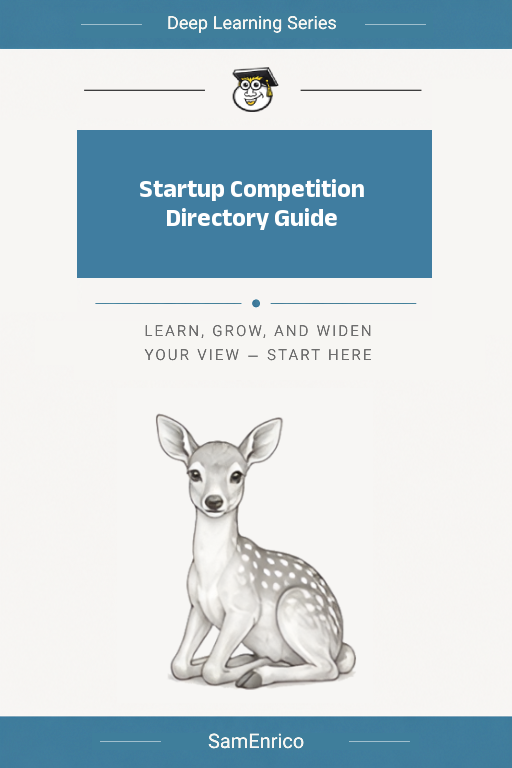
Non-FictionStartup GuideNon-Dilutive Grants
Startup Competition Directory Guide eBook
Find startup competitions and prizes worldwide. No
by Goebel Ona
Find startup competitions and prizes worldwide. Non-dilutive funding opportunities for early-stage founders.
Formats
Free sample
Chapter 1: The Fifty Billion Dollar Blindspot--Most founders are playing the wrong game. They spend their first twelve months obsessing over pitch decks, cap tables, and coffee meetings with venture capitalists who have a 98 percent probability of saying no. Meanwhile, fifty billion dollars sits in plain sight, ignored, dismissed, or simply unknown. That is not a typo. Fifty billion dollars.
Every single year. This money does not ask for equity. It does not demand a board seat. It does not require you to grow at 40 percent month over month or die trying. It asks one question only: did you build something that solves a real problem?The answer for most early-stage founders is yes.
But they never claim the money because they never knew it existed. Or they assumed it was only for elite university spinouts, or for nonprofits, or for founders with Ph Ds and patent lawyers on retainer. Those assumptions are wrong. This chapter exists to prove that the single biggest mistake in early-stage fundraising is not a bad pitch or a weak network. It is ignoring the fifty billion dollar blindspot.Let us start with a story.
A biotech founder we will call Maya had six months of runway. She had a working prototype, three informal advisors, and a growing sense of dread. She had applied to forty venture capital firms. Thirty-eight ignored her. Two scheduled calls and then ghosted.
A mentor told her about a competition she had never heard of: a government grant program for deep tech startups with a thirty percent win rate. Maya did not believe it. Thirty percent sounded like a fantasy. She applied anyway. Three months later, she had two hundred fifty thousand dollars in non-dilutive funding.
She did not surrender a single share. Eighteen months after that, having won four more prizes totaling just under seven hundred thousand dollars, she raised a seed round at a valuation three times higher than comparable startups. The lead investor told her, "You de-risked your science better than any pre-revenue company I have ever seen. We are not betting on a prototype. We are betting on a team that has already been validated by five independent judging panels."That is the power of the blindspot.
And it is available to almost every founder who learns to see it.The Myth of "Real" Fundraising The startup world has a creation myth. It goes like this: a brilliant founder has an idea, builds a minimum viable product, and then pitches a venture capitalist who writes a check. The founder hires a team, grows fast, and eventually exits. The myth is seductive because it is simple. It is also catastrophically incomplete.The reality is that venture capital is a niche product for a tiny fraction of startups.
According to data from Pitch Book and the National Venture Capital Association, fewer than one tenth of one percent of startups that apply to top-tier VC firms receive funding. Even among startups that have revenue, traction, and a complete team, the acceptance rate hovers around one to two percent. The math is not personal. It is structural. Venture capital firms have a business model that requires them to invest only in companies that can plausibly return ten times their money within ten years.
That eliminates most startups immediately. If you are building a solution for a niche market, or if your growth trajectory is steady rather than explosive, or if you simply do not want to spend a decade in a pressure cooker, you are not a venture-scale business. That does not mean you are a bad business. It means you are playing the wrong game with the wrong scorecard.Competitions invert the scorecard. A venture capitalist asks: how big can this get?
A competition judge asks: how well does this work? The difference is everything. A venture capitalist needs to see a billion-dollar market. A competition judge needs to see a problem solved. A venture capitalist needs to see hockey-stick growth.
A competition judge needs to see evidence that your solution actually works. A venture capitalist is betting on a lottery ticket with a massive upside. A competition judge is awarding a prize for demonstrated progress.Here is the counterintuitive truth: for most early-stage founders, the competition judge is a better partner than the venture capitalist. Not because judges are nicer or easier to impress, but because their incentives align with yours. You want to build a working solution.
They want to fund working solutions. You want to prove that your idea has merit. They want to reward proven merit. You want to avoid dilution. They offer cash without equity.
The alignment is almost perfect, yet most founders never think to exploit it.The Fifty Billion Dollar Map Let us break down where this money actually lives. The fifty billion dollar figure is not a round number pulled from thin air. It is a conservative estimate compiled from public data on government grant programs, corporate innovation challenges, philanthropic prizes, and accelerator pitch competitions.The largest single source is government grants. In the United States alone, the Small Business Innovation Research program and the Small Business Technology Transfer program distribute approximately four billion dollars annually. The European Innovation Council Accelerator adds another two billion euros.
National programs in Canada, the United Kingdom, Germany, France, Japan, Singapore, and Israel add billions more. Government grants typically have the highest win rates, often between fifteen and thirty percent for early-stage applicants, but they also require the most paperwork and the longest timelines. They are not glamorous. They are reliable.The second largest source is corporate innovation challenges. Companies like Unilever, Toyota, Merck, Visa, and Google run hundreds of competitions every year.
The prizes range from fifty thousand to five hundred thousand dollars. The win rates are lower than government grants, typically five to fifteen percent, but the non-cash benefits can be extraordinary. Corporate challenges often come with mentorship, pilot opportunities, and direct access to decision makers who might become customers. A startup that wins a corporate challenge is not just richer. It is certified.The third source is accelerator pitch-offs.
Tech Crunch Disrupt, Startup World Cup, Slush 100, and dozens of other events award millions of dollars annually. Win rates are low, often one to five percent, but the publicity and networking value can exceed the prize money. A single win at a high-profile event has been known to trigger inbound investor interest that leads to a full funding round.The fourth source is what this book calls mega-prizes. XPRIZE, Hult Prize, and similar competitions offer seven-figure payouts for solving massive global problems. Win rates are below one tenth of one percent.
For most founders, mega-prizes are a distraction. But for a small minority with existing traction, institutional backing, or unique access to non-cash benefits like lab space or regulatory fast-tracking, they can be transformational. The key is knowing whether you are in that minority.The remaining billions come from philanthropic foundations, regional economic development funds, university competitions, and industry-specific prizes that are too numerous to count. The money is fragmented, which is precisely why it goes unclaimed. No single database tracks it all.
No single gatekeeper controls access. The founders who win are not the smartest or the most connected. They are the…
This is the end of the free sample. Get the eBook to keep going. Buy now
About this book
Details
- Author
- Goebel Ona
- Publisher
- SamEnrico
- Language
- English
- Genre
- Non-Fiction, Startup Guide, Non-Dilutive Grants
- Released
- 2026-05-30
- Pages (approx.)
- 122
- Available as
- eBook, Audiobook

Read better in the ZLOADR app
Your eBooks on your phone or tablet. Sign in with your SamEnrico account and start reading.
More by Goebel Ona
 The Anti Inflammatory Brain DietGoebel Ona$11.99
 Sleep Meditation for ToddlersGoebel Ona$11.99
 Assertiveness for College StudentsGoebel Ona$11.99
 The Deep Work Single Task GuideGoebel Ona$11.99
 Racial Isolation Connection GuideGoebel Ona$11.99
 The Raven Mockers: Navajo Spirits of the Dying WindGoebel Ona$11.99
 How to Start a Carbon Dioxide Business (Beginners Guide)Goebel Ona$11.99
 Learn to Play the BeatboxingGoebel Ona$11.99
 AuctioneerGoebel Ona$11.99
 Sibling in Canada CRS BonusGoebel Ona$12.99
You may also like
 Hong Kong Handover 1997Dunn Johnnie$11.99
 Zumba For Postnatal Recovery CourseNeal Christian$11.99
 Zumba for BeginnersLadner Nikia$11.99
 YouTube Comment Mining GuideHumes Pandora$12.99
 Worry Box MeditationCarlin Rudy$11.99
 Workplace Stress MeditationNguyen Lynn$11.99
 Workplace Stress and Sleep RepairHawley Ivory$11.99
 Workplace Perfectionism CureDelaney Jeffry$11.99
 Workplace Injustice Anger GuideWallen Isabelle$11.99
 Work Addiction and Burnout LinkGreenwood Ester$11.99
 Women in Yoga and WellnessBeattie Galina$11.99
 Women in Stand Up ComedyChun Evangeline$11.99