
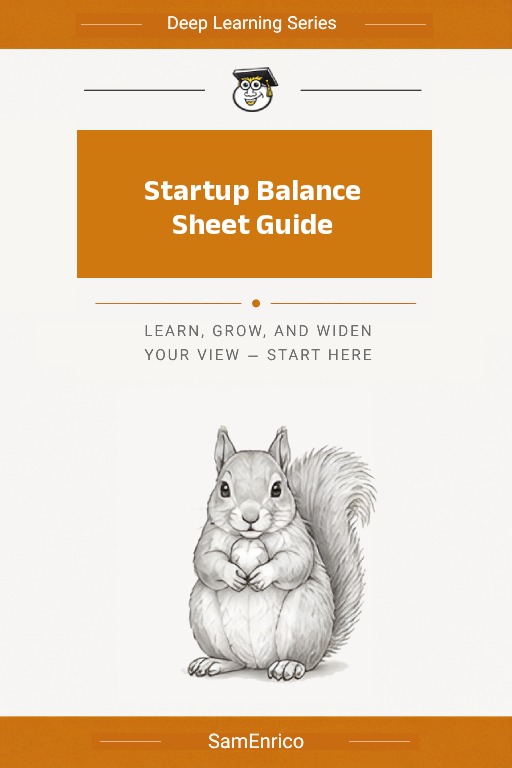
Non-FictionStartup GuideFinance Basics
Startup Balance Sheet Guide eBook
Understand your startup's balance sheet. Assets, l
Understand your startup's balance sheet. Assets, liabilities, and shareholder equity explained.
Formats
Free sample
Chapter 1: The Kingdom Under Siege...--–- It was a Tuesday morning when Sarah’s phone started buzzing. Not the usual Slack notifications or email pings, but a frantic call from her head of finance. “We have a problem,” he said. “The bank account is fine. The income statement shows a profit.
But something is wrong with the balance sheet.” Sarah, the founder of a promising Saa S startup that had just closed a $4 million Series A, didn’t understand. How could the bank account be fine, the company be profitable, and yet something be “wrong”? Three weeks later, she laid off 40 percent of her staff. The bank account was still fine. The profit was real.
But the balance sheet had been quietly screaming for months—and she hadn’t learned to listen.This is a book about learning to listen.The Founder’s Blind Spot Every week, I meet founders who can recite their revenue growth rate, their customer acquisition cost, and their lifetime value from memory. They can tell you their month-over-month conversion improvements and their churn rate to three decimal places. But when I ask them about their current ratio, their deferred revenue balance, or their accrued expenses, they freeze. Their eyes glaze over. Some laugh nervously.
Others admit, “That’s what I pay my accountant for.”That reaction is the single most expensive mistake a founder can make.The income statement tells you how fast you are running. The balance sheet tells you whether you will trip. And in the startup world—where cash is oxygen, where investors demand transparency, and where the difference between a successful exit and a fire sale often comes down to a single accounting line—ignoring your balance sheet is not a sign of focus. It is a death wish.Why This Book Exists There are already dozens of books about startup finance. Some are excellent textbooks.
Others are practical guides for accountants. But almost none of them speak the language of founders—the people who built the product, hired the team, and convinced investors to believe in a dream. Founders don’t need to pass the CPA exam. They need to understand, intuitively and immediately, what their balance sheet is telling them about their survival, their negotiating power, and their future.This book is that translation.Over the next twelve chapters, you will learn not just what a balance sheet is, but how to wield it like a weapon. You will learn why a profitable startup can go bankrupt (and how to make sure yours doesn’t).
You will learn which liabilities are dangerous and which are strategic. You will learn how to read your equity section like a map of who truly owns your company and what they will demand when you sell. And by the final chapter, you will be able to build a pro-forma balance sheet for your next fundraising round—and use it to negotiate a better valuation.But first, we have to start with a fundamental truth that most founders resist.The Two Reports You Cannot Ignore Every growing company produces three primary financial statements. You have probably heard of all of them. But you have almost certainly been taught to prioritize the wrong one.The Income Statement (Profit & Loss)The income statement measures performance over a period of time—a month, a quarter, or a year.
It shows your revenue, your expenses, and the difference between them: your profit or loss. This is the report that founders love because it tells a story of progress. Revenue went up. Expenses stayed controlled. Profit improved.
Everything looks good.But the income statement has a dangerous secret.It operates on an accounting concept called “accrual accounting.” This means revenue is recorded when you earn it (not when you receive cash), and expenses are recorded when you incur them (not when you pay cash). For example, if you sign a 120,000annualcontractin January,yourincomestatementfor Januarywillshow120,000 annual contract in January, your income statement for January will show 120,000annualcontractin January,yourincomestatementfor Januarywillshow10,000 of revenue (one month’s worth), even if the customer paid the full 120,000upfront.Andifyoureceiveaninvoicefromavendorin Januaryfor120,000 upfront. And if you receive an invoice from a vendor in January for 120,000upfront.Andifyoureceiveaninvoicefromavendorin Januaryfor30,000 of software licenses that you don’t have to pay until March, your income statement for January will show the $30,000 expense immediately.This means your income statement can say you are profitable while your bank account is empty.The Balance Sheet (Statement of Financial Position)The balance sheet measures health at a single moment in time. It is a photograph, not a movie. It shows three things: what you own (Assets), what you owe (Liabilities), and what is left over for the owners (Shareholder Equity).Unlike the income statement, the balance sheet does not guess or accrue.
It reports actual, verifiable positions. The cash balance is the cash balance. The debt balance is the debt balance. And—crucially—the balance sheet forces you to account for timing differences that the income statement glosses over. That 120,000prepaidcontractwejustdiscussed?Ontheincomestatement,itshowedupas120,000 prepaid contract we just discussed?
On the income statement, it showed up as 120,000prepaidcontractwejustdiscussed?Ontheincomestatement,itshowedupas10,000 of revenue. On the balance sheet, it shows up as 120,000ofcashin Assetsand120,000 of cash in Assets and 120,000ofcashin Assetsand110,000 of Deferred Revenue in Liabilities (the portion of the prepayment you have not yet earned). The balance sheet never forgets what you owe the future.This is why the balance sheet is the real picture of your company’s survival odds.The Runaway Train: A Case Study Let me tell you about a company I will call Swift Logic. Swift Logic was a Saa S startup that built project management software for construction firms. They had a good product, a passionate team, and a growing list of enterprise customers.
By their second year, they were generating $2 million in annual recurring revenue. Their income statement showed a consistent 15 percent net profit margin. They were, by every conventional measure, a success.Then they missed payroll.How does a profitable company miss payroll? The answer lies not in the income statement but in the balance sheet—specifically, in the relationship between two line items: Cash and Deferred Revenue.Swift Logic had a sales model that required customers to pay annually upfront. This was great for cash flow in the short term.
In January, they would sign a new enterprise customer for 120,000,receivethefullpaymentimmediately,anddeposititintotheirbankaccount.Theircashbalancewouldjump.Theirincomestatementwouldshow120,000, receive the full payment immediately, and deposit it into their bank account. Their cash balance would jump. Their income statement would show 120,000,receivethefullpaymentimmediately,anddeposititintotheirbankaccount.Theircashbalancewouldjump.Theirincomestatementwouldshow10,000 of revenue for January. Everyone celebrated.But here is what the balance sheet showed: 120,000ofnew Cash(an Asset)and120,000 of new Cash (an Asset) and 120,000ofnew Cash(an Asset)and110,000 of new Deferred Revenue (a Liability). That $110,000 was not free money.
It was an obligation to deliver eleven months of software, support, and updates. If Swift Logic spent that cash on new hires, marketing campaigns, or office furniture—as they did—they were spending money they had not yet earned.For two years, this worked because new customer prepayments kept arriving faster than the old obligations came due. It is the classic Ponzi-like structure of many growing Saa S…
This is the end of the free sample. Get the eBook to keep going. Buy now
About this book
Details
- Author
- Christenson Garland
- Publisher
- SamEnrico
- Language
- English
- Genre
- Non-Fiction, Startup Guide, Finance Basics
- Released
- 2026-06-01
- Pages (approx.)
- 143
- Available as
- eBook, Audiobook

Read better in the ZLOADR app
Your eBooks on your phone or tablet. Sign in with your SamEnrico account and start reading.
More by Christenson Garland
 I Told You I Was SickChristenson Garland$11.99
 MDD Diagnosis JourneyChristenson Garland$11.99
 Teen Nature Connection GuideChristenson Garland$11.99
 The Foster Care BirthdayChristenson Garland$11.99
 The Sugar and Aging GuideChristenson Garland$11.99
 The Ruby Throne: Letters from the Siege of GolcondaChristenson Garland$11.99
 Minority Firm Service ContractsChristenson Garland$12.99
 The Breeder's Guide to Sussex ChickensChristenson Garland$11.99
 Radiology TechnicianChristenson Garland$11.99
 10 Ways to Use Fructose (Recipe Book)Christenson Garland$11.99
You may also like
 Hong Kong Handover 1997Dunn Johnnie$11.99
 Zumba For Postnatal Recovery CourseNeal Christian$11.99
 Zumba for BeginnersLadner Nikia$11.99
 YouTube Comment Mining GuideHumes Pandora$12.99
 Worry Box MeditationCarlin Rudy$11.99
 Workplace Stress MeditationNguyen Lynn$11.99
 Workplace Stress and Sleep RepairHawley Ivory$11.99
 Workplace Perfectionism CureDelaney Jeffry$11.99
 Workplace Injustice Anger GuideWallen Isabelle$11.99
 Work Addiction and Burnout LinkGreenwood Ester$11.99
 Women in Yoga and WellnessBeattie Galina$11.99
 Women in Stand Up ComedyChun Evangeline$11.99