
Non-FictionMental WealthEnvironmental
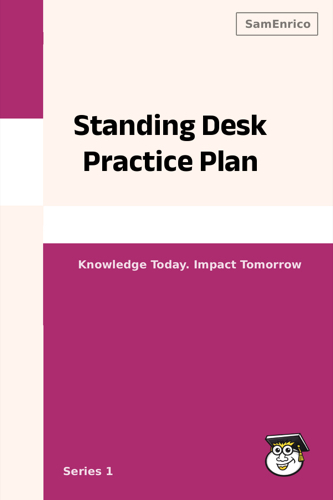
Standing Desk Practice Plan eBook
Rehearse standing exactly as you will perform to s
Rehearse standing exactly as you will perform to simulate real conditions.
Formats
Free sample
Chapter 1: The Memory Trap--–- You have experienced this before, even if you do not remember it. Standing in front of a conference room, fifteen pairs of eyes waiting, your mouth opening to deliver a presentation you have rehearsed for three days. And then – nothing. The words are gone. Not forgotten exactly, but disconnected, as if they belong to someone else who prepared them while sitting down.
You fumble. You recover. But the damage is done. You look less competent than you are, and you cannot explain why.This is not a failure of preparation. It is a failure of postural encoding – and it is the single most overlooked reason that standing desk users underperform.Before we build your Standing Practice Plan, we must first understand why simply "practicing" while seated destroys your ability to perform while standing.
This chapter establishes the scientific foundation for everything that follows: the neuroscience of state-dependent memory, the concept of the Performance Zone, and the critical distinction between rehearsing for endurance versus rehearsing for excellence. By the end of this chapter, you will have completed a weekly audit that identifies exactly which tasks require standing rehearsal – and you will understand why most ergonomic advice has failed you.The Neuroscience You Were Never Told In 1975, psychologists Duncan Godden and Alan Baddeley conducted a now-famous experiment with deep-sea divers. One group learned a list of words while underwater. Another group learned the same list while on dry land. When tested later, the divers who learned underwater recalled the words significantly better when tested underwater.
Those who learned on land recalled better on land. The environment itself had become part of their memory.This phenomenon is called state-dependent memory – the principle that information learned in one physical or emotional state is best recalled when that state is recreated. For decades, this research has been applied to drug studies, mood disorders, and eyewitness testimony. Almost no one has applied it to the standing desk.But the implications are undeniable. When you draft a report seated, your brain encodes that content alongside sensory information: the pressure of the chair against your hamstrings, the angle of your spine, the position of your arms relative to your torso, even the subtle hum of your desk at sitting height.
These cues become part of the memory trace. When you stand to deliver that same report, the cues vanish. Your brain must work harder to retrieve the information – not because you have forgotten it, but because you have lost the neural scaffolding that supported it.The result is measurable. Research on context-dependent memory shows a performance degradation of 15–30% when the learning and recall environments differ significantly. For complex cognitive tasks – writing, coding, strategic analysis – the degradation can exceed 40%.
This is not a trivial inconvenience. It is the difference between sounding like an expert and sounding like you are reading from a script you have never seen.Posture Is Not Separate From Performance Here is a statement that will reshape how you think about your workday: Posture is performance.Not posture affects performance. Not posture influences performance. Posture is performance. The distinction is critical because it moves posture from the category of "ergonomic hygiene" (nice to have, like a good chair) into the category of "cognitive infrastructure" (essential, like a working processor).Think of your body as an instrument.
A violinist does not practice in a slouched position and then perform upright, expecting the same sound. A singer does not warm up lying down and then step onto a stage standing, expecting their diaphragm to respond identically. These would be absurdities. Yet knowledge workers routinely draft emails seated and send them standing, write code in a recliner and debug it at a height-adjustable desk, prepare presentations in a cozy chair and deliver them on camera with no rehearsal of the physical conditions.The body is not a neutral vessel for the brain. The body is part of the brain's operating system.
Proprioception – your sense of where your body is in space – consumes neural resources that could otherwise be used for executive function. When you change posture, you reallocate those resources. This is not a metaphor. It is measurable brain activity.Functional MRI studies have shown that even simple postural changes activate different neural networks. Standing increases activation in the cerebellum and vestibular system – regions responsible for balance and spatial orientation.
This activation comes at a cost: reduced blood flow and glucose availability to the prefrontal cortex, which handles complex reasoning, impulse control, and working memory. The brain does not have unlimited resources. Every calorie spent maintaining balance is a calorie not spent on your spreadsheet, your code, or your client pitch.The Performance Zone: Identifying What Matters If posture is performance, and if state-dependent memory means your body position encodes your learning, then the logical conclusion is uncomfortable: you must rehearse the exact posture you will use during your most important work.But here is the nuance that most standing desk guides miss. You do not need to stand all day. You do not need to rehearse every task standing.
You only need to rehearse the tasks that matter most – what this book calls the Performance Zone.The Performance Zone is the 10–20% of your workday that requires peak cognitive or physical output. These are the tasks where your performance has consequences: client presentations, code deployments, design critiques, strategic planning, difficult negotiations, creative breakthroughs. These are the tasks that determine your reputation, your compensation, and your professional trajectory. Everything else is maintenance.Yet when most people acquire a standing desk, they do the opposite of what this book recommends. They stand during low-stakes tasks – checking email, sorting files, attending low-engagement meetings – and then sit down for their hardest work.
This is precisely backward. It trains the body to associate standing with boredom and sitting with focus. It reinforces the Postural Gap rather than closing it.The Performance Zone approach flips this script. You will identify your highest-stakes tasks. You will rehearse them standing, in the exact setup you will use during the actual event.
And you will treat everything else as optional standing practice – nice to have, but not essential.The Weekly Audit: Finding Your Performance Zone Before you can rehearse standing, you must know what to rehearse. This chapter includes a practical tool: the Weekly Performance Audit. Take fifteen minutes at the start of your week to complete it. You will need a calendar, a notebook, and brutal honesty about which tasks actually matter versus which tasks merely feel urgent.Step One: List Every Task You Will Perform This Week Write down every work task, meeting, and obligation. Do not filter yet.
Include everything from "respond to five low-priority emails" to "present quarterly results to executive team."Step Two: Rate Each Task on Two Scales Cognitive Load (1–5) : 1 = automatic, requires almost no thinking (filing, sorting, routine data entry). 5 = intense concentration, creative or analytical demand (writing from scratch, debugging complex code, strategic planning).Performance Consequence (1–5) : 1 = no one will notice if you do this poorly (internal busywork). 5 = your reputation, compensation, or project success depends on this (client presentation, performance review, launch decision).Step Three: Calculate Your Performance Score…
This is the end of the free sample. Get the eBook to keep going. Buy now
About this book
Details
- Author
- Mclean Mirtha
- Publisher
- SamEnrico
- Language
- English
- Genre
- Non-Fiction, Mental Wealth, Environmental
- Released
- 2026-06-10
- Pages (approx.)
- 154
- Available as
- eBook, Audiobook

Read better in the ZLOADR app
Your eBooks on your phone or tablet. Sign in with your SamEnrico account and start reading.
More by Mclean Mirtha
 Job Interview ConfidenceMclean Mirtha$11.99
 Swimming Interval GuideMclean Mirtha$11.99
 Warrant Valuation 409AMclean Mirtha$11.99
 Crowns & Conspiracies: The Secret Betrothal of Cleopatra and AntonyMclean Mirtha$11.99
 How to Start a Lock Business (Beginners Guide)Mclean Mirtha$11.99
 Factoring in Vietnam GuideMclean Mirtha$12.99
 How to Produce Cereal and GranolaMclean Mirtha$11.99
 Pet & Reptile Operations ManagerMclean Mirtha$11.99
You may also like
 Hong Kong Handover 1997Dunn Johnnie$11.99
 Zumba For Postnatal Recovery CourseNeal Christian$11.99
 Zumba for BeginnersLadner Nikia$11.99
 YouTube Comment Mining GuideHumes Pandora$12.99
 Worry Box MeditationCarlin Rudy$11.99
 Workplace Stress MeditationNguyen Lynn$11.99
 Workplace Stress and Sleep RepairHawley Ivory$11.99
 Workplace Perfectionism CureDelaney Jeffry$11.99
 Workplace Injustice Anger GuideWallen Isabelle$11.99
 Work Addiction and Burnout LinkGreenwood Ester$11.99
 Women in Yoga and WellnessBeattie Galina$11.99
 Women in Stand Up ComedyChun Evangeline$11.99