
Non-FictionInformativeEducational
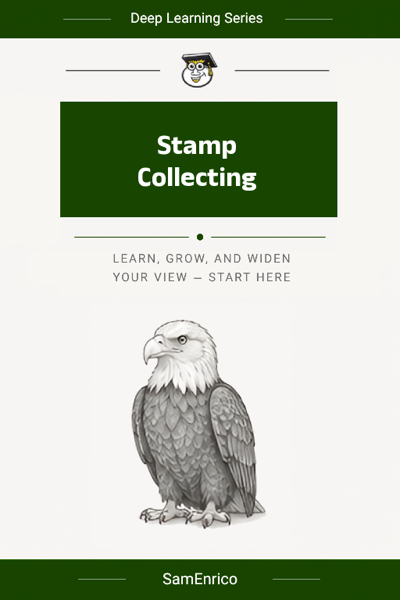
Stamp Collecting eBook
A Coursebook on Stamp Collecting
A Coursebook on Stamp Collecting
Formats
Free sample
Chapter 1: The Quiet Rebellion--–- The first time you hold a stamp that has traveled across an ocean, been licked by a stranger, canceled by a machine that no longer exists, and then forgotten in an attic for sixty years, you are not holding paper. You are holding a time machine the size of your thumbnail. And something strange happens when you hold it: the world slows down. The ping of your phone becomes distant. The endless scroll loses its pull.
For a moment, you are not consuming. You are discovering.This is the secret that stamp collectors have kept for 175 years, and it is the secret that is about to make philately one of the most unexpected cultural rebellions of the 2020s.If you picked up this book expecting a dry, grey manual about album pages and perforation gauges, close it for a moment and take a breath. That book exists elsewhere, and it has its place. But this is not that book. This is the book that begins with a provocation: stamp collecting is not a retirement hobby for the terminally boring.
It is a quiet act of defiance against a world that has decided your attention is a product to be harvested, your time is a resource to be monetized, and your hands should never touch anything that isn't a glowing rectangle.In the chapters that follow, you will learn everything the top ten stamp collecting books teach. You will master perforations and watermarks, printing methods and grading scales, the mysteries of the Scott Catalogue and the dark arts of spotting a regummed forgery. You will learn where to buy stamps, how to preserve them for your grandchildren, and—if you must—how to sell them without being swindled. But this first chapter has a different job. This first chapter exists to answer one question before you invest another minute: why?Why stamps?
Why now? And why you?The Unlikely Comeback of an Analog Hobby In 2024, the United States Postal Service issued a stamp featuring the cartoon character Mister Rogers. It sold out in hours. In the same year, a unique example of the British Guiana 1c Magenta—a stamp the size of a fingernail, printed in 1856 on cheap paper because the colony had run out of proper supplies—was valued at over eight million dollars. Between these two extremes lies an entire universe of collecting, and that universe is growing.For decades, experts have declared stamp collecting dead.
The obituaries began in the 1990s, when email started replacing letters. They continued through the 2000s, as social media consumed the attention of younger generations. By 2015, major stamp auction houses were quietly diversifying into wine and watches. The narrative was simple: no letters meant no stamps, and no stamps meant no collectors.That narrative was wrong.What the obituaries missed was a fundamental truth about human nature. People do not collect stamps because they need to mail letters.
They collect stamps because the act of collecting—sorting, organizing, classifying, hunting, and discovering—triggers something deep in the brain. Neuroscientists have identified that activities involving categorization and fine motor skills activate the brain's reward system in ways similar to meditation. The term "flow state," coined by psychologist Mihaly Csikszentmihalyi, describes moments of total absorption where self-consciousness disappears and time seems to stop. Sorting stamps on a quiet evening, with nothing but a magnifier and a pair of tongs, is a near-perfect recipe for flow.A 2023 study from the Journal of Occupational Science followed two groups of adults over six months. One group engaged in digital hobbies (gaming, social media scrolling, streaming).
The other engaged in analog collecting hobbies (stamps, coins, model-building). The analog group reported significantly lower levels of anxiety, higher levels of life satisfaction, and a greater sense of accomplished time—the feeling that they had done something meaningful with their hours. The digital group, by contrast, reported higher levels of fatigue and a persistent sense of "time vertigo": the unsettling feeling of losing hours to a screen without any memory of what they had seen.Stamp collecting, it turns out, is not a hobby of the past. It is a remedy for the present.The Great Digital Backlash We are living through a peculiar moment in history. For the first time since the smartphone was introduced in 2007, a measurable percentage of young adults are deliberately choosing analog alternatives to digital experiences.
Vinyl records have outsold CDs for three consecutive years. Film photography is experiencing a renaissance among photographers under thirty. Handwritten letters—actual, physical letters, posted with stamps—are being celebrated on social media platforms ironically enough, as a form of "slow communication."This is not nostalgia. Most of these young adults grew up with streaming services, cloud storage, and social media. They are not longing for a past they never experienced.
They are rejecting a present that has exhausted them. The endless scroll, the algorithmic recommendation, the notification badge that never quite empties—these are not features. They are friction points. And an increasing number of people are discovering that the antidote to digital overwhelm is not more technology, but less of it.Stamp collecting fits perfectly into this cultural shift. It requires no electricity, no Wi-Fi, and no account creation.
It cannot track you, advertise to you, or harvest your data. It does not demand your attention in five-minute bursts throughout the day. Instead, it asks for your focused, uninterrupted presence for an hour or two, and then it gives you something in return: a collection that grows with you, a physical object you can hold and show to another person, and a sense of accomplishment that no "achievement unlocked" notification can match.One collector interviewed for this book, a twenty-four-year-old graphic designer in Chicago, put it this way: "I spend all day staring at a screen, making things that disappear into the cloud. At night, I sort stamps. I can touch them.
I can put them in an album. When I fill a page, I can close the book and see it on my shelf. That feeling doesn't have a dopamine crash."She is not alone. Online stamp communities have seen a surge of younger members since 2020. The subreddit r/philately grew from 15,000 to over 45,000 members in four years.
Stamp shows that once worried about aging out of existence report a noticeable increase in attendees under thirty-five. And while the total number of collectors is still far below its mid-twentieth-century peak—when an estimated twenty million Americans collected stamps—the demographic is shifting. The hobby is not dying. It is changing.The Two Markets: A Crucial Distinction Before we go any further, we must address a point that will save you confusion, disappointment, and potentially a great deal of money. The previous section mentioned an eight-million-dollar stamp.
This section will explain why the stamps in your grandmother's shoebox are almost certainly worth very little, and why that is perfectly fine.There are two entirely separate stamp markets, and understanding the difference is the single most important financial lesson in this entire book.The first market is the rare stamp market. This market includes stamps that are genuinely scarce—often because very few were printed, because most were…
This is the end of the free sample. Get the eBook to keep going. Buy now
About this book
Details
- Author
- Tackett Henry
- Publisher
- SamEnrico
- Language
- English
- Genre
- Non-Fiction, Informative, Educational
- Released
- 2026-05-11
- Pages (approx.)
- 135
- Available as
- eBook, Audiobook

Read better in the ZLOADR app
Your eBooks on your phone or tablet. Sign in with your SamEnrico account and start reading.
More by Tackett Henry
 Alcoholism Recovery for Introverts WorkbookTackett Henry$11.99
 Working Parent Boundary SettingTackett Henry$11.99
 Work Addiction for PsychologistsTackett Henry$11.99
 Incurrence Covenant GuideTackett Henry$11.99
 The Great Shanghai Fake: The Million-Dollar Insurance Scam That Fooled a NationTackett Henry$11.99
 Cross Border Payment Automation RoadmapTackett Henry$12.99
 How to Produce AlcoholsTackett Henry$11.99
 How to Become a Maintenance SupervisorTackett Henry$11.99
You may also like
 Hong Kong Handover 1997Dunn Johnnie$11.99
 Zumba For Postnatal Recovery CourseNeal Christian$11.99
 Zumba for BeginnersLadner Nikia$11.99
 YouTube Comment Mining GuideHumes Pandora$12.99
 Worry Box MeditationCarlin Rudy$11.99
 Workplace Stress MeditationNguyen Lynn$11.99
 Workplace Stress and Sleep RepairHawley Ivory$11.99
 Workplace Perfectionism CureDelaney Jeffry$11.99
 Workplace Injustice Anger GuideWallen Isabelle$11.99
 Work Addiction and Burnout LinkGreenwood Ester$11.99
 Women in Yoga and WellnessBeattie Galina$11.99
 Women in Stand Up ComedyChun Evangeline$11.99