
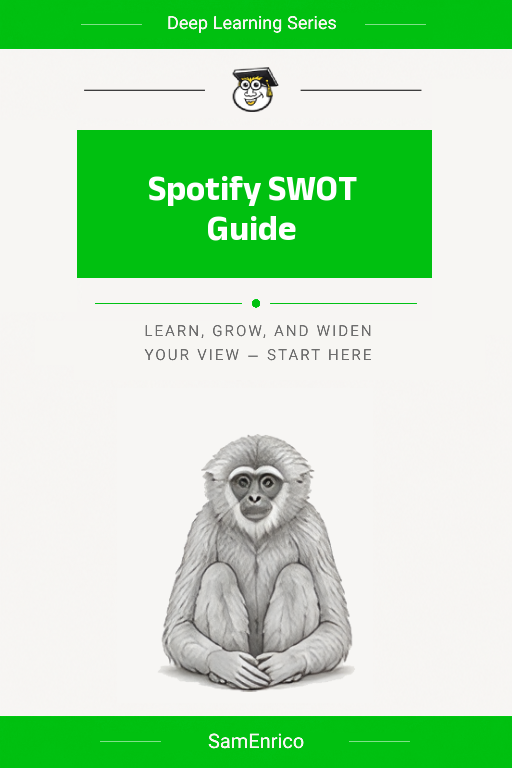
Non-FictionStrategic AtlasAudio Streaming
Spotify SWOT Guide eBook
Evaluate music streaming leadership, podcast inves
Evaluate music streaming leadership, podcast investment, competition from Apple Music and Amazon, and margin pressure.
Formats
Free sample
Chapter 1: The Algorithm's Embrace--–- The first time I realized Spotify was not a neutral tool but an active architect of my taste, I was driving through Pennsylvania on a gray November afternoon. My Discover Weekly playlist had just served me a song by an artist I had never heard of—a slow-building, melancholic folk track with lyrics about leaving a small town. It was perfect. It felt personal. It felt like the algorithm had been listening to conversations I had never spoken aloud.
I pulled over to check the artist's page: 4,000 monthly listeners, no Wikipedia entry, no major label affiliation. Spotify had reached into the long tail of recorded music, pulled out a song recorded probably in someone's bedroom, and decided—correctly—that I needed to hear it.That moment of algorithmic intimacy is Spotify's greatest strength. Not the licensing deals, not the 678 million users, not the $10 billion in annual revenue. The strength is this: Spotify knows you better than you know yourself, and it uses that knowledge to keep you close. This chapter dissects how Spotify built that machine, why it works, and the hidden price of convenience that both listeners and the company pay.The Convenience Revolution Before streaming, music ownership meant accumulation.
CDs filled binders. Vinyl demanded shelf space. MP3s required hard drives and meticulous folder structures. Even piracy had friction: you had to know what you wanted, find a reliable source, wait for downloads, and manage metadata. Spotify eliminated every barrier.
For zero dollars (with ads) or a monthly fee, the entire history of recorded music became available instantly. This is not hyperbole. Spotify's catalog exceeds 100 million tracks, including deep cuts, regional releases, and archival material that would require months of crate-digging to find physically.The convenience advantage seems simple, even obvious, but its psychological effect is profound. Behavioral economists call it the "default effect"—people rarely switch from a default option unless the alternative is dramatically better. Once Spotify became the default way to listen to music for hundreds of millions of people, the company achieved what tech strategists call "behavioral lock-in." You do not stay with Spotify because of a contract.
You stay because the path of least resistance leads directly to the green play button.Consider the switching costs. To leave Spotify for Apple Music or Amazon Music, you must: cancel your subscription, download a new app, learn a new interface, migrate your playlists (possible but annoying), and retrain a new algorithm that knows nothing about you. That last cost is the killer. Your Spotify algorithm has been learning your taste for years—every skip, repeat, late-night deep dive, and guilty pleasure. Abandoning that trained model feels like losing a friend who finally understands you.
That is the moat.The Algorithm That Knows Your Soul Spotify's recommendation engine is not a single algorithm but a suite of machine learning models working in concert. Three approaches dominate.First, collaborative filtering analyzes patterns across millions of users. If users who listen to Artist A also listen to Artist B, the algorithm assumes you will too. This is the "people who liked this also liked" method pioneered by Amazon in the 1990s, but Spotify applies it at unprecedented scale and speed. Collaborative filtering excels at popular music discovery—moving from Taylor Swift to Olivia Rodrigo to Gracie Abrams.
It fails, however, at surfacing genuinely obscure music, because it requires enough overlapping user behavior to establish a pattern.Second, natural language processing (NLP) scans the internet for mentions of songs and artists, analyzing blog posts, reviews, and social media to understand how music is described. If a new indie band is consistently described as "sounding like early Arcade Fire with more electronic elements," Spotify's NLP models can infer that fans of Arcade Fire's Funeral era might enjoy this new band—even before any user has listened to them. This allows Spotify to recommend music that has no listening history, solving the "cold start" problem that plagues collaborative filtering.Third, and most controversially, audio analysis examines the raw sound of tracks. Spotify's models analyze tempo, key, loudness, timbre, and more abstract features like "danceability" and "valence" (musical positivity). This allows the algorithm to recommend music based purely on how it sounds, independent of user behavior or textual description.
This is how Spotify serves you a lo-fi hip hop track when you are studying—not because other listeners studied to that track, but because the audio features match the "study music" profile.Together, these models create what Spotify calls "personalized listening." The phrase sounds innocuous, but it represents a fundamental shift in how music is discovered. Before algorithms, discovery was social (friends' recommendations), curatorial (radio DJs, music journalists), or active (digging through record stores). Now, discovery is computational. The algorithm decides what you hear next, and it makes that decision in milliseconds based on patterns you never consciously chose.The Freemium Funnel Spotify's business model rests on a simple observation: most people will not pay for music until they have experienced it for free. The Freemium model—unlimited ad-supported listening plus paid Premium tier—is not a generosity play.
It is a customer acquisition funnel designed with precision.Here is how it works. A user signs up for free. They encounter occasional audio and display ads. They build playlists, train the algorithm, and integrate Spotify into their daily routine. Over time, the friction of ads (or the desire for offline listening, higher audio quality, and no interruptions) prompts an upgrade.
The conversion rate from free to paid is approximately 40-50% in mature markets—remarkably high for any freemium business. Each converted user costs Spotify nothing in marketing spend. The free tier is the marketing.The numbers tell the story. Spotify's 678 million monthly active users include approximately 300 million Premium subscribers and 378 million ad-supported users. The ad-supported users generate revenue—about 2−3peruserperyear,farbelowthe2-3 per user per year, far below the 2−3peruserperyear,farbelowthe120+ per Premium user—but their primary value is as a pipeline.
Every free user is a potential premium user, and the algorithm's job is to make that potential irresistible.But the Freemium funnel has a hidden cost that most analyses overlook, and it is one of Spotify's structural weaknesses. Free users still generate royalty payments. Every stream by an ad-supported user triggers a payment to rights holders, albeit at a lower rate than premium streams. Those royalty payments come from advertising revenue, which is volatile and low-margin. In other words, Spotify pays real money to serve free users who may never convert.
During economic downturns, when advertising spending collapses, this model bleeds cash.A former Spotify financial analyst I interviewed described the tension bluntly: "The free tier is the best marketing we never paid for. It is also the largest drain on our margins that we cannot cut. Every free user is a bet—a bet that they will upgrade before the royalty costs outweigh the ad revenue. Most of them do, eventually. But the ones who don't?
They are a slow bleed."Behavioral Lock-In: The Real Moat When industry analysts discuss Spotify's competitive advantages, they often cite scale, licensing deals, and brand recognition. These matter, but they are not the moat. The moat is behavioral lock-in—the…
This is the end of the free sample. Get the eBook to keep going. Buy now
About this book
Details
- Author
- Ransom Tessie
- Publisher
- SamEnrico
- Language
- English
- Genre
- Non-Fiction, Strategic Atlas, Audio Streaming
- Released
- 2026-06-01
- Pages (approx.)
- 139
- Available as
- eBook, Audiobook

Read better in the ZLOADR app
Your eBooks on your phone or tablet. Sign in with your SamEnrico account and start reading.
More by Ransom Tessie
 Assertive Communication for DoctorsRansom Tessie$11.99
 Mental Health PovertyRansom Tessie$11.99
 Imposter Syndrome Perfectionism LinkRansom Tessie$11.99
 Dynamic Flexibility Warm Up PrimerRansom Tessie$11.99
 The Beginner Meditation Trauma GuideRansom Tessie$11.99
 Understanding Myopathy, Mcardle TypeRansom Tessie$17.99
 Cleaning StaffRansom Tessie$11.99
 How to Become a Documentation-billing ClerkRansom Tessie$11.99
 Citation Style Cheat SheetRansom Tessie$12.99
You may also like
 Hong Kong Handover 1997Dunn Johnnie$11.99
 Zumba For Postnatal Recovery CourseNeal Christian$11.99
 Zumba for BeginnersLadner Nikia$11.99
 YouTube Comment Mining GuideHumes Pandora$12.99
 Worry Box MeditationCarlin Rudy$11.99
 Workplace Stress MeditationNguyen Lynn$11.99
 Workplace Stress and Sleep RepairHawley Ivory$11.99
 Workplace Perfectionism CureDelaney Jeffry$11.99
 Workplace Injustice Anger GuideWallen Isabelle$11.99
 Work Addiction and Burnout LinkGreenwood Ester$11.99
 Women in Yoga and WellnessBeattie Galina$11.99
 Women in Stand Up ComedyChun Evangeline$11.99