
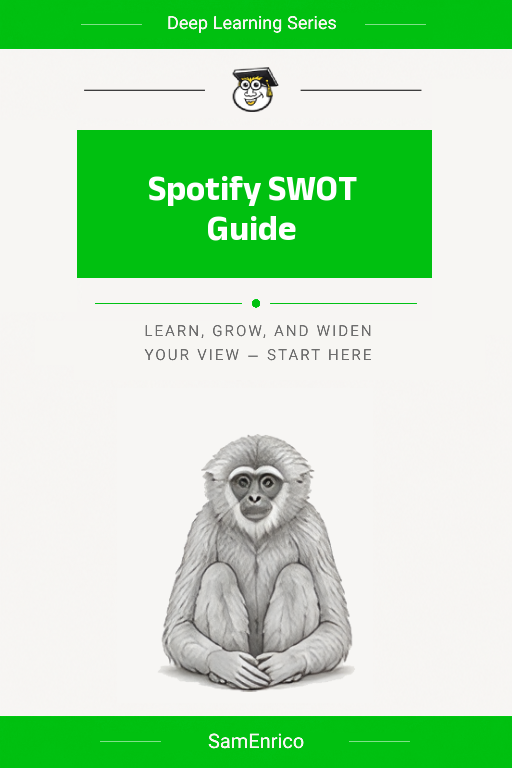
Non-FictionStrategic AtlasAudio Streaming
Spotify SWOT Guide Audiobook
Evaluate music streaming leadership, podcast inves
Evaluate music streaming leadership, podcast investment, competition from Apple Music and Amazon, and margin pressure.
Formats
Free sample
Chapter 1: The Algorithm's Embrace--–- The first time I realized Spotify was not a neutral tool but an active architect of my taste, I was driving through Pennsylvania on a gray November afternoon. My Discover Weekly playlist had just served me a song by an artist I had never heard of—a slow-building, melancholic folk track with lyrics about leaving a small town. It was perfect. It felt personal. It felt like the algorithm had been listening to conversations I had never spoken aloud.
I pulled over to check the artist's page: 4,000 monthly listeners, no Wikipedia entry, no major label affiliation. Spotify had reached into the long tail of recorded music, pulled out a song recorded probably in someone's bedroom, and decided—correctly—that I needed to hear it.That moment of algorithmic intimacy is Spotify's greatest strength. Not the licensing deals, not the 678 million users, not the $10 billion in annual revenue. The strength is this: Spotify knows you better than you know yourself, and it uses that knowledge to keep you close. This chapter dissects how Spotify built that machine, why it works, and the hidden price of convenience that both listeners and the company pay.The Convenience Revolution Before streaming, music ownership meant accumulation.
CDs filled binders. Vinyl demanded shelf space. MP3s required hard drives and meticulous folder structures. Even piracy had friction: you had to know what you wanted, find a reliable source, wait for downloads, and manage metadata. Spotify eliminated every barrier.
For zero dollars (with ads) or a monthly fee, the entire history of recorded music became available instantly. This is not hyperbole. Spotify's catalog exceeds 100 million tracks, including deep cuts, regional releases, and archival material that would require months of crate-digging to find physically.The convenience advantage seems simple, even obvious, but its psychological effect is profound. Behavioral economists call it the "default effect"—people rarely switch from a default option unless the alternative is dramatically better. Once Spotify became the default way to listen to music for hundreds of millions of people, the company achieved what tech strategists call "behavioral lock-in." You do not stay with Spotify because of a contract.
You stay because the path of least resistance leads directly to the green play button.Consider the switching costs. To leave Spotify for Apple Music or Amazon Music, you must: cancel your subscription, download a new app, learn a new interface, migrate…
This is the end of the free sample. Get the Audiobook to keep going. Buy now
About this book
Details
- Author
- Ransom Tessie
- Publisher
- SamEnrico
- Language
- English
- Genre
- Non-Fiction, Strategic Atlas, Audio Streaming
- Released
- 2026-06-01
- Pages (approx.)
- 139
- Available as
- eBook, Audiobook

Listen in the VoxFlicks app
Audiobooks and audio dramas wherever you go. Sign in with your SamEnrico account and press play.
More by Ransom Tessie
 Assertive Communication for DoctorsRansom Tessie$11.99
 Mental Health PovertyRansom Tessie$11.99
 Imposter Syndrome Perfectionism LinkRansom Tessie$11.99
 Dynamic Flexibility Warm Up PrimerRansom Tessie$11.99
 The Beginner Meditation Trauma GuideRansom Tessie$11.99
 Understanding Myopathy, Mcardle TypeRansom Tessie$17.99
 Cleaning StaffRansom Tessie$11.99
 How to Become a Documentation-billing ClerkRansom Tessie$11.99
 Citation Style Cheat SheetRansom Tessie$12.99
You may also like
 Hong Kong Handover 1997Dunn Johnnie$11.99
 Zumba For Postnatal Recovery CourseNeal Christian$11.99
 Zumba for BeginnersLadner Nikia$11.99
 YouTube Comment Mining GuideHumes Pandora$12.99
 Worry Box MeditationCarlin Rudy$11.99
 Workplace Stress MeditationNguyen Lynn$11.99
 Workplace Stress and Sleep RepairHawley Ivory$11.99
 Workplace Perfectionism CureDelaney Jeffry$11.99
 Workplace Injustice Anger GuideWallen Isabelle$11.99
 Work Addiction and Burnout LinkGreenwood Ester$11.99
 Women in Yoga and WellnessBeattie Galina$11.99
 Women in Stand Up ComedyChun Evangeline$11.99