
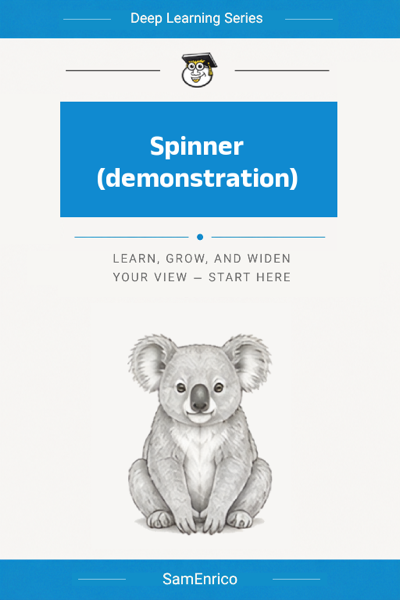
Non-FictionInformativeEducational
Spinner (demonstration) eBook
A Coursebook on Spinner (demonstration)
A Coursebook on Spinner (demonstration)
Formats
Free sample
Chapter 1: The Last Spin…--–- The first time I truly understood a spinner, I wasn’t holding one. I was watching a figure skater on a cracked television screen in a hospital waiting room. She pulled her arms tight against her chest, and suddenly she was a blur—a human gyroscope defying the slow gravity of my boredom. Beside me, a seven-year-old boy with a broken arm was hypnotized. His good hand twisted an imaginary wheel in the air.
“Why does she go faster?” he whispered. Not to anyone. Just to the spin itself.That question has followed me for fifteen years. Why does anything spin faster when it pulls its mass inward? Why does a spinning top refuse to fall?
Why does a fidget spinner—that strange, three-lobed plastic toy that appeared on every middle school desk in 2017—calm some minds and annoy others? And why, despite the toy’s brief, mocking cultural moment, has the act of spinning never lost its grip on us?This book began as a frustrated answer to that seven-year-old. But it became something else: a map of the hidden world of spin, from ancient prayer wheels to the gyroscopes guiding the James Webb Space Telescope, from a YA novel about a teenager who heals with a flick of his wrist to the silent, desperate need for repetitive motion that lives in all of us. This is not a book about fidget spinners. This is a book about why we spin, what spin teaches us, and how a simple rotating object can be a demonstration of physics, psychology, storytelling, and even hope.The Strange Universality of Spin Look around any room in any human dwelling from the last six thousand years, and you will find evidence of spin.
The potter’s wheel. The spindle for thread. The prayer wheel. The top. The yo-yo.
The dreidel. The roulette wheel. The gyroscope. The fidget spinner. Spin is not a trend.
It is a technology so ancient and so fundamental that we forget it is a technology at all.But why? Why did every human culture, independently, invent spinning objects? The answer is not merely practical—though spin is profoundly practical. The potter’s wheel allowed symmetrical vessels that could hold water without leaking. The spindle turned loose fibers into strong thread, enabling clothing, sails, and rope.
The flywheel stored energy so that machines could run smoothly between power pulses. These are engineering victories.Yet spin also appears where there is no practical need. Tibetan Buddhists have spun prayer wheels for over a thousand years, believing that each rotation releases a mantra into the universe. Sufi whirling dervishes spin as an act of worship, their white skirts flaring like opened books. Children spin until they fall down, giggling at the dizziness.
Adults spin wedding rings on tabletops, lost in thought. The spinner—in all its forms—satisfies something deeper than utility.That something is the subject of this chapter.The Potter’s Wheel and the Birth of Symmetry Let us begin in Mesopotamia, circa 4500 BCE. A potter sits at a slow wheel—a heavy disc of stone or wood that she turns by hand or foot. She places a lump of clay at the center and begins to rotate the wheel. As it turns, her hands guide the clay upward into a vessel.
Without the wheel, her pots are lumpy, asymmetrical, prone to cracking. With the wheel, they are round, even, beautiful. The wheel does not create the pot; the potter creates the pot. But the wheel’s spin makes creation possible.The potter’s wheel was the first machine to use rotational inertia intentionally. A heavy wheel, once spinning, wants to keep spinning (conservation of angular momentum, which we will explore in Chapter 2).
The potter only needs to add small pushes to overcome friction. The rest of the work is done by the stored energy in the spinning mass.This is not merely a technical achievement. It is a cognitive one. The potter’s wheel imposes order on chaos. Clay is messy, soft, unpredictable.
Spin makes it predictable. The wheel’s steady rotation creates a stable reference frame: every point on the vessel passes through the potter’s hands at the same speed. She can focus on shape, not on randomness.Emerging research in cognitive science (see recent work by Dr. Karin James at Indiana University) suggests that this experience of “ordering through rotation” may have shaped human visual perception. Repeated exposure to spinning symmetry trains the brain to expect balance, regularity, and predictability.
We find spinning objects satisfying because our brains evolved in a world where spinning usually meant controlled, intentional action—not chaos.That is the first clue. Spin is not about speed. It is about control.The Prayer Wheel: Spin as Meditation Now travel east to Tibet, circa 4th century CE. A monk walks along a mountain path, holding a cylindrical wheel on a handle. Inside the wheel is a scroll printed with mantras—sacred syllables.
With a small flick of his wrist, the wheel spins. Each rotation, he believes, releases those mantras into the world, spreading compassion and wisdom.The prayer wheel is not a labor-saving device. It is a meditation aid. The monk could recite the mantras aloud. But the spinning wheel externalizes the prayer, making it visible, tangible, rhythmic.
The wheel’s spin does not replace intention; it amplifies it.Modern psychology offers an unexpected parallel. Repetitive, rhythmic motion—of which spinning is a pure form—has been shown to reduce activity in the amygdala, the brain’s fear center. A 2022 study from the University of California, Los Angeles, measured cortisol levels in subjects who performed repetitive hand motions (including spinning a small wheel) for ten minutes. Cortisol dropped by an average of 18% compared to a control group that sat still.The prayer wheel, the fidget spinner, and the stress ball are not the same. But they share a mechanism: predictable, low-stakes, repetitive sensory input.
When the world is unpredictable, a spinning object offers a small, controllable universe. You flick. It spins. It slows. You flick again.
Cause and effect are clear. The loop is soothing.This is why, in 2017, the fidget spinner became a global phenomenon. But we are getting ahead of ourselves.The Top, the Yo-Yo, and the Science of Play Before the fidget spinner, there was the top. The oldest surviving top—made of clay, found in Iraq—dates to 3500 BCE. Tops appear in ancient Egyptian tombs, Greek pottery, and Chinese imperial records.
They are the simplest possible spinner: a pointed object that you twist and release. The top’s secret is gyroscopic stability (again, Chapter 2). Once spinning, it resists falling over. It seems to defy gravity.The yo-yo, probably invented in ancient Greece or the Philippines, adds a new element: the string. A yo-yo spins at the end of its tether, storing rotational energy, then returns to the hand.
It is a demonstration of conservation of angular momentum in a changing moment of inertia. As the yo-yo falls, it spins faster. As it rises, it slows.These toys were not just for children. Philosophers and scientists used them to understand motion. In the 17th century, Sir…
This is the end of the free sample. Get the eBook to keep going. Buy now
About this book
Details
- Author
- Sander Christin
- Publisher
- SamEnrico
- Language
- English
- Genre
- Non-Fiction, Informative, Educational
- Released
- 2026-06-02
- Pages (approx.)
- 130
- Available as
- eBook, Audiobook

Read better in the ZLOADR app
Your eBooks on your phone or tablet. Sign in with your SamEnrico account and start reading.
More by Sander Christin
 Third Party Logistics OutlookSander Christin$11.99
 Thistle Plant Based ComparisonSander Christin$11.99
 The Arthritis and Comorbidity GuideSander Christin$11.99
 The Battle Royale Gaming DisorderSander Christin$11.99
 Deep Work Morning GuideSander Christin$11.99
 Silent Shadows: The Double Life of Mata Hari’s InformantSander Christin$11.99
 B2B Sales Egypt Market GuideSander Christin$12.99
 Credit Union Business Loan RatesSander Christin$12.99
 Understanding SiderosisSander Christin$17.99
 How to Start a Dressing Gown Cord and Girdle Business (Beginners Guide)Sander Christin$11.99
You may also like
 Hong Kong Handover 1997Dunn Johnnie$11.99
 Zumba For Postnatal Recovery CourseNeal Christian$11.99
 Zumba for BeginnersLadner Nikia$11.99
 YouTube Comment Mining GuideHumes Pandora$12.99
 Worry Box MeditationCarlin Rudy$11.99
 Workplace Stress MeditationNguyen Lynn$11.99
 Workplace Stress and Sleep RepairHawley Ivory$11.99
 Workplace Perfectionism CureDelaney Jeffry$11.99
 Workplace Injustice Anger GuideWallen Isabelle$11.99
 Work Addiction and Burnout LinkGreenwood Ester$11.99
 Women in Yoga and WellnessBeattie Galina$11.99
 Women in Stand Up ComedyChun Evangeline$11.99