
Non-FictionHealth & Wellness / Music Curation
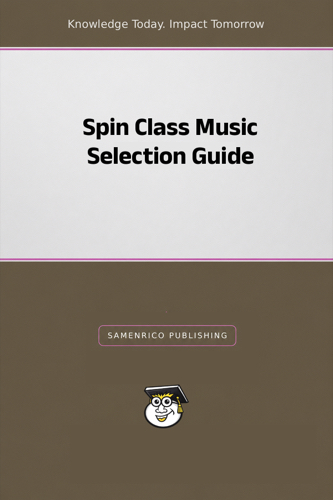
Spin Class Music Selection Guide eBook
Curate playlists that match tempo to terrain, buil
Curate playlists that match tempo to terrain, building emotional arcs for climbs, sprints, and cool-downs.
Formats
Free sample
Chapter 1: The Silent Driver--Every spin instructor remembers the moment they realized the playlist was more powerful than the bike.For Jenna, a veteran instructor with over 2,000 classes under her belt, it happened on a Tuesday morning at 6:15 AM. Her usual crowd of thirty had shown up—the regulars who knew her cues, her energy, her style. But on this particular morning, her laptop had died during her pre-class prep. She had forgotten to charge it. In a panic, she grabbed her phone, opened Spotify, and hit play on a generic "Workout Mix" she had never vetted.
The beats were fine. The songs were popular. On paper, it should have worked.It was the worst class of her career.Riders who normally crushed their PRs were checking their watches. The woman in the front row who always cried during the final climb (happy tears, she insisted) left five minutes early. Two first-timers never came back.
Jenna spent the rest of the week apologizing to studio management, convinced she had lost her touch. But here is what she eventually realized: she hadn't lost her touch. She had lost her music.The difference between a class that soars and a class that sinks is almost never the instructor's charisma, the quality of the bikes, or even the difficulty of the choreography. It is the invisible force that fills the room, dictates the pace, and reaches into the rider's chest to grab hold of their heartbeat. It is the music.
And for most instructors, it is the most underestimated tool in their arsenal.The 15% Shortcut No One Talks About Let us start with a number that should change everything about how you prepare for your next class: fifteen.Specifically, the 15% Rule. Decades of sports science research have consistently shown that athletes who exercise in synchrony with music experience up to 15% greater endurance than those who exercise without music or with randomly selected playlists. This is not a vague feeling or a marketing claim. It is peer-reviewed, replicable, physiological fact.In one landmark study conducted at Brunel University in London, researchers had cyclists complete two identical time trials. In the first trial, the cyclists rode with no music.
In the second, they rode with music that had been specifically selected to match their pedaling cadence. The results were stunning: the cyclists lasted significantly longer, reported lower perceived exertion, and recovered faster when the music was present. The researchers concluded that music acts as an "ergogenic aid"—a performance enhancer—on par with caffeine or motivational coaching, but with zero side effects and zero cost.But here is what most instructors get wrong. They assume that any music will work. They throw together a playlist of songs they personally enjoy, hit shuffle, and hope for the best.
This is like assuming any fuel will power a race car because gasoline is gasoline. The wrong fuel—or even the right fuel at the wrong time—will leave you sputtering on the side of the track.The 15% Rule only activates when two conditions are met. First, the music must be synchronized to the movement. Second, the music must be emotionally engaging to the listener. Synchronization without emotion is a metronome.
Emotion without synchronization is a concert. You need both.The Dissociation Effect: How Music Steals Your Pain Let us talk about pain. Not the good kind—the productive burn of a hard effort—but the bad kind. The voice in your head that says "stop" when your body could actually keep going. The creeping fatigue that turns a 45-minute ride into an eternity.
The moment when your legs feel like concrete and your lungs feel like sandpaper and every second on the clock is a negotiation with yourself to stay on the bike.This is where the Dissociation Effect becomes your secret weapon.Dissociation is a psychological phenomenon where the brain shifts its attention away from internal sensations (pain, fatigue, breathing rate) toward external stimuli (rhythm, melody, lyrics). When a rider is fully engaged with music, their brain literally has fewer processing resources available to interpret pain signals. The music becomes a distraction so effective that the rider stops asking "How much longer?" and starts asking "What song comes next?"Here is the neuroscience behind it. The brain processes pain and rhythm in overlapping neural networks. When the auditory cortex is heavily stimulated by a compelling beat, it competes with the somatosensory cortex for attentional resources.
The result is that pain signals are dampened. They are not eliminated—your riders will still feel the burn—but they are reduced by a measurable margin. Studies using functional MRI have shown that listening to preferred music during exercise reduces activity in the brain's pain-processing regions by up to 10%.This is why a rider can be gasping for air during a sprint but still smile when their favorite chorus hits. This is why a class can collectively groan when a terrible song comes on, even if their legs are fresh. The music is not a soundtrack to the workout.
The music is the workout's primary interface with the rider's consciousness.But dissociation only works when the music is good. Not just "I like this song" good, but structurally good for the task at hand. A slow, sad ballad will not dissociate a rider from the pain of a heavy climb—it will amplify it by giving their brain nothing to latch onto. A chaotic, poorly produced track will not distract from fatigue—it will add a layer of irritation that makes every pedal stroke feel worse. The right music, at the right tempo, with the right emotional valence, creates a state of flow where the rider loses track of time, effort, and self-consciousness.
That is the goal. That is the magic.Rhythmic Auditory Stimulation: Why Your Legs Can't Help Themselves If dissociation is about turning pain down, Rhythmic Auditory Stimulation (RAS) is about turning performance up.RAS is a neurological phenomenon where the motor cortex—the part of your brain responsible for voluntary movement—instinctively synchronizes with an external auditory rhythm. Put simply: when you hear a beat, your body wants to move to it. This is why people nod their heads to music without thinking. This is why babies bounce to songs before they can walk.
This is why, in every spin class on earth, riders will unconsciously speed up when a faster song comes on and slow down when a slower song plays.The mechanism is rooted in something called auditory-motor entrainment. Specialized neurons in the premotor cortex fire in rhythm with predictable auditory patterns, creating a neural bridge between hearing and moving. This bridge is so powerful that it operates below the level of conscious awareness. Your riders are not deciding to match the beat; their brains are doing it automatically, whether they want to or not.This is both a gift and a danger.The gift is that you can use RAS to guide your class without yelling. When you want riders to increase their cadence, you play a song with a higher BPM.
When you want them to slow down and add resistance, you play a slower, heavier track. The music becomes the silent instructor, and…
This is the end of the free sample. Get the eBook to keep going. Buy now
About this book
Details
- Author
- Houle Katrice
- Publisher
- SamEnrico
- Language
- English
- Genre
- Non-Fiction, Health & Wellness / Music Curation
- Released
- 2026-06-06
- Pages (approx.)
- 141
- Available as
- eBook, Audiobook

Read better in the ZLOADR app
Your eBooks on your phone or tablet. Sign in with your SamEnrico account and start reading.
More by Houle Katrice
 Evidence Testing Anger GuideHoule Katrice$11.99
 Zumba for Weight LossHoule Katrice$11.99
 Affirmation for MenHoule Katrice$11.99
 The HGH Deficiency Diagnosis GuideHoule Katrice$11.99
 The Last Verdict of SolomonHoule Katrice$11.99
 How to Become a Plaster Molder IiHoule Katrice$11.99
 BOP Feature Phone SolutionsHoule Katrice$12.99
 Certification for Electronics ExportHoule Katrice$12.99
 Understanding Usher Syndrome, Type 2bHoule Katrice$17.99
 Hospice AideHoule Katrice$11.99
You may also like
 Hong Kong Handover 1997Dunn Johnnie$11.99
 Zumba For Postnatal Recovery CourseNeal Christian$11.99
 Zumba for BeginnersLadner Nikia$11.99
 YouTube Comment Mining GuideHumes Pandora$12.99
 Worry Box MeditationCarlin Rudy$11.99
 Workplace Stress MeditationNguyen Lynn$11.99
 Workplace Stress and Sleep RepairHawley Ivory$11.99
 Workplace Perfectionism CureDelaney Jeffry$11.99
 Workplace Injustice Anger GuideWallen Isabelle$11.99
 Work Addiction and Burnout LinkGreenwood Ester$11.99
 Women in Yoga and WellnessBeattie Galina$11.99
 Women in Stand Up ComedyChun Evangeline$11.99