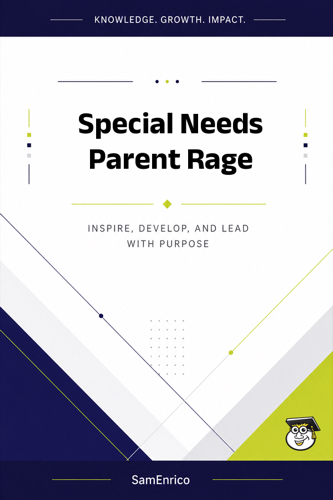
Special Needs Parent Rage eBook
Addresses anger from caregiving exhaustion and sys
Addresses anger from caregiving exhaustion and systemic barriers.
Formats
Free sample
Chapter 1: The Gratitude Trap--The first time a stranger told you that your child was “a blessing” or “chosen especially for you,” you probably nodded and smiled. Maybe you even believed it. The tenth time, you felt a small, strange pinch in your chest—something that didn’t have a name yet. The hundredth time, after a night of no sleep, after a school called to say they couldn’t handle your child “today,” after a therapist suggested you try “more acceptance,” you felt it clearly: not gratitude, not patience, not love. Rage.
Hot, shameful, terrifying rage directed at exactly the people you are supposed to be grateful to.If you are reading this book, you have already noticed that something is wrong with the story you have been told. You have been handed a script—the “grateful parent” script—and you have been trying to perform it for months or years. But the script is not working. Your body knows it. Your nervous system knows it.
And somewhere underneath the exhaustion, you know it too: the expectation that you should be endlessly grateful for a life of sleepless nights, bureaucratic warfare, financial collapse, and watching your child struggle is not noble. It is a trap.This chapter dismantles that trap. It names the cultural, religious, and media sources of the toxic gratitude narrative. It shows you, with research, what happens to parents who swallow their anger for too long. And it gives you the single most important reframe of this entire book: you can love your child absolutely and hate your circumstances completely.
Both are true. Neither cancels the other out. And once you understand that, the gratitude trap loses its power over you forever.Where the Script Comes From The expectation that special needs parents should be perpetually grateful did not appear from nowhere. It is the product of three powerful cultural forces, each of which has been operating on you since before your child was diagnosed. Naming them is the first act of resistance.The Religious Martyrdom Tradition In many religious and spiritual frameworks, suffering is framed as sanctifying.
The parent who sacrifices endlessly, who never complains, who accepts their burden with a serene smile—this figure is held up as holy. In Christianity, the “suffering servant” archetype runs deep. In Judaism, the concept of tikkun olam (repairing the world) can be twisted into an expectation of infinite personal sacrifice. In secular spiritual circles, the language changes but the message remains: your child came into your life for a reason; this struggle is your path; you are being forged in fire.Here is what that narrative does not tell you. It does not tell you that the saints it venerates were often exhausted, angry, and deeply ambivalent—we just edited those parts out.
It does not tell you that martyrdom is a choice, not an obligation. And it absolutely does not tell you that the expectation of perpetual gratitude is a tool of control, used by religious leaders and family members alike to keep you quiet and compliant. When someone tells you to “offer it up” or “trust God’s plan,” what they are really saying is: I do not want to hear your anger. Keep it inside where it cannot bother me.The “Special Angel” Media Machine Think about every movie, every television show, every feel-good news segment you have ever seen about a child with a disability. The formula is almost identical: the child is sweet, undemanding, and somehow wise beyond their years.
The parent is long-suffering but ultimately grateful for the “gift” of this child. The story ends with a tearful montage and a title card about how “love conquers all.”This is not journalism. This is propaganda.Real disabled children have meltdowns. They break things. They bite.
They scream for hours. They elope into traffic. Their parents age faster, die earlier, and divorce at higher rates. But none of that makes for a good Christmas special. So the media shows you the sanitized version, the angel version, and then holds that image up as the standard you should aspire to.
Every time you fail to feel grateful—every time you feel rage instead—you are measured against a fiction and found wanting. The gap between your real life and that fiction is not a sign of your failure. It is a sign that the fiction is a lie.Disability Inspiration Porn The term “inspiration porn” was coined by the late Australian disability activist Stella Young. She defined it as the use of disabled people as objects of inspiration for non-disabled people. The formula is simple: a photo of a disabled person doing something ordinary (eating, walking, going to school) paired with a caption like “Your excuse is invalid” or “The only disability is a bad attitude.”Here is what inspiration porn does to parents.
It tells you that your child’s worth is measured by how much they inspire others. It tells you that your struggles are not real problems but opportunities for character development. And it tells you that any negative emotion you feel—any anger, any grief, any exhaustion—is not just a personal failing but a moral one. You are not just tired; you are ungrateful. You are not just angry; you are a bad parent.
The people who share those memes do not mean harm. But the harm is real nonetheless.The Cost of Swallowing Rage You have been told, implicitly and explicitly, that good special needs parents do not get angry. So you have done what you were told. You have swallowed the rage. You have smiled when you wanted to scream.
You have said “it’s fine” when it was absolutely not fine. You have apologized for emotions that any human being would feel.Here is what that suppression costs you.Clinical Anxiety and Depression Multiple studies have shown that parents of children with disabilities have significantly higher rates of anxiety and depression than parents of typically developing children. The conventional explanation is that the stress of caregiving causes these conditions. But that explanation misses a crucial distinction. Stress does not automatically become anxiety or depression.
What turns stress into pathology is the suppression of the normal emotional responses to that stress—including anger.When you swallow your rage, your brain does not forget it. Your amygdala (the brain’s alarm system) remains activated. Your prefrontal cortex (the rational decision-making center) gets exhausted from the constant effort of inhibition. The result is a low-grade, never-ending state of threat activation that feels exactly like generalized anxiety. And when that state continues for months or years, hopelessness sets in—the conviction that nothing will ever change, that you are trapped, that there is no point in even feeling angry anymore.
That hopelessness is the doorway to depression.Autoimmune Disorders and Chronic Inflammation The mind-body connection is not mystical. It is physiological. Chronic stress suppresses the immune system in some ways (making you more vulnerable to colds and infections) and over-activates it in others (increasing systemic inflammation). The research is now clear: caregivers of family members with chronic conditions have higher rates of autoimmune disorders—rheumatoid arthritis, lupus, multiple sclerosis, inflammatory bowel disease…
This is the end of the free sample. Get the eBook to keep going. Buy now
About this book
Details
- Author
- Kopp Alphonso
- Publisher
- SamEnrico
- Language
- English
- Genre
- Non-Fiction, Self-Help, Special Needs Parenting
- Released
- 2026-06-10
- Pages (approx.)
- 139
- Available as
- eBook, Audiobook

Read better in the ZLOADR app
Your eBooks on your phone or tablet. Sign in with your SamEnrico account and start reading.
More by Kopp Alphonso
 Eisenhower For FreelancersKopp Alphonso$11.99
 Leadership Presence BuildingKopp Alphonso$11.99
 Aging Parent Guilt ReleaseKopp Alphonso$11.99
 Tension Headache and SinusitisKopp Alphonso$11.99
 Overconfidence Bias MitigationKopp Alphonso$11.99
 Dealing with Difficult PeopleKopp Alphonso$11.99
 Creatine Brain Muscle GuideKopp Alphonso$11.99
 Sadness Recognition ToolsKopp Alphonso$11.99
 The Green Revolution: How Frank Lloyd Wright’s Legacy Shaped Sustainable ArchitectureKopp Alphonso$11.99
 The Last Flight of the Phoenix: How a 19th-Century Balloonist Disappeared Over the AtlanticKopp Alphonso$11.99
 Hashtag Revolution: The Viral Rise of the Arab SpringKopp Alphonso$11.99
 Toll Free Numbers WorldwideKopp Alphonso$12.99