
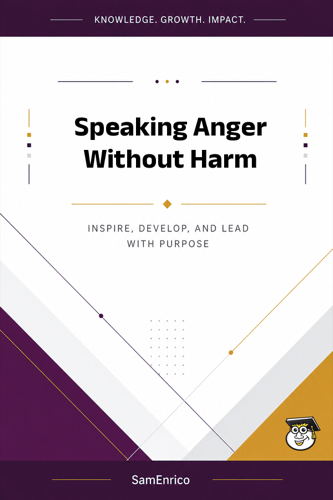
Non-FictionSelf-HelpCouples Communication
Speaking Anger Without Harm eBook
Transforms accusatory language into vulnerable req
Transforms accusatory language into vulnerable requests using 'I feel' statements.
Formats
Free sample
Chapter 1: The Ambush Word--–- The word arrives like a pebble in a shoe. Small. Unremarkable. But with every step, it grinds deeper until you cannot walk another mile without bleeding. That word is "you." Not the gentle "you" of affection—"I appreciate you"—but the accusatory "you" of blame.
"You always do this." "You never listen." "You are so selfish." In less than a second, a single syllable transforms a conversation into a courtroom, a partner into a prosecutor, and a minor disagreement into a full-scale war.I have watched this happen thousands of times. In couples therapy sessions, I have seen a woman reach for her husband's hand, only to pull it back when he says, "You are being dramatic." In corporate mediation, I have seen a team of intelligent, well-meaning professionals collapse into silence after a manager says, "You clearly didn't think this through." In parent-child workshops, I have seen a twelve-year-old's face shutter closed like a storefront after hours when a father says, "You are so lazy with your homework."The word "you" did not do this alone. But it was the trigger. The first domino. And once it falls, the rest follow with terrifying predictability.The Anatomy of a Neurological Hijack Let us begin with what actually happens inside the human nervous system the moment someone hears an accusatory "you-statement." I want you to imagine the following scene.
You are sitting at your kitchen table. Your partner walks in and says, "You never help with the dishes." Do not think about whether the statement is true or false. Do not think about your defense. Just notice what happens in your body.Your jaw tightens. Your shoulders lift slightly.
Your eyes narrow. Your breathing becomes shallower. Your heart rate increases. You feel a flush of heat or a drop in temperature. In less than one second, you have entered a physiological state of threat.What you are experiencing is your amygdala—an almond-shaped cluster of neurons deep within your brain—detecting a social threat and activating your sympathetic nervous system.
The amygdala does not distinguish between a predator lunging at you and a partner accusing you. To your limbic system, they are the same. Fight, flight, freeze, or fawn. Those are your only options.The neuroendocrinologist Robert Sapolsky, in his decades of research on stress, has shown that the human stress response is exquisitely sensitive to social evaluation. In fact, for humans, the most potent stressors are not physical threats but social threats: rejection, criticism, blame, and shame.
An accusatory "you-statement" is a social threat, and your body responds accordingly.Here is the cruelest part. Once your amygdala is activated, your prefrontal cortex—the part of your brain responsible for rational thought, empathy, impulse control, and perspective-taking—begins to down-regulate. Blood flow moves away from your reasoning centers and toward your survival centers. This is not a moral failing. This is not stubbornness.
This is biology. The person on the receiving end of a "you-statement" literally cannot hear what you are saying. Not because they are defensive. But because the neural architecture required for listening has been temporarily hijacked.I want you to sit with the implications of that. When you begin a sentence with "you" in an accusatory tone, you are biologically guaranteeing that the person you are speaking to will not be able to understand you.
You are asking them to listen with a brain that has been wired for survival, not connection. You are holding them accountable for a capacity you have just disabled.This is not a recipe for conflict resolution. It is a recipe for escalation.The Four Destinies of Blame When you launch an accusatory "you-statement," the person on the receiving end has exactly four possible responses. None of them lead to lasting resolution. Let me walk you through each one.The first response is counter-blame.
You say, "You are so selfish." They say, "Well, you are so controlling." Now you have entered an escalation spiral. Each accusation fuels the next. The original issue—perhaps whose turn it was to pick up groceries—has been abandoned entirely. The new issue is moral superiority. Who is the better person?
Who has the right to be angry? Who is the real victim? This is what conflict researchers call "kitchen-sink fighting," because every past grievance gets thrown into the current argument. Nothing gets resolved. Everything gets inflamed.
And at the end, you are both exhausted, both wounded, and both further from understanding than when you began.The second response is compliance through shame. You say, "You never listen to me." They say, "You are right. I am sorry. I will do better." This feels like a victory. But watch closely.
What just happened? The other person did not agree with you because they were persuaded by logic or moved by connection. They agreed because they were shamed into submission. Shame-based compliance does not produce lasting behavioral change. It produces resentment.
It produces passive-aggression. The person who says "you are right" too easily is often secretly thinking, "I will show you." They will comply in the moment and sabotage later. They will "forget" the task. They will do it poorly. They will do it slowly.
They will punish you with their obedience, and you will not even understand why you feel so unsatisfied with their compliance.The third response is withdrawal. You say, "You are so difficult." They say nothing. They leave the room. They look at their phone. They go silent.
This is the most deceptive "victory" of all because it looks like you have won. You had the last word. They have nothing left to say. But withdrawal is not resolution. It is a ceasefire.
The person who withdraws is not agreeing with you; they are protecting themselves. And every time they withdraw, they build a little more wall between you. Over months and years, these walls become permanent architecture. You find yourselves living in the same house but speaking only about logistics—schedules, bills, children. The intimacy is gone.
And you wonder where it went.The fourth response is fawning or appeasement. This is less common in Western cultures but appears frequently in relationships with power imbalances or histories of trauma. You say, "You are so careless." They say, "I am so sorry. Please don't be angry. I will do anything to make it right." This is not genuine accountability.
It is survival behavior. The person is not actually hearing your concern; they are trying to end the threat as quickly as possible. They will agree to anything to make the accusation stop. And because they agreed under duress, they will not follow through. Or if they do follow through, they will do so with growing resentment that eventually erupts in unexpected ways.Notice what all four responses have in common.
None of them involve the other person actually hearing your underlying need. None of them lead to genuine problem-solving. None of them build trust or intimacy. The accusatory "you-statement" has foreclosed every path to connection before the conversation has even begun.The Tragic Mistranslation Here is the insight that changed everything for me, and I hope it will change everything for…
This is the end of the free sample. Get the eBook to keep going. Buy now
About this book
Details
- Author
- Mcgill Dorsey
- Publisher
- SamEnrico
- Language
- English
- Genre
- Non-Fiction, Self-Help, Couples Communication
- Released
- 2026-06-06
- Pages (approx.)
- 136
- Available as
- eBook, Audiobook

Read better in the ZLOADR app
Your eBooks on your phone or tablet. Sign in with your SamEnrico account and start reading.
More by Mcgill Dorsey
 Forgiveness After Suicide LossMcgill Dorsey$11.99
 OKR and KPI Integration GuideMcgill Dorsey$11.99
 Twelve Step Programs And Mindfulness Integration CourseMcgill Dorsey$11.99
 Self Talk for Gaming AddictionMcgill Dorsey$11.99
 Turmeric for Brain HealthMcgill Dorsey$11.99
 Pet Cancer Death GriefMcgill Dorsey$11.99
 Fiverr Voiceover Gig OptimizerMcgill Dorsey$11.99
 The Round Table’s Legacy: How Medieval Tournaments Shaped the Modern StadiumMcgill Dorsey$11.99
 The Nuns of Tilly: Sisters of Mercy in the Thirty Years' WarMcgill Dorsey$11.99
 How to Start a Piling (building) Business (Beginners Guide)Mcgill Dorsey$11.99
 Growing AphyllanthesMcgill Dorsey$11.99
 A Collector's Handbook to the Plymouth Wimbledon Six)Mcgill Dorsey$11.99
You may also like
 Hong Kong Handover 1997Dunn Johnnie$11.99
 Zumba For Postnatal Recovery CourseNeal Christian$11.99
 Zumba for BeginnersLadner Nikia$11.99
 YouTube Comment Mining GuideHumes Pandora$12.99
 Worry Box MeditationCarlin Rudy$11.99
 Workplace Stress MeditationNguyen Lynn$11.99
 Workplace Stress and Sleep RepairHawley Ivory$11.99
 Workplace Perfectionism CureDelaney Jeffry$11.99
 Workplace Injustice Anger GuideWallen Isabelle$11.99
 Work Addiction and Burnout LinkGreenwood Ester$11.99
 Women in Yoga and WellnessBeattie Galina$11.99
 Women in Stand Up ComedyChun Evangeline$11.99