
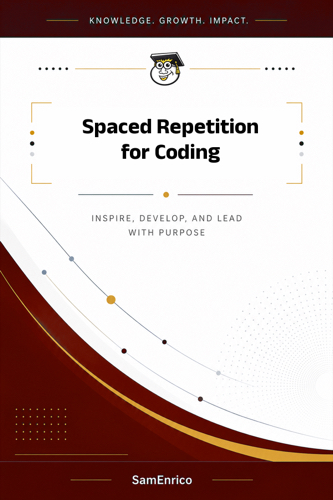
Non-FictionSelf-HelpProgramming
Spaced Repetition for Coding eBook
Remember syntax, algorithms, and APIs using SRS.
Remember syntax, algorithms, and APIs using SRS.
Formats
Free sample
Chapter 1: The Leaky Garden--–- Every developer knows the feeling. You spend a weekend mastering a new Java Script framework, writing elegant arrow functions, and wielding array methods like a weapon. On Monday morning, you sit down to use your newfound knowledge, and your fingers freeze. Was it array.map or array.map()? Does filter modify the original array?
How did that closure syntax go again? You reach for Google, again. The cycle repeats next week with a different language, a different library, the same forgetting.This is not a personal failing. It is not a sign that you lack the "coding gene" or that you are somehow less talented than the developers who seem to recite syntax in their sleep. What you are experiencing is a predictable, well-documented, and entirely solvable biological reality: the human brain is designed to forget.Every piece of syntax, every algorithm, every API signature you learn begins leaking out of your memory the moment you stop using it.
Within one hour, you have lost roughly fifty percent of what you just studied. Within twenty-four hours, seventy percent is gone. Within thirty days, without deliberate reinforcement, nearly one hundred percent of that specific memory trace has faded. This is the Ebbinghaus Forgetting Curve, discovered by German psychologist Hermann Ebbinghaus in 1885 and replicated in thousands of studies since. It is as fundamental to human cognition as gravity is to physics.Yet the programming world operates as if forgetting does not exist.
Bootcamps cram syntax into twelve weeks and send graduates into the world with the implicit promise that "knowing" something once means knowing it forever. Tutorials present information linearly, assuming that watching a video or reading a chapter constitutes learning. Online courses reward completion, not retention. And developers internalize the resulting gaps as their own fault. "I guess I'm just not a natural," they say.
"I need to practice more." But they practice the wrong way, repeating the same inefficient cycle of tutorial-then-forget-then-relearn.This book exists because that cycle is optional.The Recognition Trap Let us begin with a distinction that will become the backbone of everything that follows. There is a profound difference between recognizing code and recalling code. Recognition feels like knowledge, but it is not the same thing as usable memory.Consider this Java Script code:const doubled = numbers.map(x => x * 2);When you see this line, you likely know exactly what it does. It takes an array called numbers, applies a function that multiplies each element by two, and stores the result in doubled. You recognize the map method, understand the arrow function syntax, and can predict the output.
This is recognition, and it is effortless.Now close your eyes. Without looking, write that exact line of code from memory. Include the correct method name, the arrow function syntax, the return assignment. If you have used Java Script before, you might succeed. But many developers cannot.
They write .for Each instead of .map, or forget the return implicit in the arrow function, or misplace the parentheses. They recognize map perfectly but cannot recall it under pressure.This gap between recognition and recall is where most learning fails.Every IDE autocomplete, every documentation lookup, every Stack Overflow copy-paste trains recognition. You see the correct syntax, nod along, and move on. But technical interviews do not offer autocomplete. Debugging sessions do not come with documentation tabs pre-opened.
On-call incidents do not wait while you Google the error message. These high-stakes scenarios test recall, and only recall.Spaced Repetition Systems exist to bridge this gap. They force your brain to retrieve information from memory without cues, strengthening the neural pathways that make recall automatic. Recognition is passive; recall is active. Recognition feels good; recall produces results.A Case Study in Forgetting Let me tell you about Sarah, a junior data scientist who worked at a mid-sized e-commerce company.
Sarah had taken three separate courses on Python pandas. The first was during her master's degree, where she completed a project analyzing housing data. The second was a company-sponsored bootcamp that built a dashboard for sales metrics. The third was a self-directed tutorial she worked through before a promotion interview.Each time, Sarah learned the same groupby syntax. Each time, she could explain that df.groupby('column').agg() aggregates data by categories.
Each time, she felt confident.And each time, within two weeks of finishing the course, she forgot the exact syntax. She would sit down to write groupby and stare at the screen. Was it df.group_by or df.group By? Did the aggregation function go inside the parentheses or after? Was it .agg() or .aggregate()?
She would sigh, open her browser, and search "pandas groupby syntax" for the fourth time.Sarah is not lazy. She is not unintelligent. She completed three rigorous learning experiences. But each of those experiences relied on passive exposure: watching videos, reading documentation, copying code from examples. Passive exposure builds recognition, and recognition decays rapidly without reinforcement.Then Sarah discovered spaced repetition.
Instead of re-taking another course, she created flashcards for the groupby syntax. One card asked: "Write the pandas code to group a Data Frame by the 'category' column and calculate the mean of the 'value' column." The answer: df.groupby('category')['value'].mean(). Another card asked: "What method do you use to apply multiple aggregation functions after groupby?" Answer: df.groupby('category').agg(['mean', 'sum', 'count']).Sarah reviewed these cards at increasing intervals: two days later, then five days, then twelve days, then a month. Each review forced her to write the code from memory. After three months, the syntax had moved from "I recognize that" to "I can write it in my sleep." When she needed groupby for a new project, she did not Google.
She typed.Sarah saved approximately forty-five minutes per week that she previously spent re-searching the same syntax. Over a year, that is nearly forty hours. More importantly, she stopped feeling like an imposter. The gap between what she knew and what she could produce closed.Why Your Current Study Habits Betray You If passive learning through tutorials and projects is so inefficient, why does it feel productive? The answer lies in a cognitive bias called the fluency illusion.When you watch a tutorial or read documentation, the information flows smoothly into your short-term memory.
The instructor explains clearly. The code examples are well-commented. You understand each step as it happens. This feeling of ease creates a metacognitive error: you mistake the fluency of input for the durability of storage. Because it went in easily, you assume it will stay there.It will not.The same mechanism makes highlighting textbooks feel like studying.
The physical act of marking a passage creates a sense of ownership over the information. You have identified what matters. Surely that means you have learned it. In reality, highlighting is nearly useless for long-term retention. It is a form of passive marking, not active retrieval.Building projects, the most common advice given to new programmers, suffers from a similar problem.
When you build a to-do app or a weather dashboard, you are learning how to use tools, not how to remember them. You encounter a problem, Google the solution…
This is the end of the free sample. Get the eBook to keep going. Buy now
About this book
Details
- Author
- Hardesty Alpha
- Publisher
- SamEnrico
- Language
- English
- Genre
- Non-Fiction, Self-Help, Programming
- Released
- 2026-06-06
- Pages (approx.)
- 124
- Available as
- eBook, Audiobook

Read better in the ZLOADR app
Your eBooks on your phone or tablet. Sign in with your SamEnrico account and start reading.
More by Hardesty Alpha
 Morning Mindset RitualsHardesty Alpha$11.99
 Women's Gun Violence ActivismHardesty Alpha$11.99
 Belgium Green IncentivesHardesty Alpha$11.99
 Mindfulness Techniques for Cannabis CravingsHardesty Alpha$11.99
 Psychopathy and Recidivism RatesHardesty Alpha$11.99
 Caregiver Self Care GuideHardesty Alpha$11.99
 Work Experience Bullet PointsHardesty Alpha$11.99
 The Vanishing Hour: How 1977’s Great Blackout Could Rewrite HistoryHardesty Alpha$11.99
 Understanding Lumbar Disc DiseaseHardesty Alpha$11.99
 A Collector's Handbook to the Chrysler (Aus) Chrysler Charger 770Hardesty Alpha$11.99
 How to Produce Slot MachinesHardesty Alpha$11.99
 African Students Recommendation Letter HandbookHardesty Alpha$12.99
You may also like
 Hong Kong Handover 1997Dunn Johnnie$11.99
 Zumba For Postnatal Recovery CourseNeal Christian$11.99
 Zumba for BeginnersLadner Nikia$11.99
 YouTube Comment Mining GuideHumes Pandora$12.99
 Worry Box MeditationCarlin Rudy$11.99
 Workplace Stress MeditationNguyen Lynn$11.99
 Workplace Stress and Sleep RepairHawley Ivory$11.99
 Workplace Perfectionism CureDelaney Jeffry$11.99
 Workplace Injustice Anger GuideWallen Isabelle$11.99
 Work Addiction and Burnout LinkGreenwood Ester$11.99
 Women in Yoga and WellnessBeattie Galina$11.99
 Women in Stand Up ComedyChun Evangeline$11.99