
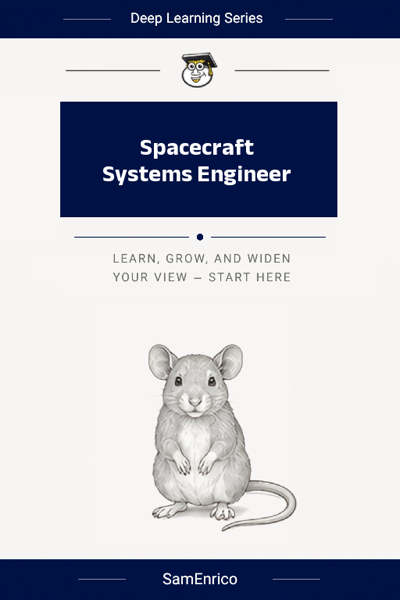
Spacecraft Systems Engineer Audiobook
A Coursebook on Spacecraft Systems Engineer
by Shores Caron
A Coursebook on Spacecraft Systems Engineer
Formats
Free sample
Chapter 1: The Architect's Gambit...--You have just been hired as a junior systems engineer. On your first day, your manager walks you to a small, windowless conference room. On the table sits a single stack of paper—498 pages, double-sided, three-hole-punched, and bound with a worn black spiral. "This is the requirements document for our next spacecraft," she says. "It has 1,247 individual requirements.
Some of them contradict each other. Three of them are physically impossible. And one of them is a typo that has been copied forward from the last three missions because no one has ever questioned it. Don't drown."She leaves. The door clicks shut.This chapter teaches you how to swim.The Myth of the Lone Genius If you have watched movies about space exploration, you have been sold a comforting fiction: the brilliant engineer has a sudden insight, sketches something on a napkin, and the spacecraft is built.
The reality is far messier, far more collaborative, and far more interesting.Spacecraft are not designed by geniuses. They are designed by committees of competent people who argue productively. The spacecraft systems engineer is not the smartest person in the room—the propulsion engineer knows more about thrust, the thermal engineer knows more about heat flow, and the structural engineer knows more about stress concentrations. What the systems engineer knows is how all of those things fit together.This is the first and most important truth of this book: A spacecraft is not a collection of parts. A spacecraft is a system of interdependent subsystems, where changing one thing changes everything.Consider a seemingly simple decision: you want to add one more scientific instrument to a Mars orbiter.
That instrument has mass. That mass requires more structure. More structure requires more material. More material adds more mass. More mass requires either a larger launch vehicle (more expensive) or removing propellant (shorter mission life).
The instrument also needs power. More power requires larger solar arrays. Larger solar arrays have more drag in the thin upper atmosphere of Mars, which means the orbit decays faster, which means even more propellant for orbit maintenance. The instrument also generates heat. That heat must be radiated away.
Larger radiators add more mass and change the spacecraft's thermal balance, potentially affecting other instruments that need to stay cold.A single instrument can cascade through every subsystem on the spacecraft. And it is the systems engineer's job…
This is the end of the free sample. Get the Audiobook to keep going. Buy now
About this book
Details
- Author
- Shores Caron
- Publisher
- SamEnrico
- Language
- English
- Genre
- Non-Fiction, Informative, Educational
- Released
- 2026-05-04
- Pages (approx.)
- 135
- Available as
- eBook, Audiobook

Listen in the VoxFlicks app
Audiobooks and audio dramas wherever you go. Sign in with your SamEnrico account and press play.
More by Shores Caron
 Merge Rage Prevention GuideShores Caron$11.99
 Snowfall Visualization Peace GuideShores Caron$11.99
 Sick Day Work Guilt ReliefShores Caron$11.99
 PCOS N Acetyl CysteineShores Caron$11.99
 The Max Planck Quantum OriginShores Caron$11.99
 The Architect of Timbuktu: Ishaq al-Timbukti and the Grandeur of SonghaiShores Caron$11.99
 Understanding Osteodysplasia Familial Anderson TypeShores Caron$17.99
 SoFi SWOT GuideShores Caron$12.99
 Canadian Graduate Self Employed PathShores Caron$12.99
 How to Become a Condenser-tube TenderShores Caron$11.99