
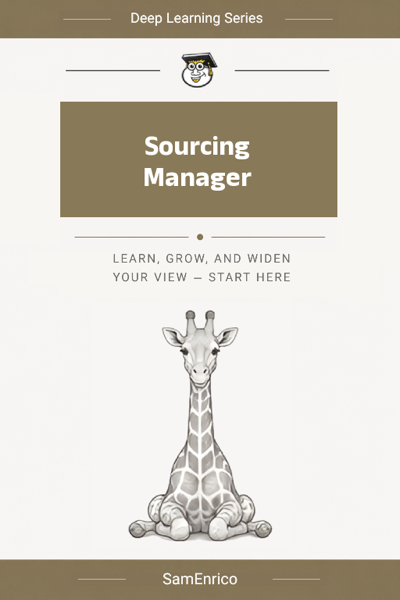
Non-FictionInformativeEducational
Sourcing Manager eBook
A Coursebook on Sourcing Manager
A Coursebook on Sourcing Manager
Formats
Free sample
Chapter 1: Beyond the P.O.--The purchase order sat on his desk, a single sheet of paper that had taken three days to approve. The requisition had been correct. The budget had been allocated. The supplier was already qualified. Yet here he was, a Tuesday morning, watching ink dry on a document that should have been generated automatically.
This was sourcing, he had been told. This was the job.It was not the job. Not anymore.For most of modern industrial history, the person responsible for buying things for a company was viewed as a necessary expense—a clerical function performed by people who knew how to fill out forms, check inventory levels, and maybe negotiate a small discount on office supplies. That person existed in the basement, near the loading dock, far from the corner offices where real decisions were made. That person was told what to buy and given very little room to question why.That person is now extinct.The Sourcing Manager of the twenty-first century sits at the executive table, not because of charity or corporate trend-chasing, but because global supply chains have become the single greatest lever for profit, innovation, and resilience.
A company might have the best product design, the most talented engineers, and the most aggressive sales force, but if its sourcing strategy fails, nothing else matters. A missing semiconductor stops a production line. A single-source supplier facing bankruptcy collapses an entire product category. An ethical violation buried three tiers deep in a subcontractor's subcontractor destroys a brand's reputation overnight.This book is not about how to fill out purchase orders. This book is about how to architect value from the source.The Evolution of a Forgotten Profession To understand where sourcing is going, we must first understand where it has been.
The history of supply management is not a straight line of progress. It is a story of fits and starts, of crises that forced change, and of opportunities that were either seized or squandered.The First Era (1850–1900): Vertical Integration In the age of the railroad barons and steel magnates, the dominant logic was simple: own everything. Andrew Carnegie did not buy steel from suppliers; he owned the iron mines, the coke ovens, the railroads, and the steel mills. John D. Rockefeller did not purchase barrels for his oil; he owned the forests, the barrel-making factories, and the shipping fleet.
The philosophy was that control eliminated risk. If you owned the source, no supplier could hold you hostage.This era produced enormous fortunes but also enormous inefficiency. Carnegie Steel was profitable not because it optimized sourcing but because it eliminated the need for sourcing altogether. The purchasing function, where it existed at all, was simply an internal logistics operation moving materials from one company-owned facility to another. There was no negotiation because there was no external party.
There was no supplier relationship management because there was no relationship—only ownership.The Second Era (1900–1945): The Rise of the Purchasing Agent As companies grew too large to vertically integrate everything, the purchasing agent emerged. This figure was a gatekeeper, responsible for ensuring that departments did not buy the same things from different suppliers at different prices. Standardization was the goal. A purchasing agent at General Motors in the 1920s would specify that all divisions use the same grade of steel, the same fastener sizes, and the same lubricants.This era introduced the concept of volume leverage: buying more from fewer suppliers to drive down per-unit costs. But the purchasing agent was still administrative.
They did not influence product design. They did not shape corporate strategy. They executed orders and tracked invoices. The profession had a title but not yet a seat at the table.The Third Era (1945–1975): Materials Management After World War II, the complexity of manufacturing exploded. The rise of the conglomerate—companies like ITT, Textron, and LTV—meant that a single firm might make everything from electrical components to hotel bedding to aerospace systems.
Coordinating the flow of materials across dozens of divisions became a logistical nightmare.The response was materials management, an integrated function that combined purchasing, inventory control, production scheduling, and logistics. For the first time, someone was responsible for the entire flow of physical goods from supplier to factory floor. This was progress, but the focus remained internal. The materials manager worried about stockouts and warehouse space, not about supplier innovation or total cost of ownership.The Fourth Era (1975–1990): Just-in-Time and the Supplier Partnership The oil shocks of the 1970s exposed the fragility of large, centralized inventories. Japanese manufacturers, led by Toyota, offered a radical alternative: just-in-time (JIT) production.
The idea was simple yet profound: instead of holding massive safety stocks, arrange for suppliers to deliver small quantities exactly when needed.JIT required a fundamentally different relationship with suppliers. You could not treat a JIT supplier as an adversarial vendor to be squeezed on price. You needed trust. You needed transparency. You needed suppliers who were willing to locate factories next to yours, share production schedules, and invest in quality systems.This era gave birth to strategic sourcing as a concept.
For the first time, purchasing professionals were asked to think long-term, to evaluate suppliers on more than price, and to participate in cross-functional teams. The purchasing agent began to transform into the sourcing manager.The Fifth Era (1990–2010): Globalization and the Low-Cost Country The fall of the Berlin Wall, the rise of the World Trade Organization, and China's entry into the global trading system created a new reality: anywhere could supply anything. Labor cost arbitrage became the dominant sourcing logic. If a factory in Guangdong could produce a component for one-tenth the cost of a factory in Ohio, the math seemed simple.Sourcing departments raced to establish offices in Shanghai, Bangalore, and Mexico City. The mantra was "low-cost country sourcing," and the metric was landed cost per unit.
This era produced huge savings but also hidden costs: long lead times, intellectual property theft, language barriers, and supply chains so extended that a single port closure could paralyze production.The Sixth Era (2010–2020): The Digital Transformation Cloud computing, big data analytics, and e-procurement platforms digitized the sourcing process. Spend analysis tools could now classify millions of transactions in seconds. E-reverse auctions allowed buyers to drive prices down in real time. Supplier portals provided visibility into inventory levels and production schedules.This era promised to automate the tactical work of sourcing, freeing professionals for strategic thinking. But many companies discovered that technology alone could not fix broken processes or adversarial relationships.
The tools were powerful, but they were only as good as the strategies behind them.The Seventh Era (2020–Present): The Age of Disruption The Covid-19 pandemic was not the first supply chain crisis, but it was the most revealing. It showed that decades of efficiency-focused sourcing had produced brittle, fragile systems. A single factory lockdown in Wuhan. A single container ship stuck in the Suez Canal. A single ransomware attack on a logistics provider.
Any one of these events could—and did—ripple across the global economy.This era is defined by a fundamental rebalancing. Efficiency remains important, but resilience now has equal weight. Sourcing managers are asked to map their multi-tier supply chains…
This is the end of the free sample. Get the eBook to keep going. Buy now
About this book
Details
- Author
- Mcdonnell Ali
- Publisher
- SamEnrico
- Language
- English
- Genre
- Non-Fiction, Informative, Educational
- Released
- 2026-06-02
- Pages (approx.)
- 155
- Available as
- eBook, Audiobook

Read better in the ZLOADR app
Your eBooks on your phone or tablet. Sign in with your SamEnrico account and start reading.
More by Mcdonnell Ali
 Product Line Positioning AtlasMcdonnell Ali$11.99
 Outsourcing for Content CreatorsMcdonnell Ali$11.99
 Business Plan Software Tools GuideMcdonnell Ali$11.99
 Downsizing Your Home Equity GuideMcdonnell Ali$11.99
 Men's Coronary Calcium Score GuideMcdonnell Ali$11.99
 Seams of Rebellion: The Radical Threads of Vivienne WestwoodMcdonnell Ali$11.99
 The Storm and the Summit: The First Ascent of Mont Blanc and the Birth of Alpine ExplorationMcdonnell Ali$11.99
 How to Start a Motor Vehicle Reconditioning By Manufacturer Business (Beginners Guide)Mcdonnell Ali$11.99
 Furniture Retail RetentionMcdonnell Ali$12.99
 Vendor Training Program GuideMcdonnell Ali$12.99
 Understanding Chromosome 11, Deletion 11pMcdonnell Ali$17.99
You may also like
 Hong Kong Handover 1997Dunn Johnnie$11.99
 Zumba For Postnatal Recovery CourseNeal Christian$11.99
 Zumba for BeginnersLadner Nikia$11.99
 YouTube Comment Mining GuideHumes Pandora$12.99
 Worry Box MeditationCarlin Rudy$11.99
 Workplace Stress MeditationNguyen Lynn$11.99
 Workplace Stress and Sleep RepairHawley Ivory$11.99
 Workplace Perfectionism CureDelaney Jeffry$11.99
 Workplace Injustice Anger GuideWallen Isabelle$11.99
 Work Addiction and Burnout LinkGreenwood Ester$11.99
 Women in Yoga and WellnessBeattie Galina$11.99
 Women in Stand Up ComedyChun Evangeline$11.99