
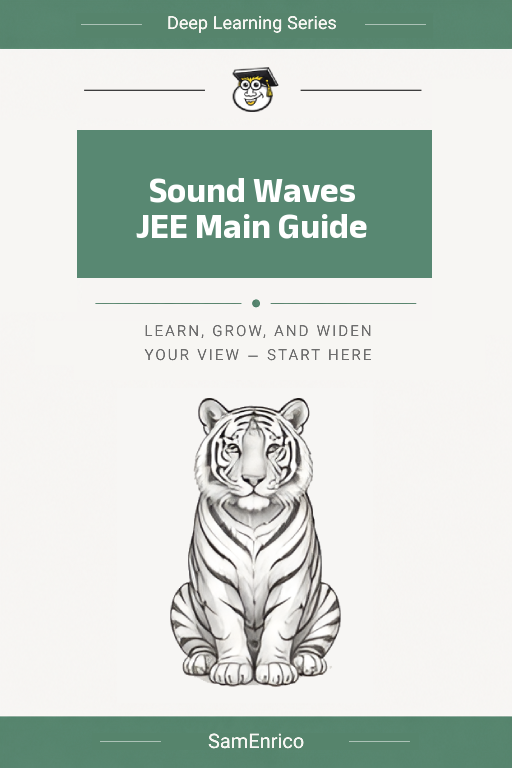
Sound Waves JEE Main Guide
Solve resonance organ pipe and intensity level pro
Solve resonance organ pipe and intensity level problems using wave equation and decibel scale.
Formats
About this book
Free sample
Chapter 1: The Invisible Bridge...--The first time you heard a sound, you didn’t think about equations. You just heard. A dog bark, a bell chime, your mother’s voice. But beneath every sound lies a mathematical ghost—a wave moving through air, carrying energy from one place to another without carrying the air itself. To master sound waves for the JEE Main, you must cross an invisible bridge: from the physical world of vibrating strings and organ pipes to the abstract world of sines, cosines, and logarithms.
This chapter builds that bridge, stone by stone, starting with the most powerful tool in physics: the wave equation.1.1 Why the Wave Equation Rules Everything Imagine dropping a pebble into still water. Ripples expand outward. Each water molecule moves up and down, but the ripple travels horizontally. That is a wave: a disturbance that propagates through a medium without permanently displacing the medium itself.Sound is exactly the same, except the medium is air (or water, or steel) and the disturbance is a compression—a region where air molecules bunch together—followed by a rarefaction where they spread apart. The wave equation is the mathematical rule that every such disturbance obeys.For a wave traveling along the x-axis, the displacement of the medium at position x and time t is given by:y(x,t) = A sin(kx - ωt + φ)This single equation contains the entire physics of sinusoidal waves.
Let us decode it term by term.A is the amplitude—the maximum displacement from equilibrium. For sound, amplitude determines loudness. Double the amplitude, and the sound carries four times the energy.k is the wave number, defined as k = 2π/λ, where λ is the wavelength—the distance between two consecutive compressions.ω is the angular frequency, defined as ω = 2πf, where f is the frequency in hertz—the number of compressions that pass a point each second. Frequency determines pitch. A higher frequency means a higher pitch.φ is the phase constant, which shifts the wave left or right along the x-axis.
For most JEE problems, you can set φ = 0 unless two waves are being compared.The argument (kx - ωt…
This is the end of the free sample. Get the eBook to keep going. Buy now
Contents
- Chapter 1
- Chapter 2
- Chapter 3
- Chapter 4
- Chapter 5
- Chapter 6
- Chapter 7
- Chapter 8
- Chapter 9
- Chapter 10
- Chapter 11
- Chapter 12
Details
- Author
- Vasquez Rachael
- Publisher
- SamEnrico
- Language
- English
- Genre
- Non-Fiction, Student's Shortcut
- Released
- 2026-06-01
- Pages (approx.)
- 121
- Available as
- eBook, Audiobook

Read better in the ZLOADR app
Your eBooks on your phone or tablet. Sign in with your SamEnrico account and start reading.
More by Vasquez Rachael
 Self Esteem Without Weight Loss Goals ManualVasquez Rachael$11.99
 Real Estate Agent Commission StressVasquez Rachael$11.99
 Perfectionism Creative GuideVasquez Rachael$11.99
 Death Road Expedition LogVasquez Rachael$11.99
 Aging Planning MythsVasquez Rachael$11.99
 Partner Anger Triggers GuideVasquez Rachael$11.99
 Mindfulness For JealousyVasquez Rachael$11.99
 Startup Workaholic CultureVasquez Rachael$11.99
 The Last Broadcast of Radio Luxembourg: How a Secret WWII Transmission Changed the WarVasquez Rachael$11.99
 The Last Light of the Abyss: The Titanic’s Secret Deep-Sea DiscoveryVasquez Rachael$11.99
 Ultimate Handbook Guide to Lianjiang : (China) Travel GuideVasquez Rachael$11.99
 Chinese Student Accommodation GuideVasquez Rachael$12.99
You may also like
 LSE Online Program LengthAgee Letisha$11.99
 Harvard Extension School for Working AdultsRoush Yer$11.99
 LSE Online Reading ListAshford Ludivina$11.99
 LSE Online Language RequirementsWhitten Daphine$11.99
 LSE Online Class SizeHughey Garret$11.99
 LSE Online Alumni MentorshipWild Lyla$11.99
 London School of Economics Alumni NetworkDutton Chantal$11.99
 Harvard Extension School Student SupportCantrell Christene$11.99
 Harvard Extension School Library AccessSantana Adah$11.99
 Harvard Extension School Degree CompletionBray Wyatt$11.99
 Harvard Extension School Course AuditingAbbott Craig$11.99
 Harvard Extension School Extension DiplomaNew Joane$11.99