
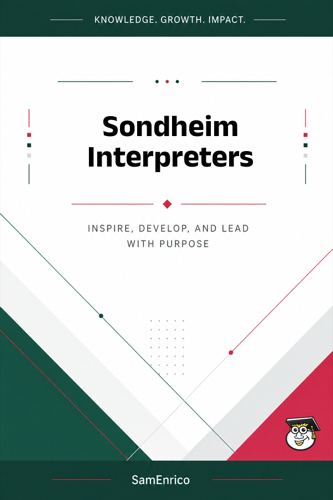
Non-FictionBiographyMusical Theatre
Sondheim Interpreters eBook
Reveals how Mandy Patinkin, Bernadette Peters, and
Reveals how Mandy Patinkin, Bernadette Peters, and others mastered Sondheim's complexity.
Formats
Free sample
Chapter 1: The Singing Actor--The first time I heard Stephen Sondheim’s music, I wanted to quit the theater.I was twenty-two years old, fresh out of a musical theater program where I had been trained to belt, to tap, to project to the back of a thousand-seat house, to sell a song with a smile and a jazz square. I had been taught that the voice was an instrument to be perfected, the body a machine to be controlled, and the audience a force to be conquered. Then someone handed me the vocal score for Sunday in the Park with George, and I opened it to "Finishing the Hat."I could sing the notes. Any trained singer could sing the notes. The intervals were unusual – a descending seventh here, an ascending tritone there – but nothing a few hours of practice couldn’t solve.
What I could not do was make the song mean anything. I sang the words, and the words sat on top of the music like a foreign language I had memorized phonetically. I understood every word individually. I understood nothing collectively.My voice teacher, a kind woman who had spent twenty years teaching teenagers to be charming in community theater auditions, listened to my attempt and said: "You’re singing it beautifully. But you’re not in it."I didn’t know what that meant.
I thought being "in it" meant feeling the emotion – and I felt plenty of emotion. I felt frustrated. I felt inadequate. I felt like I was failing. But those were my emotions, not the character’s.
I had no idea what George Seurat felt while finishing his hat, because I had never spent years of my life obsessed with a single image, never chosen art over love, never stood alone in a studio wondering if any of it mattered.That was my first encounter with the Sondheim puzzle. It would be years before I understood what was actually happening in that practice room. The problem was not my voice. The problem was not my technique. The problem was my entire training, which had prepared me to be a singer when Sondheim demanded I be a singing actor – and those two things are not the same.This book is about the difference between them.
It is about the handful of performers who have cracked the Sondheim code – Mandy Patinkin, Bernadette Peters, Elaine Stritch, Patti Lu Pone, Raúl Esparza, and others – and what their techniques can teach us about the art of interpretation itself. It is not a biography of Sondheim, though we will discuss his methods. It is not a history of his musicals, though we will visit them. It is a practical and philosophical investigation of a single question: What does it mean to interpret a song that refuses to be sung?And before we go any further, let me tell you what I mean by that word – interpretation – because it will appear on nearly every page of this book, and I want us to be working from the same definition.What We Mean by "Interpretation"When I say "interpretation," I do not mean "a performer’s personal style." I do not mean "the way someone sings a song differently from someone else." Those are the shallow uses of the word, the ones you find in reality competition shows where a judge says "You really made that song your own." Making a song your own is not interpretation. It is branding.Interpretation, as I will use it throughout this book, is the act of revealing subtext through vocal and physical choices that serve the character’s immediate psychological objective.Let me break that down.Revealing subtext means uncovering what the song is really about, beneath the surface meaning of the words.
Sondheim’s lyrics are famously dense, but they are also famously deceptive. His characters rarely say what they mean. They deflect, they joke, they attack, they retreat. The interpreter’s job is to show the audience what the character is not saying – the fear beneath the flirtation, the rage beneath the politeness, the desperation beneath the wit.Through vocal and physical choices means that interpretation lives in the body and the voice, not just the mind. You can understand a song perfectly in your head and still perform it poorly, because understanding is not enough.
The audience cannot see your thoughts. They can only see what you do with your breath, your tongue, your hands, your spine. Interpretation is action, not intention.That serve the character’s immediate psychological objective means that every choice must answer a question: What does this character want right now, and how is this song an attempt to get it? Not what the performer wants. Not what the director wants.
What the character wants. Sondheim’s songs are not arias of self-expression. They are tactics. They are weapons. They are pleas.
They are confessions the character did not mean to make.This definition will guide us through every chapter that follows. It will help us understand why Patinkin stands motionless on stage with his arms folded (Chapter 2). It will help us understand why Peters sacrifices diction for emotional texture (Chapters 4 and 5). It will help us understand why Stritch is considered a great interpreter despite her limited vocal range (Chapter 6). It will help us understand why Lu Pone’s ferocity is different from Peters’ fragility (Chapter 6).
And it will help us understand why the scream in Patinkin’s "Losing My Mind" is not a gimmick but a logical conclusion (Chapter 7).But before we can understand the interpreters, we must understand the composer. Sondheim did not accidentally create a body of work that demands this kind of interpretation. He designed it that way.The Sondheim Difference: Why His Music Is Not Like Other Music If you have spent any time in musical theater, you have heard someone say: "Sondheim is harder than other composers." This is true, but it is true for reasons that have nothing to do with vocal range or rhythm. There are plenty of high notes in Andrew Lloyd Webber. There are plenty of syncopations in Stephen Schwartz.
The difficulty of Sondheim is not technical difficulty – though there is plenty of that – but interpretive difficulty.Let me illustrate with a comparison.Consider "Memory" from Cats. The song is a lament. The character, Grizabella, is remembering a better time. The emotion is nostalgia tinged with regret. The structure is verse-chorus-verse-chorus-bridge-chorus.
The performer’s job is to convey that emotion clearly and powerfully, to build from a whisper to a belt, to make the audience feel the sadness of a forgotten cat. It is a beautiful song, and a great performance of it can be moving. But the interpretive demands are low. The song tells you what to feel. The performer just has to feel it convincingly.Now consider "Not a Day Goes By" from Merrily We Roll Along.
On the surface, it is also a lament – a woman remembering a lost love. But the song is not straightforward. The lyric "Not a day goes by" can be read as either a confession of enduring love or a curse of enduring pain. The melody rises…
This is the end of the free sample. Get the eBook to keep going. Buy now
About this book
Details
- Author
- Sharkey Nathanael
- Publisher
- SamEnrico
- Language
- English
- Genre
- Non-Fiction, Biography, Musical Theatre
- Released
- 2026-06-06
- Pages (approx.)
- 139
- Available as
- eBook, Audiobook

Read better in the ZLOADR app
Your eBooks on your phone or tablet. Sign in with your SamEnrico account and start reading.
More by Sharkey Nathanael
 The Cialdini Persuasion GuideSharkey Nathanael$11.99
 Self Hypnosis for Chemotherapy Induced PainSharkey Nathanael$11.99
 Young Professional LayoffSharkey Nathanael$11.99
 Team Creative ConfidenceSharkey Nathanael$11.99
 Daily Joy HandbookSharkey Nathanael$11.99
 Self Esteem After Public FailureSharkey Nathanael$11.99
 Design Thinking for AccessibilitySharkey Nathanael$11.99
 The Maestro's Gambit: How Mozart and Haydn Reshaped the Musical CosmosSharkey Nathanael$11.99
 The Colonial Clash: Australia’s First Rugby Showdown and the Birth of a Sporting LegacySharkey Nathanael$11.99
 How to Become a Gun ExaminerSharkey Nathanael$11.99
 African Clawed Frogs: Care, Habitat & Biology For OwnersSharkey Nathanael$11.99
 A Collector's Handbook to the Studebaker ChampionSharkey Nathanael$11.99
You may also like
 Hong Kong Handover 1997Dunn Johnnie$11.99
 Zumba For Postnatal Recovery CourseNeal Christian$11.99
 Zumba for BeginnersLadner Nikia$11.99
 YouTube Comment Mining GuideHumes Pandora$12.99
 Worry Box MeditationCarlin Rudy$11.99
 Workplace Stress MeditationNguyen Lynn$11.99
 Workplace Stress and Sleep RepairHawley Ivory$11.99
 Workplace Perfectionism CureDelaney Jeffry$11.99
 Workplace Injustice Anger GuideWallen Isabelle$11.99
 Work Addiction and Burnout LinkGreenwood Ester$11.99
 Women in Yoga and WellnessBeattie Galina$11.99
 Women in Stand Up ComedyChun Evangeline$11.99