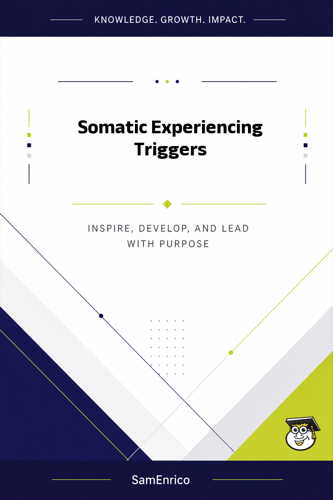
Somatic Experiencing Guide eBook
Releases frozen trauma from the body.
Releases frozen trauma from the body.
Formats
Free sample
Chapter 1: The Body's Betrayal--–- Every morning for the past eleven years, Sarah has woken up with a knot in her stomach. Not the gentle flutter of nervous anticipation, but a dense, hot fist of dread that sits just below her ribcage. She has tried everything: meditation apps that tell her to "observe her thoughts," journaling practices that ask her to trace the feeling back to its source, and seven years of twice-weekly talk therapy with a compassionate psychologist who helped her understand her childhood, reframe her negative beliefs, and articulate her emotions with impressive clarity. She can tell you the exact origin story of her anxiety. She can name the defense mechanisms.
She can even smile wryly and say, "My mother's criticism became my inner critic." And yet, every morning, the knot remains. It does not care about her insights. It does not respond to her logic. It simply sits there, a loyal, unwanted companion, as stubborn and physical as a scar.–- This is the body's betrayal: not that it holds trauma, but that it holds trauma silently, invisibly, and in complete defiance of everything the conscious mind understands. You can have a Ph D in psychology, a decade of therapy, a daily gratitude practice, and a perfectly articulated life narrative, and your body may still flinch at a sudden sound, freeze when someone raises their voice, or collapse into exhaustion after a minor conflict.
This is not because you are broken. It is not because you haven't tried hard enough. It is because trauma is not primarily a story. It is a survival response that never got the signal that the danger has passed.–- This chapter dismantles the most persistent and damaging myth in modern understandings of trauma: the belief that talking about a traumatic event, understanding its origins, and reframing its meaning is sufficient to heal its physical imprint. We will explore why traditional talk therapy—despite its many virtues—so often fails to resolve the body-based symptoms of trauma.
We will distinguish between explicit memory (the story you can tell) and implicit memory (the sensations and actions your body remembers without words). We will introduce the fundamental distinction between bottom-up healing (body to brain) and top-down healing (brain to body), and explain why the former must always precede the latter. Finally, we will return to the animal model that inspired the entire field of Somatic Experiencing: the observation that wild animals shake off trauma instinctively, while humans, blessed with a sophisticated prefrontal cortex, talk themselves into staying frozen.–- By the end of this chapter, you will understand why your body has not listened to your explanations, and you will begin to glimpse a different path forward—one that does not require you to find the perfect words, but only to learn how to listen.The Limits of the Talking Cure–- In the popular imagination, therapy looks like two people sitting in comfortable chairs, one talking while the other nods and occasionally asks, "And how did that make you feel?" This image is not wrong, but it is incomplete. The "talking cure," as it was originally called, emerged from Freudian psychoanalysis, which assumed that neurotic symptoms were the result of repressed memories and unresolved conflicts buried in the unconscious. The solution, therefore, was to excavate those memories, bring them into conscious awareness, and reframe their meaning.
If you could say, "Ah, my fear of authority figures comes from my father's unpredictable rages," the symptom should theoretically dissolve.–- For some people, with certain kinds of problems, this works. Cognitive behavioral therapy (CBT), the most scientifically validated form of talk therapy, has excellent outcomes for conditions like specific phobias, obsessive-compulsive disorder, and non-traumatic anxiety. If you are afraid of flying because you have catastrophizing thoughts about plane crashes, CBT can help you restructure those thoughts, and your fear may diminish. But for trauma—especially developmental trauma, complex PTSD, or single-incident trauma that involved physical overwhelm—talk therapy alone has a much lower success rate. In fact, some research suggests that traditional trauma-focused talk therapy can actually make symptoms worse, a phenomenon sometimes called "re-traumatization."–- Why?
Because the talking cure assumes that the problem is located in the explicit memory system: the part of the brain that stores facts, narratives, chronological sequences, and autobiographical details. Explicit memory is hippocampal-dependent, verbal, and accessible to conscious recall. When you tell the story of your car accident, your divorce, or your childhood, you are drawing on explicit memory. But trauma does not primarily live there.Explicit vs. Implicit Memory: The Crucial Distinction–- To understand why your body has not healed despite your best efforts, you need to understand a fundamental split in how the human brain stores experience.
Memory is not one thing. It is at least two.–- Explicit memory (also called declarative memory) is the kind of memory you can declare out loud. It has two subtypes: semantic memory (facts: "Paris is the capital of France") and episodic memory (events: "Last Tuesday I had lunch with my friend"). Explicit memory is time-stamped, context-dependent, and flexible. You can recall it, reflect on it, and revise your interpretation of it.
When you tell your therapist "My father left when I was seven," you are accessing explicit memory. When you remember your wedding day, your first kiss, or the plot of a movie, you are using explicit memory. This system matures slowly, which is why most adults have few explicit memories from before age three.–- Implicit memory (also called non-declarative memory) is everything else. It is the memory of how, not what. Procedural memory—how to ride a bike, tie your shoes, or flinch away from a hot stove—is implicit.
Emotional memory—the body's learned emotional responses to certain stimuli—is implicit. And most critically for trauma, somatic memory—the body's memory of sensations, postures, movements, and autonomic responses—is implicit. Implicit memory is not time-stamped. It has no story. It does not say, "This happened ten years ago, and now I am safe." It says only: "This sensation is happening now.
Prepare for threat."–- Here is the crucial point. During a traumatic event, the brain's threat-detection system (the amygdala, the periaqueductal gray, the hypothalamus) activates the sympathetic nervous system at maximum intensity. Simultaneously, the hippocampus—the part of the brain necessary for encoding explicit, time-stamped memories—often goes offline. This is why trauma survivors frequently report fragmented or missing explicit memories of the event. They may remember isolated images, sounds, or physical sensations, but not a coherent narrative.
"I remember the smell of cologne and the feeling of the carpet on my back, but I don't remember how I got home." The explicit memory system failed to record the event properly. But the implicit memory system recorded everything: the sensation of pressure, the sound of a voice, the posture of freezing, the racing heart, the held breath.–- This means that a trauma survivor may have very little explicit memory of the event (and thus very little to "talk about" in therapy) while their implicit memory system fires off complete, vivid, overwhelming somatic responses every time a trigger appears. The smell of a certain…
This is the end of the free sample. Get the eBook to keep going. Buy now
About this book
Details
- Author
- Gould Carylon
- Publisher
- SamEnrico
- Language
- English
- Genre
- Non-Fiction, Self-Help, Somatic Experiencing
- Released
- 2026-06-07
- Pages (approx.)
- 145
- Available as
- eBook, Audiobook

Read better in the ZLOADR app
Your eBooks on your phone or tablet. Sign in with your SamEnrico account and start reading.
More by Gould Carylon
 Batch Cooking Master GuideGould Carylon$11.99
 Loneliness in Polyamorous CommunitiesGould Carylon$11.99
 From Dishwasher to DistributorGould Carylon$11.99
 ACT for OCD GuideGould Carylon$11.99
 Fear of Failure for MarketersGould Carylon$11.99
 Dream Incubation Tracking LogGould Carylon$11.99
 Time Blocking For FocusGould Carylon$11.99
 The Sword of the Sun: Arjuna's Celestial QuestGould Carylon$11.99
 The Alchemist and the Astronomer: A Love Letter to the StarsGould Carylon$11.99
 Service Providers Guide to Landscaping ConsultantsGould Carylon$11.99
 How to Produce Laptop BatteriesGould Carylon$11.99
 How to Produce Vehicle Waxes, Polishes and ProtectantsGould Carylon$11.99