
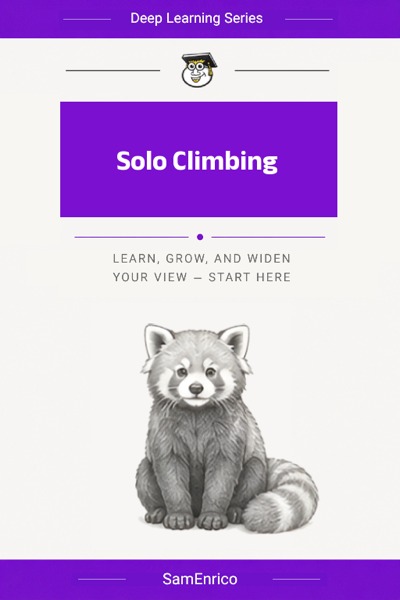
Non-FictionInformativeEducational
Solo Climbing eBook
A Coursebook on Solo Climbing
A Coursebook on Solo Climbing
Formats
Free sample
Chapter 1: The Unforgiving Math...--The first time I stood at the base of a climb I intended to solo, my hands were not shaking. That was the problem. I had climbed this particular route a dozen times with a rope, knew every crystal and scar in the stone, and had told myself that familiarity bred safety. But standing there at dawn, alone, with no rope coiled over my shoulder and no partner to say "you've got this," I felt something I had not anticipated: not fear, but a strange, hollow calm. My hands were steady.
My breathing was slow. And that stillness terrified me more than any tremor could have, because I realized in that moment that I had already decided to climb. I had not asked myself whether I should. I had only asked myself whether I could. The difference between those two questions is the entire subject of this book.Solo climbing is often misunderstood by those who have never done it, and sometimes even by those who have.
Outsiders see it as a single activity, a monolithic act of daring defined by the absence of a rope. But within the climbing community, "soloing" fractures into distinct disciplines, each with its own risk profile, skill requirements, and psychological terrain. Before we go any further, we need to map that terrain together. This chapter introduces the fundamental taxonomy of solo climbing, the psychological drivers that lead climbers to pursue it, and the single most important skill that separates the living soloist from the statistic. That skill has nothing to do with hand strength, footwork, or endurance.
It is the ability to walk away.The Three Paths If you ask a non-climber to picture solo climbing, they will almost certainly imagine a person scaling a vertical wall with no ropes, no gear, nothing between them and the ground but air and nerve. That image is accurate for one discipline: free soloing. But it ignores two other forms of solo climbing that are vastly more common, technically complex, and philosophically distinct.Free Soloing is what most people think of when they hear the word "solo." The climber ascends with no protective equipment whatsoever. No rope. No harness.
No gear that could catch a fall. The only thing between the climber and death is their own ability to hold on. This is the most consequential form of climbing in existence, and it is also the rarest. At any given moment, there are perhaps a few hundred people in the world who free solo with any regularity, and only a handful who do so at advanced grades. Alex Honnold's 2017 free solo of El Capitan's Freerider (5.12d, 3,000 feet) remains the most famous example, but for every Honnold, there are dozens of climbers free soloing moderate routes—5.7 cracks, 5.8 slabs, 30-foot highballs—without ever appearing in a documentary.
Free soloing is not a monolith of daring; it is a spectrum of personal risk tolerance, and most free soloists operate at the low-consequence end of that spectrum, choosing routes where a fall is unlikely and the ground is forgiving.Roped Soloing is the opposite of what the name suggests. The climber uses a rope, a harness, and a mechanical belay device specifically designed for solo use. But unlike climbing with a partner, where another person manages the rope, the rope soloist must be both climber and belayer simultaneously. The rope is anchored at the bottom (for top-rope soloing) or fed through protection placed on the route (for lead soloing). When the climber falls, the device locks and catches them—but only if the system has been set up correctly, which is a genuinely difficult technical skill.
Roped soloing is far more common than free soloing, practiced by hundreds of climbers worldwide who want the solitude and self-reliance of solo climbing without the absolute consequence of a no-fall zone. Andy Kirkpatrick, one of the most accomplished big-wall climbers of his generation, has written extensively about rope soloing techniques, and much of what appears in Part II of this book draws directly from that tradition.Highball Bouldering occupies a gray area between the two. The climber climbs without a rope but with crash pads on the ground below. The route is typically between 15 and 40 feet tall—high enough that a fall could break ankles, wrists, or a spine, but low enough that death is rare. Highball bouldering emerged from the bouldering subculture in places like Bishop, California, and Hueco Tanks, Texas, where climbers pushed the limits of how high they could climb without a rope, relying on pads and spotters to mitigate the fall.
The risk calculus is different from free soloing: the consequence is severe injury rather than death, and the probability of falling is higher because climbers push their physical limits in ways that free soloists cannot afford to. Highball bouldering has its own stars—Jason Kehl, Nalle Hukkataival, and more recently, climbers like Drew Ruana and Brooke Raboutou have pushed the discipline's standards—but it remains distinct from both free soloing and rope soloing.These three paths are not mutually exclusive. Many climbers move between them depending on the day, the route, and their headspace. A climber might free solo a 40-foot crack in the morning (low consequence, low probability), rope solo a 300-foot sport route in the afternoon (high consequence, mitigated by gear), and highball a 25-foot slab in the evening (moderate consequence, moderate probability). The skills transfer, but the mindset requires constant recalibration.
The climber who cannot recalibrate is the climber who gets hurt.The Psychology of One Why would anyone climb alone? This question haunts every soloist, not because we do not have an answer, but because the answer is complicated and often unflattering. The simplest explanation is also the most honest: solitude is beautiful. Climbing with a partner is social, collaborative, and often joyful. But it is also distracting.
You talk. You negotiate. You wait while they place gear or rest or panic. Solo climbing strips all of that away. There is no one to impress, no one to blame, no one to save you.
The only voice is your own.For many soloists, this silence is the goal. The climber and the rock enter a dyad that excludes the rest of the world. Every decision—where to place a foot, when to breathe, whether to commit to a reach—is made in real time by the same person who must live with the consequences. This is not merely independence; it is a kind of radical accountability that is increasingly rare in modern life. Most of us spend our days buffered by systems, teams, and safety nets.
Solo climbing removes the buffers.But self-reliance can curdle into recklessness if it is not held in check by humility. The difference between a soloist and a suicide is not the absence of fear but the presence of a realistic assessment of their own abilities. The healthy soloist knows exactly how hard they can climb, exactly how much risk they are willing to accept, and exactly when to say no. The reckless soloist is driven by ego, by the need to prove something to themselves or others, by the belief that they are the exception to…
This is the end of the free sample. Get the eBook to keep going. Buy now
About this book
Details
- Author
- Crawford Emmett
- Publisher
- SamEnrico
- Language
- English
- Genre
- Non-Fiction, Informative, Educational
- Released
- 2026-05-11
- Pages (approx.)
- 143
- Available as
- eBook, Audiobook

Read better in the ZLOADR app
Your eBooks on your phone or tablet. Sign in with your SamEnrico account and start reading.
More by Crawford Emmett
 Alcoholism and Bipolar DisorderCrawford Emmett$11.99
 The Immigrant Child AdultCrawford Emmett$11.99
 Feeling ExcludedCrawford Emmett$11.99
 Detox Unit Admission GuideCrawford Emmett$11.99
 The Lioness of Kadesh: A Queen’s War for the Hittite EmpireCrawford Emmett$11.99
 Philippines Virtual Assistant Sourcing GuideCrawford Emmett$12.99
 How to Produce a Clean Process OvenCrawford Emmett$11.99
 A Beginners Guide to Scrub baseball (Volume 1)Crawford Emmett$11.99
You may also like
 Hong Kong Handover 1997Dunn Johnnie$11.99
 Zumba For Postnatal Recovery CourseNeal Christian$11.99
 Zumba for BeginnersLadner Nikia$11.99
 YouTube Comment Mining GuideHumes Pandora$12.99
 Worry Box MeditationCarlin Rudy$11.99
 Workplace Stress MeditationNguyen Lynn$11.99
 Workplace Stress and Sleep RepairHawley Ivory$11.99
 Workplace Perfectionism CureDelaney Jeffry$11.99
 Workplace Injustice Anger GuideWallen Isabelle$11.99
 Work Addiction and Burnout LinkGreenwood Ester$11.99
 Women in Yoga and WellnessBeattie Galina$11.99
 Women in Stand Up ComedyChun Evangeline$11.99