
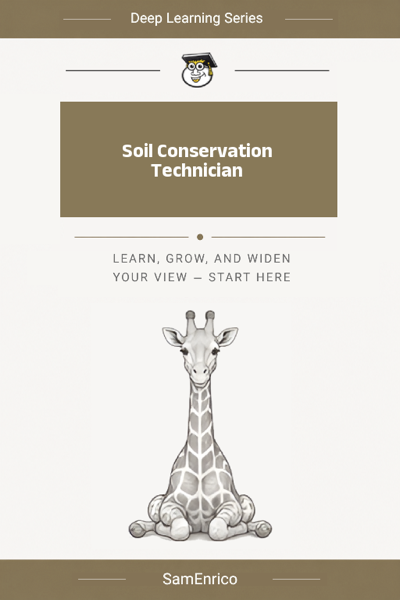
Non-FictionInformativeEducational
Soil Conservation Technician eBook
A Coursebook on Soil Conservation Technician
A Coursebook on Soil Conservation Technician
Formats
Free sample
Chapter 1: The Living Skin--– The first time I watched a hillside bleed, I was twenty-two years old, standing in work boots caked with someone else’s clay, holding a clipboard I barely understood. It wasn’t blood, of course. It was topsoil—black, rich, irreplaceable topsoil—sluicing off a freshly cleared construction site during a spring rain that hadn’t even been heavy enough to cancel a little league game. The water ran brown, then dark brown, then nearly black. Within forty minutes, a small gully had carved itself across the bare slope like a wound that wouldn’t stop weeping.
The property owner stood next to me, arms crossed, and said something I have never forgotten: “I didn’t know dirt could move that fast.”That sentence changed my career. Because the truth is, dirt moves all the time. It moves slowly, invisibly, in sheets so thin you’d need a year of observation to see the change. And it moves catastrophically, in torrents of mud that bury roads, silt in streams, and strip fertility from land that took ten thousand years to build. The difference between those outcomes—between a functioning farm and a gullied wasteland, between a successful construction project and a lawsuit, between a legacy of stewardship and a history of neglect—is the knowledge carried by a soil conservation technician.This book exists because that knowledge is neither common nor optional.
It is the technical, practical, boots-on-the-ground expertise that sits at the intersection of soil science, hydrology, engineering, and human psychology. It is the ability to dig a hole and read a landscape’s history in the color of its horizons. It is the discipline to calculate runoff before a drop of rain falls. It is the wisdom to recommend a cover crop instead of a concrete structure—or the courage to recommend the concrete when the cover crop won’t be enough.Why This Chapter Matters Before you can conserve soil, you must understand what soil actually is. And here lies the first surprise that confronts every new technician: soil is not dirt.
Dirt is what you sweep off a floor. Dirt is displaced, dead, and disconnected. Soil, by contrast, is a living system—perhaps the most complex and underestimated living system on the planet. A single teaspoon of healthy soil contains more individual organisms than there are people on Earth. It breathes.
It filters water. It cycles nutrients. It sequesters carbon. And when it dies—when it is crushed, stripped, burned, or eroded away—it does not come back on any human timescale.This chapter establishes the foundational paradigm for everything that follows. You will learn to distinguish soil quality from soil health, two concepts that are often confused but must be clearly separated for effective conservation work.
You will learn the five major functions that soil performs in every landscape, from the wettest lowland to the driest rangeland. You will receive a working overview of soil taxonomy and texture analysis—not the full academic treatment, but the practical field skills you will use every week. And you will study the Dust Bowl, not as ancient history but as a living warning about what happens when a civilization forgets that soil is finite.The technician takeaway from this chapter is simple and unforgiving: you cannot manage what you do not respect, and you cannot respect what you do not understand. By the time you finish these pages, you will understand soil as a living system. And that understanding will change how you see every field, every hillside, and every raincloud you encounter for the rest of your career.What Soil Really Is: Dispelling the “Dirt” Myth Let us begin with a fundamental reorientation.
Ask a hundred people on the street what soil is, and most will say something like “ground” or “dirt” or “the stuff plants grow in.” These answers are not wrong, but they are dangerously incomplete. Soil is not an inert substance. It is not a simple mixture of mineral particles. It is a dynamic, four-dimensional system that includes solids, liquids, gases, and living organisms, all interacting across time and space.The mineral component of soil—sand, silt, and clay—comes from the physical and chemical weathering of bedrock and transported sediments. But that mineral matrix alone is not soil.
It becomes soil only when organic matter accumulates, when water moves through it, when air circulates among its pores, and when living organisms colonize it. A sterile mixture of crushed rock, no matter how finely ground, will not grow a crop. It will not filter water. It will not sequester carbon. It is geological material, not soil.The living component of soil is astonishing in its density and diversity.
A single gram of agricultural soil typically contains 100 million to 1 billion bacteria, representing thousands of species. It contains up to 200 meters of fungal hyphae. It contains protozoa, nematodes, mites, springtails, earthworms, and arthropods, all organized into a food web more complex than anything visible above ground. These organisms are not incidental. They are the engine of soil function.
Bacteria decompose organic matter and release plant-available nutrients. Fungi bind soil particles into stable aggregates and transport water and phosphorus across distances that would be enormous for their microscopic scale. Earthworms create macropores that channel water deep into the profile. Without these organisms, soil collapses into something closer to sand or dust.This living system performs work. It transforms dead plant material into humus.
It degrades pollutants. It suppresses plant pathogens. It builds structure that resists erosion. And it does all of this constantly, silently, and without human intervention—until human intervention disrupts it.Soil Quality Versus Soil Health: A Critical Distinction One of the first conceptual hurdles for new technicians is understanding the difference between soil quality and soil health. These terms are often used interchangeably in casual conversation, but in technical practice they refer to different things, and confusing them leads to poor conservation decisions.Soil quality refers to the inherent, relatively static properties of a soil that determine its capacity to function.
These properties include texture (the relative proportions of sand, silt, and clay), mineralogy (the types of minerals present in the parent material), depth to bedrock or restrictive layer, and landscape position. Soil quality is largely determined by the natural processes of soil formation—climate, organisms, relief, parent material, and time. You cannot change soil quality in a human lifetime. A clay-rich soil will always behave like a clay-rich soil. A shallow soil over bedrock will always be shallow.
A soil formed from granite will have different properties than a soil formed from limestone.Soil health, by contrast, refers to the dynamic, manageable properties of a soil that determine its current functional status. These properties include organic matter content, aggregate stability, microbial biomass and activity, infiltration rate, bulk density, and available nutrient levels. Soil health responds to management. It can improve within a few years of adopting cover crops, reduced tillage, and diverse rotations. It can decline within a single season of overgrazing, excessive tillage, or heavy equipment traffic on wet soil.Here is where the distinction becomes operationally important.
As a soil conservation technician, you must assess both quality and health. The quality tells you what is possible. A…
This is the end of the free sample. Get the eBook to keep going. Buy now
About this book
Details
- Author
- Legg Floretta
- Publisher
- SamEnrico
- Language
- English
- Genre
- Non-Fiction, Informative, Educational
- Released
- 2026-05-04
- Pages (approx.)
- 146
- Available as
- eBook, Audiobook

Read better in the ZLOADR app
Your eBooks on your phone or tablet. Sign in with your SamEnrico account and start reading.
More by Legg Floretta
 The Darien Gap SurvivorLegg Floretta$11.99
 Antwerp Heist Unanswered QuestionsLegg Floretta$11.99
 Barbara McClintock Jumping Genes GuideLegg Floretta$11.99
 The Safe Fish Mercury CalculatorLegg Floretta$11.99
 Stress and Hot Flashes GuideLegg Floretta$11.99
 The Bone Collector: A Siberian Yeti’s WrathLegg Floretta$11.99
 Paddles Through the Unknown: The Daring Kayak Expedition of the Sulu SeaLegg Floretta$11.99
 How to Become a Circular-sawyer HelperLegg Floretta$11.99
 Understanding Fetal Left Ventricular AneurysmLegg Floretta$17.99
 Frugal Innovation Fit ManualLegg Floretta$12.99
 Remote Team Agreement GuideLegg Floretta$12.99
You may also like
 Hong Kong Handover 1997Dunn Johnnie$11.99
 Zumba For Postnatal Recovery CourseNeal Christian$11.99
 Zumba for BeginnersLadner Nikia$11.99
 YouTube Comment Mining GuideHumes Pandora$12.99
 Worry Box MeditationCarlin Rudy$11.99
 Workplace Stress MeditationNguyen Lynn$11.99
 Workplace Stress and Sleep RepairHawley Ivory$11.99
 Workplace Perfectionism CureDelaney Jeffry$11.99
 Workplace Injustice Anger GuideWallen Isabelle$11.99
 Work Addiction and Burnout LinkGreenwood Ester$11.99
 Women in Yoga and WellnessBeattie Galina$11.99
 Women in Stand Up ComedyChun Evangeline$11.99