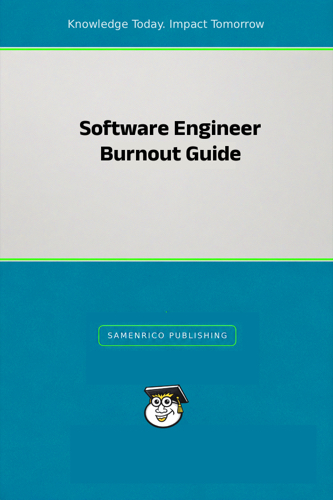
Software Engineer Burnout Guide eBook
Prevent crunch culture exhaustion and maintain sus
by Mayes Marina
Prevent crunch culture exhaustion and maintain sustainable coding practices.
Formats
Free sample
Chapter 1: The Hero Delusion--–- The first time I watched a senior engineer cry in a stairwell, I assumed he had received terrible news. A family emergency, perhaps. A diagnosis. Something from the real world that had punctured the bubble of the office.Instead, he was crying because he had fixed a production outage at 2 AM, slept four hours, and then been told in the morning stand-up that his fix had introduced a new bug. His manager, standing in front of the team, had said: "We really need to be more careful.
Let's not have a repeat of last night."Not "thank you for waking up at 2 AM." Not "good job restoring service." Just a quiet shaming for the second bug that emerged from the exhaustion of the first. The engineer sat through the rest of the meeting with a flat expression, excused himself, and walked to the stairwell where he thought no one could see him.That was my first encounter with the central delusion of the software industry: the belief that heroism is sustainable.The engineer in the stairwell was not weak. He was not lazy. He was not a bad developer. He was, by every measurable standard, the most productive person on the team.
He closed more tickets than anyone else. He answered pages at 3 AM when no one else would. He worked weekends. He was the "10x developer" that management loved to praise.And he was falling apart.This chapter is about why that happens—and why the very behaviors that get you promoted are the ones most likely to destroy you.The Myth of the 10x Developer The "10x developer" is a seductive idea. It suggests that some engineers are simply magical—that they can produce ten times the output of their peers through sheer talent, intuition, and dedication.
The myth appears in job postings ("We're looking for 10x engineers!"), in VC pitches ("Our CTO is a 10x developer"), and in the whispered conversations of engineering managers ("If we could just find another Sarah...").Here is the truth that no one wants to admit: the 10x developer is not a person. It is a system failure wearing a costume.When an engineer appears to be 10x more productive, one of three things is almost always happening. First, they may be working 80 hours while their peers work 40—in which case they are not 10x more efficient, they are simply burning twice the fuel. Second, they may be surrounded by an exceptionally slow baseline—a team drowning in meetings, interruptions, and technical debt—in which case a merely competent engineer looks like a genius. Third, and most dangerously, they may be accruing technical debt faster than anyone else, delivering features now that will require triple the maintenance later.None of these are signs of sustainable excellence.
All of them are warning lights.Let me be precise about what I mean. Research on developer productivity consistently shows that the variance between engineers is real but far smaller than the myth suggests. Studies of code output, bug rates, and feature delivery typically find a 2-3x difference between the 25th and 75th percentiles—significant, yes, but not 10x. The mythical 10x figure usually emerges from studies that count lines of code (a famously useless metric) or that measure output during unsustainable crunch periods.What happens when you examine those same engineers six months later? The gap closes.
The "10x" engineer has burned out, left the company, or is now producing negative value through buggy code that requires constant rework. The steady, boring, reliable engineer is still there, still delivering, still sleeping through the night.I have seen this pattern repeat dozens of times across multiple companies. The engineer who pulls the all-nighter gets the bonus. The engineer who refactors the payment module to prevent future all-nighters gets nothing. The engineer who says "yes" to every deadline becomes the hero.
The engineer who says "we need to reduce scope" becomes the pessimist.The industry's incentive system is perfectly designed to produce burnout.The Hero Cycle: How Organizations Reward Self-Destruction Let me map out the mechanism. I call it the Hero Cycle, and it operates in four stages.Stage one is the Crisis. Something breaks. A deadline is approaching and the team is behind. A competitor launched a feature and now the company must respond.
The pressure rises. Management starts using words like "all hands on deck" and "this is critical."Stage two is the Hero. Someone steps up. They work late. They answer pages on the weekend.
They close tickets at 2 AM. They are visible, vocal, and seemingly indefatigable. Management notices. In the next all-hands, the hero is praised. In the next performance review, they receive an "exceeds expectations." They get the bonus, the promotion, the public recognition.Stage three is the Expectation.
Now that the hero has saved the day once, management expects them to save it always. The baseline shifts. What was once extraordinary becomes ordinary. The hero is now assigned the hardest tickets, the most critical projects, the 3 AM on-call rotation. Their peers, who worked sustainable hours during the crisis, are now seen as "less committed."Stage four is the Collapse.
After months or years of unsustainable output, the hero breaks. They start making mistakes. They become irritable. Their sleep quality collapses. They dread opening their laptop.
Eventually, they quit, go on medical leave, or become so ineffective that they are managed out. The company loses a talented engineer, and the cycle begins again with the next hero.I have watched this cycle destroy careers. I have watched it destroy teams. And I have watched senior executives express genuine confusion about why their "best people" keep burning out.The answer is simple: you rewarded the behaviors that cause burnout and punished the behaviors that prevent it.Focused Energy Versus Manic Urgency To understand why the Hero Cycle is so destructive, we need a better vocabulary. Let me introduce two terms that will appear throughout this book: focused energy and manic urgency.Focused energy is deep, regenerative work done within sustainable parameters.
It looks like this: you arrive at work well-rested. You spend your morning on a single complex problem, with no interruptions, no context switching, no Slack notifications. You take breaks when your focus naturally wanes. You stop at a reasonable hour. You sleep.
You repeat.Focused energy compounds. The work you do on Monday makes Tuesday easier because you wrote clean code, added tests, and documented your assumptions. The month of focused energy makes the next month easier because you reduced technical debt, built reusable tools, and established sustainable patterns. Over years, focused energy produces a career trajectory that is both high-performing and joyful.Manic urgency is the opposite. It is adrenaline-driven, cortisol-soaked output that borrows from future health.
It looks like this: you arrive at work already tired from last night's late session. You drink coffee to compensate. You context-switch between five urgent requests because everything is a fire. You work through lunch. You stay late.
You answer pages at midnight. You sleep poorly. You repeat.Manic urgency collapses. The work you do on Monday creates problems for Tuesday because you wrote sloppy code, skipped tests…
This is the end of the free sample. Get the eBook to keep going. Buy now
About this book
Details
- Author
- Mayes Marina
- Publisher
- SamEnrico
- Language
- English
- Genre
- Non-Fiction, Self-Help, Tech Careers
- Released
- 2026-06-06
- Pages (approx.)
- 141
- Available as
- eBook, Audiobook

Read better in the ZLOADR app
Your eBooks on your phone or tablet. Sign in with your SamEnrico account and start reading.
More by Mayes Marina
 History Dates Chronology GuideMayes Marina$11.99
 Career Transition for ArtistsMayes Marina$11.99
 Proximity Fuse: Radar Miniaturization MiracleMayes Marina$11.99
 Caregiver Self Care BasicsMayes Marina$11.99
 Step Four Personal Inventory CourseMayes Marina$11.99
 Lost Boy Of Dadaab ResettledMayes Marina$11.99
 Disappointment In RetirementMayes Marina$11.99
 First Female Combat PilotMayes Marina$11.99
 The Last Waltz: The Secret Life of Vienna’s Forgotten BallroomsMayes Marina$11.99
 The Labors of Atalanta: The Hunt for the Calydonian BoarMayes Marina$11.99
 Steel and Shadows: The Deadly Design of the Silver BridgeMayes Marina$11.99
 Understanding Arachnodactyly Mental Retardation DysmorphismMayes Marina$17.99