
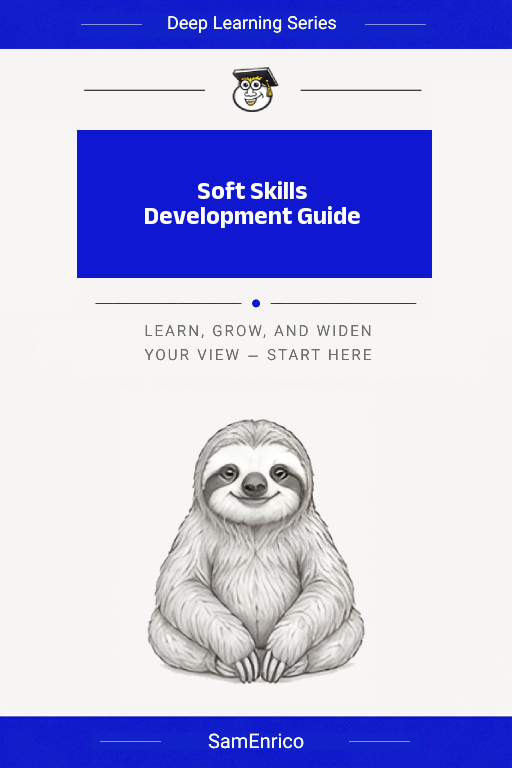
Non-FictionProfessional's Cheat SheetSoft SkillsEQ
Soft Skills Development Guide eBook
Plan soft skill growth for your PDP including comm
Plan soft skill growth for your PDP including communication emotional intelligence and collaboration goals.
Formats
Free sample
Chapter 1: The $1.2 Trillion Mistake--–- You were hired for your hard skills. You will be fired—or, more likely, silently passed over—for your soft ones. Not because you are bad at your job. Because you are vague.Let that land for a moment.You have likely spent years, perhaps decades, accumulating technical expertise. You learned the software, mastered the spreadsheet, memorized the regulations, earned the certification.
You built a fortress of hard skills, believing that each new credential would be the key to the next title, the next salary bump, the next opportunity. And for a while, it worked. Early promotions often reward technical competence. But somewhere along the way—usually between individual contributor and team leader, or between mid-level and senior—the rules changed.You probably felt it before you understood it. The meeting where you had the right answer but said it the wrong way.
The performance review that praised your output but noted "opportunities for leadership presence." The promotion that went to someone with less experience but more polish. The project where your idea was ignored, then someone else said the same thing and was celebrated.This is the Professional Plateau. It is not a wall. It is a ceiling made of glass and silence. You can see where you want to go, but you cannot break through.
And the cruelest part? No one tells you what you are missing. Your manager says, "Be more strategic." Your peers say, "You're fine." Your friends say, "Just be yourself." But "yourself" as you are right now is not winning.This book is not about becoming a different person. It is about becoming a more intentional version of the person you already are. And it starts with a single, uncomfortable truth: Your technical genius will not save you.The $1.2 Trillion Elephant in the Room Let us begin with a number so large it almost loses meaning: $1.2 trillion.
That is the estimated annual cost of miscommunication in the U.S. workforce, according to research from CRM platform Salesforce and various organizational behavior studies. To put that number in perspective, it is larger than the GDP of most countries. It represents lost productivity, duplicated work, missed deadlines, broken deals, and the slow erosion of trust that happens when people fail to understand one another.But the true cost is not measured in dollars alone. It is measured in stalled careers.A multi-year study by the Carnegie Institute of Technology found that 85 percent of financial success comes from personality and ability to communicate, negotiate, and lead.
Only 15 percent comes from technical knowledge. Think about that. The skills that most professionals spend 85 percent of their education and training developing account for only 15 percent of their career success. The remaining 85 percent of success comes from skills that are rarely taught, rarely measured, and rarely discussed in performance reviews—until they become the reason you are not advancing.Harvard University, the Carnegie Foundation, and the Stanford Research Institute have all reached similar conclusions. Technical skills and cognitive abilities (IQ) are threshold competencies.
They get you in the door. But emotional intelligence (EQ) and social skills are differentiating competencies. They determine how far you go once you are inside.The data is relentless. A study of 358 managers by the Center for Creative Leadership found that the primary cause of executive derailment (being fired, demoted, or plateaued) is not lack of technical skill. It is interpersonal deficiencies: insensitivity, arrogance, poor conflict management, and an inability to build trust.
In other words, smart people fail not because they stop being smart. They fail because they never learned to be effective with other people.The Myth of "Soft" Skills The term "soft skills" is itself a problem. It implies something gentle, optional, secondary—the garnish on the plate rather than the meal. The word "soft" suggests that these abilities are squishy, unmeasurable, and somehow less real than "hard" skills. This linguistic bias has done enormous damage to careers.
When organizations say they value "soft skills," they often mean they tolerate them. But when promotion time comes, they reward technical excellence and then wonder why their newly promoted manager cannot lead.Throughout this book, we will use a different term: power skills. Not because it is more marketable (though it is), but because it is more accurate. Communication, emotional intelligence, and collaboration are not soft. They are hard.
They are difficult to master, easy to lose under pressure, and brutally unforgiving when absent. A missing technical skill might cause a calculation error. A missing power skill might cause a team to implode, a client to leave, or a career to stall for years.Consider the difference. If you make a technical mistake—a bug in code, a typo in a contract, an error in a financial model—the problem is visible. Someone catches it.
You fix it. You move on. But if you make a power skill mistake—interrupting a colleague, dismissing an idea, failing to read the room in a tense meeting—the damage is often invisible. No one sends an email saying, "When you rolled your eyes during Jessica's presentation, you lost her trust for the next six months." No one puts on your performance review, "Your tendency to solve before listening cost the team three good ideas this quarter." The damage accumulates silently, like plaque in an artery, until one day there is a blockage and no one can explain why.That is the Professional Plateau. It is not a single failure.
It is the compound interest of a thousand small relational missteps.Introducing the Career GPS Matrix If you are going to escape the plateau, you need more than motivation. You need a map. This chapter introduces the first of several frameworks you will use throughout the 12-week sprint: the Career GPS Matrix.The matrix is simple but powerful. It has three columns and three rows.The three columns represent the core power skill clusters we will develop in this book:Communication (speaking, writing, presenting, listening)Emotional Intelligence (self-awareness, self-regulation, empathy, social skill)Collaboration (teamwork, conflict resolution, trust-building, influence)The three rows represent your career horizons:Current Role (where you are today)Next Role (the position you want within 12–24 months)Long-Term Aspiration (where you want to be in 3–5 years)Here is how you use it. On a piece of paper (or using the downloadable worksheet), draw a 3x3 grid.
For each of the nine cells, rate yourself from 1 (critically underdeveloped) to 10 (world-class). Then answer one question per cell: "What specific behavior would change if I were one point higher here?"For example, consider the intersection of Emotional Intelligence and Next Role. You might rate yourself a 5. Then you ask: what would a 6 look like? Perhaps: "I would pause for five seconds before responding in heated meetings." That is a specific, observable behavior.
That is something you can practice.The Career GPS Matrix does three things. First, it reveals where you are overconfident. Most people rate themselves highly on "communication" but cannot name the last time they asked a clarifying question. Second, it reveals where you are underinvesting. Many professionals spend zero hours per week on power skill development, then wonder why they are not growing.
Third, it creates a personalized roadmap. The gap between your current rating and your desired rating is not a weakness.…
This is the end of the free sample. Get the eBook to keep going. Buy now
About this book
Details
- Author
- Thomsen Rachell
- Publisher
- SamEnrico
- Language
- English
- Genre
- Non-Fiction, Professional's Cheat Sheet, Soft Skills, EQ
- Released
- 2026-05-30
- Pages (approx.)
- 146
- Available as
- eBook, Audiobook

Read better in the ZLOADR app
Your eBooks on your phone or tablet. Sign in with your SamEnrico account and start reading.
More by Thomsen Rachell
 TM Podcast Listening GuideThomsen Rachell$11.99
 Toddler Bedtime Battles GuideThomsen Rachell$11.99
 Brazilian Green Tax Credits CourseThomsen Rachell$11.99
 Men's Myocarditis Recovery GuideThomsen Rachell$11.99
 Summit of Shadows: The Forgotten Climbers of Everest's Golden AgeThomsen Rachell$11.99
 Innocence Project North Carolina CasesThomsen Rachell$11.99
 The Silent Choir: How a Music Cult Planned the End of the WorldThomsen Rachell$11.99
 World Record BreakingThomsen Rachell$11.99
 Police Certificate for EEThomsen Rachell$12.99
 Understanding Chromosome 17 DeletionThomsen Rachell$17.99
 How to Become a Calender-roll Press OperatorThomsen Rachell$11.99
You may also like
 Hong Kong Handover 1997Dunn Johnnie$11.99
 Zumba For Postnatal Recovery CourseNeal Christian$11.99
 Zumba for BeginnersLadner Nikia$11.99
 YouTube Comment Mining GuideHumes Pandora$12.99
 Worry Box MeditationCarlin Rudy$11.99
 Workplace Stress MeditationNguyen Lynn$11.99
 Workplace Stress and Sleep RepairHawley Ivory$11.99
 Workplace Perfectionism CureDelaney Jeffry$11.99
 Workplace Injustice Anger GuideWallen Isabelle$11.99
 Work Addiction and Burnout LinkGreenwood Ester$11.99
 Women in Yoga and WellnessBeattie Galina$11.99
 Women in Stand Up ComedyChun Evangeline$11.99