
Non-FictionSelf-HelpSocial Dynamics
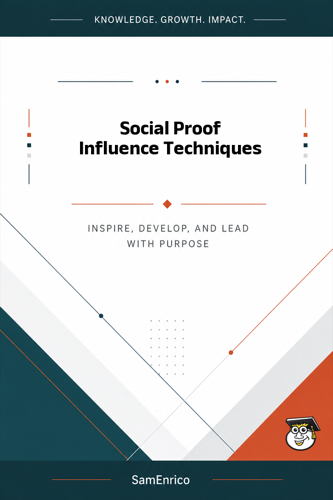
Social Proof Influence Techniques eBook
Uses testimonials, reviews, and crowd behavior to
Uses testimonials, reviews, and crowd behavior to persuade.
Formats
Free sample
Chapter 1: The Silent Persuader--–- It operates in the space between your thoughts, invisible and relentless. You cannot see it, but it sees you. It whispers to you through the behavior of strangers, the choices of crowds, and the accumulated judgment of millions who will never know your name. By the time you finish this chapter, it will have influenced you at least three times without your conscious awareness. That is not a prediction.
That is a measurement.This invisible force is called social proof, but that clinical term disguises its true nature. Social proof is not merely evidence that others have taken an action. It is a psychological override switch—a mechanism that can bypass your rational mind, subvert your preferences, and redirect your behavior toward the safety of the herd. It is the silent persuader that has shaped human decisions for two hundred thousand years, and it is more powerful today than at any point in human history.Consider a simple experiment conducted by behavioral scientists in the 1970s. Researchers stood on a busy New York City street and looked up at the sky.
That was it. They did not point. They did not speak. They simply tilted their heads back and gazed upward. Within sixty seconds, passersby began stopping and looking up as well.
Within five minutes, a crowd had formed, all staring at nothing. When the researchers finally asked the gathered strangers what they were looking at, most admitted they did not know. They had looked up because everyone else was looking up.This is the silent persuader in its purest form. No advertisement. No sales pitch.
No conscious decision. Just the automatic, irresistible pull of the crowd. The same mechanism that made New Yorkers stare at an empty sky makes you check which restaurant has a line, which product has the most reviews, and which book is on the bestseller list. It is the hidden architecture of influence, and once you understand how it works, you will see it everywhere.This chapter will strip away the mystery of social proof and reveal its mechanical core. You will learn why the human brain is wired to follow the crowd even when the crowd is obviously wrong.
You will discover the two distinct forms of social proof that operate in different situations and how to identify which one is influencing you at any given moment. You will understand the neurological shortcuts that make social proof nearly impossible to resist and the conditions under which it backfires catastrophically. And you will begin to see the silent persuader not as an abstract concept but as a tangible force that shapes your daily decisions—whether you know it or not.The Wiring of the Herd Animal To understand social proof, you must first abandon a comforting fiction: that you are a rational, independent thinker who makes decisions based on careful analysis of available information. You are not. No human is.
The rational actor model beloved by economists and classical philosophers is a myth—a useful approximation for certain mathematical models, but a poor description of how actual human beings navigate the world.The reality is far messier and far more interesting. Your brain is not a supercomputer designed for objective truth-seeking. It is a survival organ shaped by millions of years of evolutionary pressure. And the primary pressure was not accuracy. It was speed.Consider the environment in which the human brain evolved.
You are a hominid on the African savanna. You hear a noise in the tall grass. You have milliseconds to decide whether to run. You do not have time to investigate the noise, analyze the threat level, or consult external data sources. You have time for one thing only: a heuristic.
A mental shortcut that gives you a fast, dirty answer to the question "Should I be afraid?"The most reliable heuristic available to your ancient ancestor was the behavior of other humans. If the group was relaxed, the noise was probably the wind. If the group was running, the noise was probably a predator. The human who stopped to verify the threat did not live long enough to become anyone's ancestor. The human who imitated the crowd survived.This is the evolutionary foundation of social proof.
It is not a bug in the human operating system. It is a feature—a survival adaptation that worked so well for so long that it became deeply embedded in the neural architecture of every human being alive today. You do not follow the crowd because you are weak-willed or easily manipulated. You follow the crowd because your ancestors who followed the crowd lived, and your ancestors who did not died.The psychologist Robert Cialdini, whose work forms the backbone of modern influence science, called this principle "social proof" in his seminal book Influence: The Psychology of Persuasion. But the term has always been slightly misleading.
Proof implies evidence. Evidence implies a rational evaluation. Social proof is not rational. It is reflexive. It is the brain's default response to uncertainty, and it operates below the threshold of conscious awareness.This is why social proof is so effective as a persuasion tool.
You cannot argue with someone about a decision they did not consciously make. You cannot reason someone out of a position they did not reason themselves into. Social proof works in the shadows of the mind, and by the time the light of conscious awareness arrives, the decision has already been made.The Two Engines of Conformity Not all social proof operates the same way. Psychologists have identified two distinct pathways through which the behavior of others influences individual decisions. Understanding the difference between these pathways is essential for both deploying social proof effectively and recognizing when you are being influenced by it.The first pathway is informational social proof.
This occurs when the correct course of action is genuinely ambiguous. You do not know what to do, so you look to others for information. Their behavior becomes your data. Their choices become your evidence.Imagine you are walking through an unfamiliar city and you need to find a place to eat lunch. You see two restaurants across the street from each other.
One is empty. One has a line out the door. Which do you choose? The empty one, if you have independent knowledge that the food is excellent. But you do not.
You have no information except the behavior of other diners. So you choose the one with the line, because you assume that the crowd knows something you do not.This is informational social proof. It is not irrational. In fact, under conditions of genuine uncertainty, following the crowd is often a reasonable strategy. The crowd may have access to information you lack.
The crowd may have experience you do not possess. The crowd may have collectively solved a problem that you are facing alone.The problem is that informational social proof works even when the crowd has no special information at all. Consider the Columbia University music study mentioned in the previous chapter. The researchers created a fake download site where the "popularity" of songs was randomly assigned. Visitors who saw a song labeled as popular…
This is the end of the free sample. Get the eBook to keep going. Buy now
About this book
Details
- Author
- Jarrell Winnie
- Publisher
- SamEnrico
- Language
- English
- Genre
- Non-Fiction, Self-Help, Social Dynamics
- Released
- 2026-06-05
- Pages (approx.)
- 136
- Available as
- eBook, Audiobook

Read better in the ZLOADR app
Your eBooks on your phone or tablet. Sign in with your SamEnrico account and start reading.
More by Jarrell Winnie
 Wings Visualization Escape GuideJarrell Winnie$11.99
 Executor Duties GuidebookJarrell Winnie$11.99
 Hypnosis For Driving AngerJarrell Winnie$11.99
 Europe Spending Trends GuideJarrell Winnie$11.99
 The Iron Crown: Bismarck's Gamble at SedanJarrell Winnie$11.99
 Understanding Osteoporosis Oculocutaneous Hypopigmentation SyndromeJarrell Winnie$17.99
 Beta Access Terms HandbookJarrell Winnie$12.99
 Chinese New Student Assessment GuideJarrell Winnie$12.99
 Warehouse General LaborJarrell Winnie$11.99
 How to Start a Ballotini Business (Beginners Guide)Jarrell Winnie$11.99
You may also like
 Hong Kong Handover 1997Dunn Johnnie$11.99
 Zumba For Postnatal Recovery CourseNeal Christian$11.99
 Zumba for BeginnersLadner Nikia$11.99
 YouTube Comment Mining GuideHumes Pandora$12.99
 Worry Box MeditationCarlin Rudy$11.99
 Workplace Stress MeditationNguyen Lynn$11.99
 Workplace Stress and Sleep RepairHawley Ivory$11.99
 Workplace Perfectionism CureDelaney Jeffry$11.99
 Workplace Injustice Anger GuideWallen Isabelle$11.99
 Work Addiction and Burnout LinkGreenwood Ester$11.99
 Women in Yoga and WellnessBeattie Galina$11.99
 Women in Stand Up ComedyChun Evangeline$11.99