
Non-FictionHealth & WellnessSocial Health
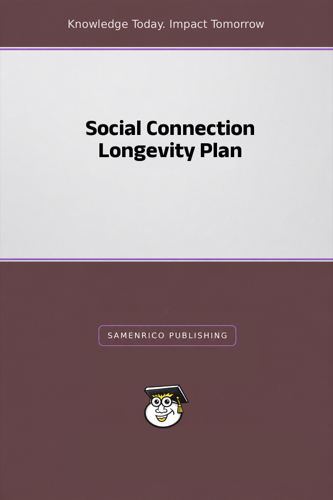
Social Connection Longevity Plan eBook
Join clubs, volunteer, and schedule weekly calls t
Join clubs, volunteer, and schedule weekly calls to combat isolation.
Formats
Free sample
Chapter 1: The 50% Increased Risk...--–- Feeling lonely is as biologically dangerous as smoking fifteen cigarettes a day. Let that land for a moment. If a doctor told you that you had a habit equivalent to packing your lungs with tar and nicotine every morning, you would quit immediately. You would buy nicotine patches, join a support group, download a quitting app, and tell everyone you know that you were finally done. And yet, when it comes to loneliness—a condition that the United States Surgeon General has declared an epidemic, a condition that increases your risk of premature death by fully 50 percent—most people shrug.
They say, "I'm fine." They say, "I'm just busy." They say, "I'll call them later." They do nothing.This chapter exists to make that shrugging impossible. It will reframe loneliness not as a sad feeling to be dismissed, but as an ancient evolutionary alarm system—like hunger, thirst, or pain—that signals a critical threat to your survival. When this alarm rings briefly, it motivates you to reconnect. But when it rings chronically, it becomes toxic, triggering a cascade of hormonal and inflammatory responses that shorten your life, weaken your immune system, and accelerate cognitive decline. By the end of this chapter, you will understand exactly how isolation is damaging your body, you will have taken the Social Stress Test to measure your current Social Health Quotient, and you will have a baseline metric against which to measure your progress through the rest of this book.The Stealth Killer: Why Loneliness Isn't Just Sadness Let us start with a definition.
Loneliness is not the same as being alone. Solitude—chosen, temporary, restorative time by yourself—can be deeply healthy. Many of the world's great thinkers, artists, and leaders have treasured their alone time. The problem is not solitude. The problem is chronic, unwanted isolation: the gnawing sense that you are disconnected, that no one truly knows you, that if you disappeared tomorrow, it might take days or weeks for anyone to notice.This perception of isolation—feeling lonely even while surrounded by people—is often more damaging than objective isolation.
The brain does not distinguish between "alone in a room" and "alone in a crowd" when it comes to stress responses. If you feel lonely, your body reacts as if you are in danger, regardless of how many people are physically present.Consider the landmark Harvard Study of Adult Development, which has followed 724 men for over eighty years—the longest longitudinal study of human happiness ever conducted. The study's director, Dr. Robert Waldinger, has summarized its findings simply: "The people who were the most satisfied in their relationships at age 50 were the healthiest at age 80." Not cholesterol levels. Not exercise habits.
Not income. Relationships. The study found that chronic loneliness is as toxic to long-term health as high blood pressure, obesity, and smoking. In fact, the study's data showed that lonely people experienced faster cognitive decline, more physical pain, and shorter lifespans—even when their diet and exercise routines were identical to their socially connected peers.Global aging studies, synthesized in the book Healthy to 100, have reached the same conclusion across multiple cultures. In the Blue Zones—places like Okinawa, Japan; Sardinia, Italy; and Nicoya, Costa Rica, where people routinely live past 100—the common denominator is not a specific diet or exercise regimen.
It is social connection. Okinawans have moai—small, committed friend groups that meet for life. Sardinians have daily piazza gatherings where elders are visible, valued, and included. Nicoyans have strong intergenerational households where no one eats alone. These are not coincidences.
They are data points pointing to a single, inescapable truth: your social health is a primary determinant of your physical health.The Biology of Broken Bonds: What Happens Inside Your Body To understand why loneliness kills, you must understand the hypothalamic-pituitary-adrenal axis—the HPA axis for short. This is your body's central stress response system. When your brain perceives a threat, the hypothalamus releases corticotropin-releasing hormone, which signals the pituitary gland to release adrenocorticotropic hormone, which tells your adrenal glands to flood your body with cortisol.Cortisol is not inherently bad. In short bursts, it saves your life. It sharpens your focus, mobilizes energy, and suppresses non-essential functions so you can fight or flee a predator.
The problem is that the human brain evolved to perceive social disconnection as a predator. Ten thousand years ago, being cast out of your tribe meant death. You could not hunt alone, gather alone, or defend yourself alone. Your brain therefore developed a powerful alarm: loneliness equals danger. When you felt lonely, your cortisol spiked, and you were motivated to rejoin the group.But here is the cruel irony of modern life.
The alarm never shuts off because the disconnection never ends. You are not cast out of a single tribe; you are algorithmically isolated by a society that prioritizes efficiency over intimacy. Your cortisol stays elevated. Chronically. Permanently.
And sustained high cortisol is a slow poison.Elevated cortisol does three terrible things to your body over time. First, it causes systemic inflammation. Cortisol suppresses the immune system's regulatory mechanisms, leading to a state of chronic, low-grade inflammation throughout your body. This inflammation damages blood vessels, weakens joints, and has been linked to depression, anxiety, and autoimmune disorders. Inflammatory markers like C-reactive protein are consistently higher in lonely people than in their socially connected peers—even when they report the same physical health status.Second, chronic cortisol exposure shortens your telomeres.
Telomeres are the protective caps at the ends of your chromosomes, like the plastic tips on shoelaces that prevent fraying. Every time a cell divides, its telomeres get slightly shorter. When telomeres become too short, the cell can no longer divide and either dies or becomes senescent—a zombie cell that leaks inflammatory chemicals into surrounding tissue. Loneliness accelerates telomere shortening. Studies have shown that lonely people have telomere lengths equivalent to someone five to ten years older.
You are not just feeling older; you are biologically aging faster.Third, cortisol remodels your brain. Chronic stress shrinks the prefrontal cortex—the region responsible for decision-making, social behavior, and impulse control—while enlarging the amygdala, the brain's fear center. This means that lonely people become more socially anxious over time, not less. They perceive threats where none exist. A neutral facial expression becomes a rejection.
A missed text becomes an insult. A canceled plan becomes proof that no one likes them. The brain literally rewires itself to expect isolation, creating a self-fulfilling prophecy that drives the lonely person further into withdrawal.The Four Types of Loneliness: Why You Might Be Lonely and Not Know It Most people think loneliness is simple: either you have friends or you do not. But the research reveals a more nuanced picture. The Social Stress Test, which you will take at the end of this chapter, measures four distinct types of loneliness.
You may suffer from one, two, or all four. Understanding which type affects you is the first step toward targeted action.Emotional Loneliness is the absence of a single close confidant. This is the person you would call at three in the morning if your car broke down…
This is the end of the free sample. Get the eBook to keep going. Buy now
About this book
Details
- Author
- Shaffer Ressie
- Publisher
- SamEnrico
- Language
- English
- Genre
- Non-Fiction, Health & Wellness, Social Health
- Released
- 2026-06-11
- Pages (approx.)
- 152
- Available as
- eBook, Audiobook

Read better in the ZLOADR app
Your eBooks on your phone or tablet. Sign in with your SamEnrico account and start reading.
More by Shaffer Ressie
 Metta for Healthcare Workers GuideShaffer Ressie$11.99
 Recovery Sponsee GuideShaffer Ressie$11.99
 Self Talk Rewiring GuideShaffer Ressie$11.99
 Beginner Mindfulness for Cancer PatientsShaffer Ressie$11.99
 The Great Chocolate Heist: How a Kid Outsmarted the WorldShaffer Ressie$11.99
 How to Become a Die-drawing CheckerShaffer Ressie$11.99
 Maintenance AttendantShaffer Ressie$11.99
 Türkiye Scholarships GuideShaffer Ressie$12.99
 FDA Software Regulation GuideShaffer Ressie$12.99
 Understanding Degos DiseaseShaffer Ressie$17.99
You may also like
 Hong Kong Handover 1997Dunn Johnnie$11.99
 Zumba For Postnatal Recovery CourseNeal Christian$11.99
 Zumba for BeginnersLadner Nikia$11.99
 YouTube Comment Mining GuideHumes Pandora$12.99
 Worry Box MeditationCarlin Rudy$11.99
 Workplace Stress MeditationNguyen Lynn$11.99
 Workplace Stress and Sleep RepairHawley Ivory$11.99
 Workplace Perfectionism CureDelaney Jeffry$11.99
 Workplace Injustice Anger GuideWallen Isabelle$11.99
 Work Addiction and Burnout LinkGreenwood Ester$11.99
 Women in Yoga and WellnessBeattie Galina$11.99
 Women in Stand Up ComedyChun Evangeline$11.99