
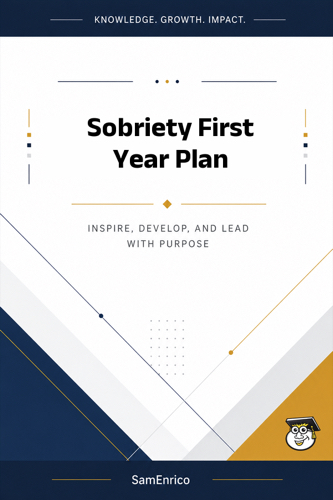
Non-FictionSelf-HelpMilestone Planning
Sobriety First Year Plan eBook
Structures milestone-by-milestone recovery through
Structures milestone-by-milestone recovery through initial 12 months.
Formats
Free sample
Chapter 1: The Collision Point--–- You are not here because you are weak. You are here because you have finally stopped lying to yourself.The difference matters more than you know. For weeks, months, or perhaps years, you have been collecting evidence. A blackout here. A promise broken there.
A morning spent calculating how much you drank versus how much you can pretend you drank. Your brain has been running a quiet cost-benefit analysis in the background, and today – right now, in this moment – the ledger has finally tipped.This is not a rock-bottom memoir. This is not a shame spiral. This is the exact millisecond when the escape hatch closes and the real work begins. Whatever brought you to this page – a DUI, a child's question, a doctor's raised eyebrow, a partner's silence that screams louder than any argument, or simply the exhaustion of waking up hungover for the ten-thousandth time – that event is not your enemy.
It is your catalyst. And catalysts, in the right hands, become rocket fuel.The title of this book is The First Year Plan, and it is called a plan for a reason. Most recovery approaches ask you to surrender to a vague, open-ended future. "One day at a time," they say. And that wisdom has saved lives.
But for many of you – the overachievers, the planners, the people who have built careers and families and entire identities on the illusion of control – "one day at a time" feels less like freedom and more like falling. You need a map. You need milestones. You need to know that on Day 47, when the anhedonia hits and the world feels beige, that is not a personal failure but a predictable neurochemical event. That is what this book provides: a month-by-month, milestone-by-milestone roadmap through the first 365 days.This chapter is called The Collision Point because that is where you are standing.
The collision between your old life – the one where alcohol was the solution, the reward, the coping mechanism, the social lubricant, the emotional anesthesia – and your new life, which you cannot yet see but can no longer pretend you do not need. The collision hurts. It is supposed to hurt. Pain is the alarm system that tells you something has broken. You have not broken.
Your relationship with an addictive substance has broken. Those are two very different things.Before we go any further, let us clear something off the table. This book will not ask you to label yourself an "alcoholic." That word carries a century of moral judgment, medical ambiguity, and cultural baggage. Some of you will find it useful. Some of you will find it shame-inducing.
Most of you will fall somewhere in the gray area – the vast middle ground where drinking has clearly become a problem but does not look like the television version of addiction. You drink too much, too often. You cannot reliably stop once you start. You have tried moderation and failed. You have woken up with intentions that evaporated by 6 PM.
You have promised yourself "never again" and meant it, only to find a glass in your hand three days later.That is not a character flaw. That is the Alcohol Deprivation Effect, which we will cover in Chapter 3, and it is as predictable as gravity. Your brain is not broken. It is doing exactly what evolution designed it to do when a substance that floods it with dopamine becomes scarce – it ramps up wanting. The difference between you and someone who "does not have a drinking problem" is not willpower.
It is neurochemistry and exposure frequency. Alcohol is an addictive substance. Given enough exposure, enough repetition, enough genetic loading, anyone's brain will adapt to expect it. Yours did. That is not a moral failure.
It is biology.So here is the deal you are making by reading this chapter. You are going to commit to thirty days. Not forever. Not "one day at a time" until you die. Thirty days.
Thirty sunrises. Thirty nights of sober sleep. That is a finite, measurable, achievable goal. And at the end of those thirty days, you are going to complete a worksheet that asks you one question: Is your life better? If the answer is no, this book has failed you, and you can return to drinking with my full blessing and a refund.
If the answer is yes – even a tentative, complicated, messy yes – then you will have the data you need to make the next decision.But we are getting ahead of ourselves. You are still at the Collision Point. You have not yet survived the first weekend. You have not yet told a single person that you are stopping. You have not yet faced the 6 PM craving that has defeated you a hundred times before.
This chapter is going to give you three things: a tool to quantify exactly what alcohol has cost you, a decision framework for whether to tell the world or keep quiet, and a strategy for surviving the "morning resolve" phenomenon that has killed more good intentions than any hangover. Let us begin.The Yikes Moment: Why Your Catalyst Is Not Your Shame Every person who stops drinking has a "yikes" moment. It is the specific event that broke the denial. For some, it is dramatic: a handcuff, a hospital bed, a car wrapped around a tree. For most, it is mundane: looking at your own face in the bathroom mirror at 3 AM and not recognizing the person staring back.
Reading a text you sent that you do not remember writing. Realizing that you have not had a single honest conversation in years because you were always at least two drinks in.Your yikes moment is not your enemy. It is the only honest friend you have.Denial is not a river in Egypt. Denial is the brain's protective mechanism against the unbearable weight of cognitive dissonance – the gap between who you think you are and what you actually do. Your brain has been working overtime to close that gap by minimizing, rationalizing, comparing, and forgetting.
"I am not as bad as my father." "I only drink wine, not liquor." "I have never missed a day of work." "I only drink after 5 PM." These are not lies. They are half-truths, and half-truths are more dangerous than lies because they contain just enough reality to be convincing.The yikes moment is when the half-truths stop working. Something happens that cannot be minimized. A blackout that lasted six hours. A child who says, "Mommy, you smell weird again." A credit card statement that shows you spent $600 on alcohol last month.
A doctor who says your liver enzymes are elevated. A partner who says, "I love you, but I am not sure I like you anymore."Your job right now is to write that moment down. Not in your head – on paper. Or on your phone. Or in the margin of this book.
The specificity matters. "I drink too much" is a thought. "On March 12th, I missed my daughter's school play because I was too hungover to drive" is an event. Events are real. Thoughts are abstractions that your brain can argue with.
You cannot argue with March 12th.Here is the worksheet. Answer these three questions:What happened? Describe the yikes moment in one…
This is the end of the free sample. Get the eBook to keep going. Buy now
About this book
Details
- Author
- Wilkinson Shaunda
- Publisher
- SamEnrico
- Language
- English
- Genre
- Non-Fiction, Self-Help, Milestone Planning
- Released
- 2026-06-06
- Pages (approx.)
- 123
- Available as
- eBook, Audiobook

Read better in the ZLOADR app
Your eBooks on your phone or tablet. Sign in with your SamEnrico account and start reading.
More by Wilkinson Shaunda
 Hospitality Sector Transaction GuideWilkinson Shaunda$11.99
 Binge Eating and ADHD MedicationWilkinson Shaunda$11.99
 Ayurvedic Oral HealthWilkinson Shaunda$11.99
 Background Noise InfluenceWilkinson Shaunda$11.99
 Police Suggestion and Contaminated LineupsWilkinson Shaunda$11.99
 Cholesterol and DementiaWilkinson Shaunda$11.99
 Omega 3 SADWilkinson Shaunda$11.99
 Gaugamela: Alexander's Lightning Strike Against DariusWilkinson Shaunda$11.99
 The Iron Spine: Eiffel and the Birth of Modern EngineeringWilkinson Shaunda$11.99
 Service Providers Guide to Gas Leak RepairWilkinson Shaunda$11.99
 How to Produce Textile and Leather ProductsWilkinson Shaunda$11.99
 How to Produce Horse Grooming Combs, Brushes and MittsWilkinson Shaunda$11.99
You may also like
 Hong Kong Handover 1997Dunn Johnnie$11.99
 Zumba For Postnatal Recovery CourseNeal Christian$11.99
 Zumba for BeginnersLadner Nikia$11.99
 YouTube Comment Mining GuideHumes Pandora$12.99
 Worry Box MeditationCarlin Rudy$11.99
 Workplace Stress MeditationNguyen Lynn$11.99
 Workplace Stress and Sleep RepairHawley Ivory$11.99
 Workplace Perfectionism CureDelaney Jeffry$11.99
 Workplace Injustice Anger GuideWallen Isabelle$11.99
 Work Addiction and Burnout LinkGreenwood Ester$11.99
 Women in Yoga and WellnessBeattie Galina$11.99
 Women in Stand Up ComedyChun Evangeline$11.99