
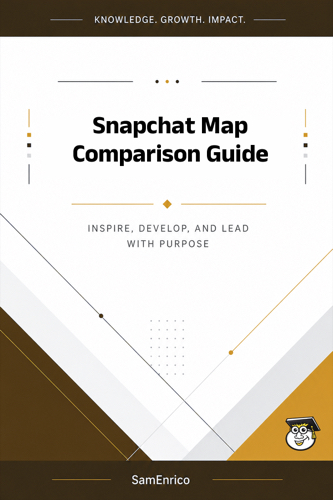
Non-FictionSelf-HelpLocationFOMO
Snapchat Map Comparison Guide eBook
Stop comparing your social activity to friends' lo
Stop comparing your social activity to friends' locations shown on Snap Map.
Formats
Free sample
Chapter 1: The Ghost in Your Pocket--–- The first time Maya realized she had a problem, she was lying on her bedroom floor at 10:47 PM on a Friday, her phone screen illuminating the ceiling above her. Her friends’ Bitmojies were clustered together like a constellation she couldn’t reach—three of them at a rooftop bar she’d never heard of, two more at a bowling alley six blocks away, and one, her “best friend” since sixth grade, sitting stationary for the past forty-seven minutes at an apartment complex she didn’t recognize. Maya wasn’t supposed to be tracking the duration. But she was. And that was the problem.This book is not about quitting Snapchat.
Let me say that again, because it matters: You do not need to delete the app, throw your phone into a river, or move to a cabin in the woods without Wi-Fi. The goal here is not abstinence. The goal is mastery. You are about to learn how to stop using Snap Map as a mirror that reflects your worst fears about yourself and start using it as a tool—one you control, not one that controls you.But before we get to solutions, we have to understand the problem. And the problem, simply put, is this: Snap Map has introduced a new kind of anxiety into modern life, one that your brain evolved to feel but did not evolve to handle.
I call it Spatial FOMO—the fear of missing out that is triggered not by what you missed in the past, but by where other people are right now. It is real-time, geographic, and uniquely relentless.The Invention of a New Emotion Let me take you back to 2017. Snapchat released a feature called Snap Map. At the time, it seemed harmless—even fun. You could see where your friends were, share your own location if you wanted, and discover what was happening in your city.
The marketing materials made it look like a digital adventure: colorful heatmaps, playful Bitmojies doing little animations, a way to feel connected to the people you cared about.But something unexpected happened. Within eighteen months, therapists began noticing a new complaint among young patients. They weren’t reporting typical social media anxiety—the kind that comes from comparing your life to carefully curated Instagram photos. They were reporting something stranger, something more visceral. They were talking about the map.“I can’t stop checking where my ex is.”“I saw my friends hanging out without me.
They were four blocks away.”“I turned on Ghost Mode, and now I feel like I’m disappearing.”“My mom checks my location every night at 2 AM. I’m in college.”These weren’t isolated stories. They were patterns. And they pointed to a fundamental truth about human psychology that Snapchat had accidentally (or perhaps deliberately) exploited: We are not wired to know where everyone we know is at all times.For 99.9 percent of human history, you had no idea where your friends were unless you were with them, had arranged to meet them, or received a letter that arrived three days late. The uncertainty was baked into life.
And that uncertainty served a purpose: it protected you from comparison spirals, from the constant evaluation of your social standing, from the exhausting work of tracking everyone else’s movements.Snap Map removed that uncertainty. And in doing so, it removed the protective barrier that had always existed between you and the painful awareness of where you stood in your social world.The Story of Maya (And Why She Sounds Like You)Let me tell you more about Maya, because her story is the reason this book exists. I met Maya (not her real name) through a friend of a friend who knew I was researching digital anxiety. Maya was twenty-two, a recent college graduate working an entry-level marketing job, living in a small apartment with two roommates. By any objective measure, her life was fine.
She had friends, a job, a family that loved her. But she was miserable.The source of her misery, she eventually admitted, was Snap Map.“I check it about thirty times a day,” she told me. “Maybe more. I don’t even realize I’m doing it half the time. I’ll be watching TV and suddenly my thumb has opened the map and I’m zooming in on someone’s Bitmoji.”The pattern was always the same.
She would see something that made her feel bad—friends at a bar without her, a coworker at a concert she couldn’t afford, an old classmate on a beach in Mexico—and she would feel a spike of anxiety. Then she would close the app, try to focus on something else, and within minutes find herself opening it again. It was compulsive, involuntary, and deeply shameful.“The worst part is when I’m at home on a Friday night,” she said. “I’ll be perfectly content watching Netflix, eating takeout, relaxing. And then I’ll check the map and see everyone out having fun without me, and suddenly my contentment turns into this hollow feeling.
Like I’m failing at life. Like everyone else got the memo about where to be and I didn’t.”What Maya was describing is something I call Spatial Social Comparison—the act of evaluating your own social standing, life quality, and emotional state based on the physical locations of your peers displayed on a map. And here’s what makes it different from the social comparison you do on Instagram or Tik Tok.On Instagram, you see a photo from a party that happened last night. You know, intellectually, that the party is over. You missed it, but the missing is done.
There’s a finality to it. The comparison is to a past event.On Snap Map, you see a Bitmoji at a party that is happening right now. And as long as that Bitmoji stays there, the party continues without you. Every minute that passes is another minute you’re not there. The comparison is to a present event—one you could theoretically still join, but won’t, because you weren’t invited or you didn’t know or you were too afraid to ask.This is Spatial FOMO.
And it is excruciating.The Shift from Checking In to Being Tracked To understand why Spatial FOMO hurts so much, we need to understand a deeper shift that has happened in how we use technology. Fifteen years ago, location sharing was something you did deliberately. You might have checked in on Foursquare or Facebook Places, announcing to your friends that you were at a coffee shop or a movie theater. That act—checking in—was voluntary, celebratory, and temporary. You controlled the narrative.Snap Map flipped that dynamic completely.
Now, your location is shared by default. You have to actively turn it off. And even if you turn it off, most of your friends probably haven’t. So you can see them, but they can’t see you. Or you can be seen, but you can’t see.
The default state is visibility.This shift—from checking in to being tracked—is profound. When you checked in, you were an active…
This is the end of the free sample. Get the eBook to keep going. Buy now
About this book
Details
- Author
- Keefe Rosario
- Publisher
- SamEnrico
- Language
- English
- Genre
- Non-Fiction, Self-Help, Location, FOMO
- Released
- 2026-06-09
- Pages (approx.)
- 128
- Available as
- eBook, Audiobook

Read better in the ZLOADR app
Your eBooks on your phone or tablet. Sign in with your SamEnrico account and start reading.
More by Keefe Rosario
 Lithuanian RES Incentive UpdateKeefe Rosario$11.99
 Benzo Withdrawal Insomnia SolutionKeefe Rosario$11.99
 Email Accessibility GuideKeefe Rosario$11.99
 The Day the Sky Fell: The Great Meteor Procession of 1860Keefe Rosario$11.99
 The Billionaire Who Gave It All Away: The Untold Story of Chuck FeeneyKeefe Rosario$11.99
 Understanding Hypotrichosis Mental Retardation Lopes TypeKeefe Rosario$17.99
 Home-Based Craft Product BusinessKeefe Rosario$11.99
 UK Green Incentives WorkbookKeefe Rosario$12.99
 Bionic Reading Tools GuideKeefe Rosario$12.99
 How to Start a Hobby in Napoleonic war reenactmentKeefe Rosario$11.99
You may also like
 Hong Kong Handover 1997Dunn Johnnie$11.99
 Zumba For Postnatal Recovery CourseNeal Christian$11.99
 Zumba for BeginnersLadner Nikia$11.99
 YouTube Comment Mining GuideHumes Pandora$12.99
 Worry Box MeditationCarlin Rudy$11.99
 Workplace Stress MeditationNguyen Lynn$11.99
 Workplace Stress and Sleep RepairHawley Ivory$11.99
 Workplace Perfectionism CureDelaney Jeffry$11.99
 Workplace Injustice Anger GuideWallen Isabelle$11.99
 Work Addiction and Burnout LinkGreenwood Ester$11.99
 Women in Yoga and WellnessBeattie Galina$11.99
 Women in Stand Up ComedyChun Evangeline$11.99