
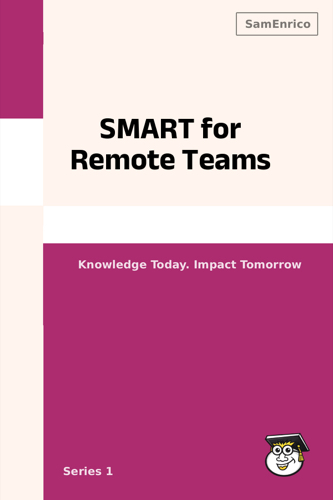
Non-FictionSelf-HelpRemote Work
SMART for Remote Teams eBook
Sets clear goals for distributed workforce with ac
by Owen Sabrina
Sets clear goals for distributed workforce with accountability.
Formats
Free sample
Chapter 1: The Container Crisis--–- When Mackenzie joined a fully remote startup as head of operations in 2021, she did what any trained manager would do: she implemented SMART goals. Every Monday, her team of fourteen product managers, data analysts, and customer experience specialists posted their weekly goals in a shared Notion database. Every goal followed the formula. Specific: "Update the onboarding email sequence by Thursday." Measurable: "Reduce drop-off by 5% based on Friday's data pull." Achievable: "Given current workload of 32 hours, this requires 4 hours." Relevant: "Supports Q3 retention objective." Time-bound: "Complete by Thursday 5 PM ET."For the first six weeks, it worked beautifully. The Notion database was a source of clarity.
Mackenzie could scan each person's goals in twenty minutes. Team members could see what others were doing. The Friday progress checks were quick and satisfying. Goals were marked green, yellow, or red. Green meant done.
Yellow meant in progress. Red meant blocked. Simple. Clean. Professional.Then, in Week 7, something strange happened.
A senior product manager named Diego marked his primary goal as green on Friday afternoon. The goal was "Complete competitive analysis document for the Q4 planning meeting." Mackenzie saw the green checkmark, nodded to herself, and closed Notion for the weekend.On Monday morning, she learned that the Q4 planning meeting had been a disaster. The head of product had asked Diego a basic question about a competitor's pricing model. Diego had no answer. The document he had marked as "complete" was a rough outline with placeholder text.
He had interpreted "complete" to mean "the first draft is started." The head of product had interpreted "complete" to mean "ready to inform strategy." Neither interpretation was wrong. The problem was that no interpretation had ever been shared.By Week 10, the Notion database had devolved into what Mackenzie called "green-check theater." Everyone marked their goals green because admitting yellow or red had started to feel dangerous. Not because Mackenzie had ever punished honesty—she hadn't—but because in a remote environment, a red goal sat in a database for days with no context. No one walked by your desk to ask what happened. No one overheard you explaining the blocker to a colleague.
The red marker just hung there, silent and damning, until the Friday check-in. So people learned to mark green. They learned to write goals they knew they could achieve. They learned to sandbag.By Week 14, two of Mackenzie's best people had given notice. In their exit interviews, they said the same thing: "The goal system felt like surveillance, not support.
I spent more time documenting my work than doing it." Mackenzie sat in her home office, staring at the Notion database she had built with such care, and realized: she had done everything right by the book, and she had still failed.The book she had read was wrong. Not wrong about SMART goals—those are still useful. Wrong about the container. The book assumed an office. It assumed hallway conversations, visible workloads, shared context, and a manager who could see.
Mackenzie had none of those things. She had a Notion database and a team in nine time zones. The container was missing. And without the container, SMART goals didn't clarify—they corroded.The Invisible Architecture of Co-Located Work Let me tell you a story about an office you have never seen. It was the headquarters of a mid-sized manufacturing company in Ohio, circa 1998.
The management team had never heard of SMART goals. They didn't use OKRs, KPIs, or any other three-letter framework. They didn't have to. Their goal system was built into the architecture of the building itself.Every morning at 8:30, the plant manager walked the floor. He didn't carry a clipboard.
He didn't take notes. He just walked. He saw which machines were running and which were down. He saw which workers were at their stations and which were in the break room. He saw the stack of unfinished orders on the shipping dock and the empty pallets waiting for new inventory.
By the time he reached his office at 9 AM, he knew exactly what was on track and what was not. No one had reported anything to him. The building had reported.At 11 AM, the production lead and the quality lead met at the coffee station. They talked for seven minutes about a recurring defect in the morning run. By 11:15, the line had been adjusted.
No email was sent. No meeting was scheduled. The problem was solved through proximity.At 2 PM, a salesperson walked into the plant manager's office and said, "I just promised a customer we could ship the Jones order two days early." The plant manager looked at the production board, saw that Line 3 was ahead of schedule, and said, "We can do that." The goal changed instantly. Everyone who needed to know found out within the hour, not through a formal announcement but through the ordinary social gravity of a shared physical space.At 4:45 PM, the night shift supervisor arrived early. He stood at the edge of the plant floor and watched the day shift finish their work.
He saw which orders were incomplete. He asked three quick questions. By 5 PM, he had a plan for the night. No handoff document. No status report.
Just seeing and speaking.This office had no formal goal system. And yet, by every modern measure, it had a highly effective one. Goals were set, tracked, adjusted, and achieved through what I call the invisible architecture of co-located work: the visual field, the casual conversation, the overheard update, the observed workload, the physical handoff. None of these things appeared in any handbook. None of them required training.
They were simply the operating system of human collaboration in shared space.When we moved our work online, we kept the formal systems—the SMART goals, the OKRs, the KPIs—but we left the invisible architecture behind. We expected a Notion database to replace the plant floor. We expected a Slack channel to replace the coffee station. We expected a Zoom call to replace the quick office visit. And we were surprised when none of it worked the same way.The Five Broken Pillars of Remote Goal Management The invisible architecture of co-located work rests on five pillars.
Each pillar seems ordinary, even trivial, until you try to work without it. Let me name them, describe how they functioned in an office, and show you exactly what breaks when you remove them.Pillar One: Shared Visual Field In an office, you can see what people are doing without asking them. You see if someone is typing intently or staring out the window. You see if their desk is covered in papers or pristine. You see if they are alone or in a meeting.
This visual information is not surveillance—it is context. It tells you whether someone is busy, whether they are struggling, whether they are available. You absorb this information unconsciously, and it calibrates every goal-related interaction you have.When you ask a co-located colleague for a status update, you already know 80 percent of the answer before they speak. You saw they were in back-to-back meetings. You saw they were eating lunch at their desk.
You saw they left early yesterday. The verbal update just fills in the remaining 20 percent.In a remote environment, the…
This is the end of the free sample. Get the eBook to keep going. Buy now
About this book
Details
- Author
- Owen Sabrina
- Publisher
- SamEnrico
- Language
- English
- Genre
- Non-Fiction, Self-Help, Remote Work
- Released
- 2026-06-08
- Pages (approx.)
- 142
- Available as
- eBook, Audiobook

Read better in the ZLOADR app
Your eBooks on your phone or tablet. Sign in with your SamEnrico account and start reading.
More by Owen Sabrina
 Spouse Terminal Grief WorkbookOwen Sabrina$11.99
 Shopping Addiction 12 Step ProgramOwen Sabrina$11.99
 Theme Days Scheduling StrategyOwen Sabrina$11.99
 The Postpartum Anger GuideOwen Sabrina$11.99
 Death Scene ReconstructionOwen Sabrina$11.99
 Self Hypnosis for Coffee ReductionOwen Sabrina$11.99
 Body Language for ChefsOwen Sabrina$11.99
 The Hollow Hill: Where the Fairy King RulesOwen Sabrina$11.99
 Storm Over the Dunes: The Tech That Won the Gulf WarOwen Sabrina$11.99
 Moorhens: WaterbirdOwen Sabrina$11.99
 How to Produce PerliteOwen Sabrina$11.99
 How to Produce CucumbersOwen Sabrina$11.99
You may also like
 Hong Kong Handover 1997Dunn Johnnie$11.99
 Zumba For Postnatal Recovery CourseNeal Christian$11.99
 Zumba for BeginnersLadner Nikia$11.99
 YouTube Comment Mining GuideHumes Pandora$12.99
 Worry Box MeditationCarlin Rudy$11.99
 Workplace Stress MeditationNguyen Lynn$11.99
 Workplace Stress and Sleep RepairHawley Ivory$11.99
 Workplace Perfectionism CureDelaney Jeffry$11.99
 Workplace Injustice Anger GuideWallen Isabelle$11.99
 Work Addiction and Burnout LinkGreenwood Ester$11.99
 Women in Yoga and WellnessBeattie Galina$11.99
 Women in Stand Up ComedyChun Evangeline$11.99