
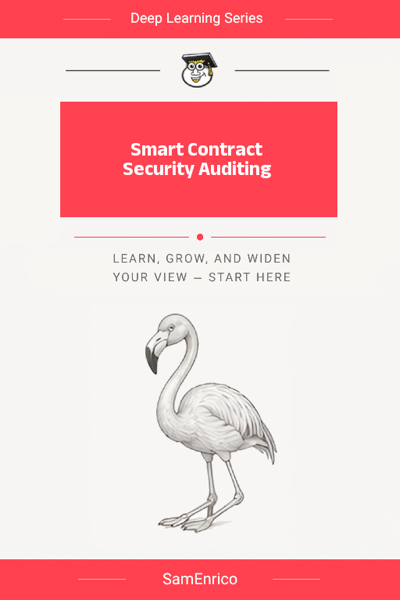
Smart Contract Security Auditing eBook
A Coursebook on Smart Contract Security Auditing
A Coursebook on Smart Contract Security Auditing
Formats
Free sample
Chapter 1: The Mindset Flip--–- Most developers wake up thinking about how to make something work. They ask: “What’s the cleanest way to implement this feature?” “How do I optimize this loop?” “Can I reduce gas costs here?” These are noble questions. They build the industry. But on October 14, 2021, a developer at a prominent cross-chain bridge asked a different question—too late. He stared at his screen, watching a transaction he didn’t recognize, and realized that a function he had marked as “internal” had just been called from the outside.
Not through malice—through misunderstanding. The function was withdraw To(). It had no access control because the developer assumed internal meant something it didn’t mean. By the time anyone asked “how can this break?” instead of “does this work?” thirty-one million dollars had already crossed into an address that would never return it. That night, a security auditor—not a developer—identified the root cause in twelve minutes.
The developers had spent months building. The auditor spent twelve minutes reading.This is not a story about incompetence. It is a story about mindset. The Parity Wallet team were excellent engineers. Their code compiled.
Their tests passed. Their features worked exactly as specified. But specifications don’t protect against assumptions. And assumptions, in smart contract security, are where money goes to die.Before you write a single line of Solidity for an audit, before you run Slither or configure Echidna, before you trace a single byte of EVM execution, you must rewire your brain. This chapter is the rewiring.
It will transform you from someone who builds systems into someone who deconstructs them—who reads a function not for what it does, but for the five ways it might fail. The tooling matters. The methodology matters. The EVM knowledge matters. But none of it works without the mindset.
So let’s begin where all audits begin: with the question developers rarely ask. “How could this go wrong?”Section 1.1 – The Economics of Hacks: What the Numbers Teach Us Every audit is, at its core, an economic exercise. You are not simply looking for “bugs” in the abstract sense. You are looking for paths where the attacker’s profit exceeds their cost. If no such path exists, the system is economically secure—even if it contains bugs.
This is the first principle that separates auditors from developers.Between January 2020 and December 2024, the ten largest smart contract exploits resulted in approximately $4.7 billion in losses across decentralized finance (De Fi) protocols, bridges, and layer-2 systems. When you analyze these events not as failures of code but as failures of incentive alignment, three patterns emerge with stunning regularity.The first pattern is what we call the Concentration Paradox: seventy percent of lost value stems from just three vulnerability classes—access control failures, arithmetic handling errors, and transaction ordering dependencies (front-running and MEV). Not obscure edge cases. Not exotic cryptographic flaws. Three categories that every competent developer knows exist.
The paradox is not that these vulnerabilities are difficult to find. It is that they persist because developers optimize for “what works” while auditors must optimize for “what breaks despite working.” A function can execute perfectly for a thousand transactions and still drain funds on the thousand and first. That is not a bug. That is an assumption waiting to be exploited.The second pattern involves incentive structures. Protocols with complex tokenomics—rebasing tokens, transfer fees, elastic supplies, or custom governance models—suffer disproportionately more exploits than simple vaults holding standard ERC-20 tokens.
The reason is not technical. It is behavioral. Complex tokenomics obscure the economic relationships between different state variables. When a token charges a 1% transfer fee, every contract that assumes “balance after transfer equals original minus amount” becomes a ticking time bomb. Auditors who master incentive mapping find vulnerabilities.
Auditors who only read code miss them.The third pattern is the 100Million Threshold.Exploitedprotocolsclusteraroundspecific Total Value Locked(TVL)rangeswherethepotentialrewardexceedstheestimatedexploitcost.Belowapproximatelyfivemilliondollars,sophisticatedattackersrarelybother.Theeffortexceedstheexpectedreturn.Aboveonehundredmilliondollars,protocolsattractmultipleaudits,formalverification,andactivebugbounties—raisingtheexploitcostconsiderably.Thedangerzoneisbetweenfiveandfiftymilliondollars.Sufficientvaluetoattractseriousattackers.Insufficientscrutinytodeterthem.Asanauditor,yourriskassessmentmustaccountfor TVL.Avulnerabilityinaprotocolwith100 Million Threshold. Exploited protocols cluster around specific Total Value Locked (TVL) ranges where the potential reward exceeds the estimated exploit cost. Below approximately five million dollars, sophisticated attackers rarely bother. The effort exceeds the expected return. Above one hundred million dollars, protocols attract multiple audits, formal verification, and active bug bounties—raising the exploit cost considerably.
The danger zone is between five and fifty million dollars. Sufficient value to attract serious attackers. Insufficient scrutiny to deter them. As an auditor, your risk assessment must account for TVL. A vulnerability in a protocol with 100Million Threshold.Exploitedprotocolsclusteraroundspecific Total Value Locked(TVL)rangeswherethepotentialrewardexceedstheestimatedexploitcost.Belowapproximatelyfivemilliondollars,sophisticatedattackersrarelybother.Theeffortexceedstheexpectedreturn.Aboveonehundredmilliondollars,protocolsattractmultipleaudits,formalverification,andactivebugbounties—raisingtheexploitcostconsiderably.Thedangerzoneisbetweenfiveandfiftymilliondollars.Sufficientvaluetoattractseriousattackers.Insufficientscrutinytodeterthem.Asanauditor,yourriskassessmentmustaccountfor TVL.Avulnerabilityinaprotocolwith2 million locked is an informational finding.
The same vulnerability in a protocol with $200 million locked is a critical stop-ship issue.To operationalize this, we introduce the Auditor’s ROI Matrix. For each function or code path, you estimate two values: potential loss (if the path were exploited) and exploitability difficulty (how many conditions must align for an attacker to succeed). Multiply them. High potential loss with low difficulty demands immediate attention. Low potential loss with high difficulty is archival.
The matrix is not precise—you cannot calculate exact probabilities—but it forces the cognitive habit of economic reasoning. You are not a bug finder. You are a financial risk analyst who happens to read Solidity.Section 1.2 – The Audit Process Mapped: Five Phases to Professional Results Audits are not random acts of curiosity. They are structured investigations with defined phases, deliverables, and professional standards. Understanding the process is not merely administrative—it protects you legally, manages client expectations, and ensures you don’t miss vulnerabilities by stopping too early or burning out too late.Phase One: Scoping – Duration 1-2 Days The scoping phase defines what you will audit, how you will audit it, and what the client will receive.
You and the client agree on the contract inventory (every address and file), the commit hash of the codebase (no “we changed a few things” midway), the threat model (are we assuming the admin key is compromised? the oracles?), and the tooling selection (which static analyzers, which fuzzers). The deliverable is a Scope of Work (So W) document signed by both parties. Without an So W, scope creep destroys timelines and clients dispute findings. With an So W, you have clear boundaries and legal protection.During scoping, you also conduct initial threat modeling.
List every external dependency: oracles, governance timelocks, admin multisigs, bridge validators, off-chain keepers. For each dependency, ask: “If this component were malicious or compromised, what is the worst damage?” This pre-audit exercise often uncovers architectural vulnerabilities before you read a single line of code.Phase Two: Intake – Duration 1 Day Intake verifies that the provided codebase is complete, buildable, and testable. Clone the repository. Run forge build. Run the existing test suite.
If the tests fail, stop—you cannot audit code that doesn’t compile or passes its own tests. Create a fresh branch and add your own sanity checks. The intake checklist includes: contract inventory matches the So W, all dependencies are pinned (no floating versions), the test suite passes, the deployment scripts exist…
This is the end of the free sample. Get the eBook to keep going. Buy now
About this book
Details
- Author
- Grubbs Delicia
- Publisher
- SamEnrico
- Language
- English
- Genre
- Non-Fiction, Informative, Educational
- Released
- 2026-05-11
- Pages (approx.)
- 148
- Available as
- eBook, Audiobook

Read better in the ZLOADR app
Your eBooks on your phone or tablet. Sign in with your SamEnrico account and start reading.
More by Grubbs Delicia
 Nonverbal Listening SkillsGrubbs Delicia$11.99
 The Self Talk for CompetitionGrubbs Delicia$11.99
 TM for Gambling RecoveryGrubbs Delicia$11.99
 The Childhood Psychopath PredictorsGrubbs Delicia$11.99
 The Trial of the Century: The Downfall of Richard NixonGrubbs Delicia$11.99
 Manufacturing Invoice FactoringGrubbs Delicia$12.99
 Free Validation Template PackGrubbs Delicia$12.99
 Understanding Tnf Receptor Associated Periodic Syndrome (Traps)Grubbs Delicia$17.99
 10 Ways to Use Deepwater Rice (Recipe Book)Grubbs Delicia$11.99