
Non-FictionInformativeEducational
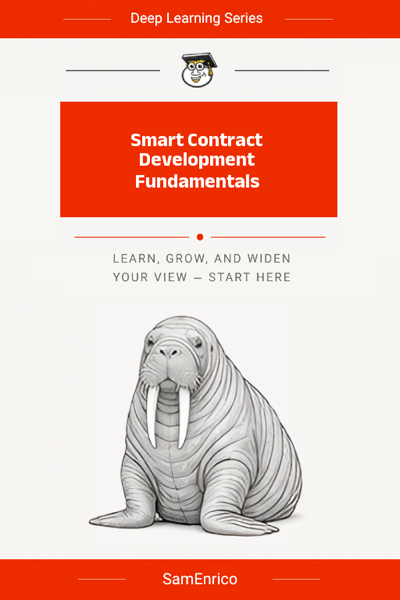
Smart Contract Development Fundamentals eBook
A Coursebook on Smart Contract Development Fundame
A Coursebook on Smart Contract Development Fundamentals
Formats
Free sample
Chapter 1: The Trust Deception--For most of human history, you have never truly owned anything of value—you have only ever rented the privilege of trusting someone else to hold it for you. The money in your bank account is not a stack of bills in a vault with your name on it; it is a database entry controlled by a corporation that can freeze your access without a court order. The deed to your house is not a document you possess; it is a record in a government registry that could be misfiled, disputed, or altered. The shares of stock you bought last week are not certificates in your hand; they are entries on a ledger kept by a broker who lends them out to short sellers without asking your permission. Every asset you believe you own is, in reality, a promise from someone else that they will honor your claim.
And promises can be broken.This is not paranoia. It is history. In 2013, the government of Cyprus, facing a banking crisis, announced that all bank accounts would be subject to a "haircut"—depositors would lose up to 40 percent of their savings to bail out the banks. The bank had the money. The depositors had the receipts.
And the law sided with the bank. In 2015, the Greek stock exchange closed for five weeks, and when it reopened, capital controls prevented anyone from moving money out of the country. Investors could see their portfolio values on a screen, but they could not touch a single euro. In 2021, the Canadian government froze the bank accounts of truck convoy protesters without criminal charges, without trial, without conviction—simply because the government disagreed with their politics. The banks complied instantly.
Not because a law required it, but because the government asked.If you are reading this book, you have either already experienced a moment where trust failed you, or you sense that it will. The centralized systems we have built—banks, governments, corporations, registries, exchanges—all share a fatal flaw that no amount of regulation, auditing, or good intentions can fix. They are controlled by people. And people can be coerced, corrupted, compromised, or simply mistaken. The question is not whether trust will fail you.
The question is when.This book is about building systems that eliminate the need for trust entirely. Not by replacing humans with better humans, but by replacing human judgment with mathematical certainty. Smart contracts—self-executing programs that run on blockchain networks—offer the first practical alternative to the trusted third party model that has governed civilization for ten thousand years. But before you can write a single line of Solidity, before you can deploy your first contract, before you can call yourself a blockchain developer, you must understand a deeper truth: decentralization is not a feature of software. It is a rejection of human nature's oldest flaw.The Architecture of Trust: Why We Accept the Unacceptable Every centralized system follows the same pattern, whether it is a bank, a social media platform, a cloud provider, or a government records office.
There is a central authority that maintains the single source of truth. There is a database controlled by that authority. There are users who must ask permission to read from or write to that database. And there is an implicit promise that the authority will act honestly, competently, and in the users' best interest.This pattern has endured for millennia because it works—until it doesn't. The Roman Empire maintained a centralized currency for centuries, then debased it so severely that by the end, a denarius contained almost no silver.
The Medici Bank, the most powerful financial institution of the Renaissance, collapsed when its managers made bad loans to monarchs who refused to repay. In 2008, the entire global financial system nearly collapsed because rating agencies (centralized authorities) gave AAA ratings to mortgage-backed securities that were filled with loans to people who could not afford them.The problem is not malice, though malice certainly exists. The problem is structural. Every centralized system has three unavoidable weaknesses that no amount of oversight or regulation can eliminate.First: The Single Point of Failure. When one server, one company, or one government controls a system, that system can be attacked, disrupted, or destroyed by attacking that single point.
In 2021, a fire at a single data center in Strasbourg, France, owned by OVHcloud, took down millions of websites, including government services, banks, and news outlets. One fire. One building. One company. Millions of users locked out.
In a decentralized system, there is no single point to attack. To disrupt the Bitcoin network, an attacker would need to simultaneously disable thousands of independent nodes spread across every continent, each operated by different people with different incentives and different vulnerabilities. That is not merely difficult. It is mathematically impossible for any realistic adversary.Second: Censorship. A centralized authority can always deny service to anyone, for any reason, or for no reason at all.
In 2010, Pay Pal, Visa, and Master Card froze donations to Wiki Leaks, not because the donations were illegal (they were not), but because the US government pressured them to do so. The corporations complied because they had no choice—they are centralized entities that must maintain relationships with governments that can shut them down. In 2017, Cloudflare terminated service to the neo-Nazi website The Daily Stormer. Whether you agree with that decision or oppose it, the power to make it should give you pause. Cloudflare is a private company.
If it can censor Nazis, it can censor you. On a decentralized network like Ethereum, no single entity can prevent a transaction from being included in a block. The only way to censor a transaction is to control a majority of the network's mining or staking power—an extraordinarily expensive and detectable act that would destroy the value of the network in the process.Third: The Trusted Third Party Problem. Every centralized system requires you to trust someone who is not you. You trust your bank not to lose your money.
You trust the government not to seize your house. You trust the stock exchange not to fake your trades. And sometimes that trust is rewarded. But trust is not a guarantee—it is a hope. The lawyer Bernie Madoff was trusted by thousands of investors who gave him billions of dollars.
He was running a Ponzi scheme for decades, and the auditors, regulators, and custodians who were supposed to catch him either missed it or looked the other way. In the aftermath, investors discovered that their account statements were fabrications. The money was not there. The receipts were not worth the paper they were printed on. A smart contract, by contrast, does not ask for your trust.
It asks you to verify its code, to understand its logic, and to decide for yourself whether it will do what it promises. If the code says you own something, you own it—as long as the blockchain exists. No human can override that. No court can seize it without your private key. No government can freeze it without your consent.These three weaknesses—single point of failure, censorship vulnerability, and the trusted third party problem—are not bugs in centralized…
This is the end of the free sample. Get the eBook to keep going. Buy now
About this book
Details
- Author
- Minton Mafalda
- Publisher
- SamEnrico
- Language
- English
- Genre
- Non-Fiction, Informative, Educational
- Released
- 2026-05-11
- Pages (approx.)
- 149
- Available as
- eBook, Audiobook

Read better in the ZLOADR app
Your eBooks on your phone or tablet. Sign in with your SamEnrico account and start reading.
More by Minton Mafalda
 Mindful Stress Reduction for TherapistsMinton Mafalda$11.99
 The Networking Confidence GuideMinton Mafalda$11.99
 Wholesaling Skip Tracing GuideMinton Mafalda$11.99
 Road Rage Triggers IdentificationMinton Mafalda$11.99
 Creative Block AssessmentMinton Mafalda$11.99
 The Birthday YellMinton Mafalda$11.99The Birthday YellMinton Mafalda$11.99
 Baseball Arm Care ProgramMinton Mafalda$11.99
 High Sensitivity Child WorthMinton Mafalda$11.99
 Redgrave Dynasty - Lynn RedgraveMinton Mafalda$11.99
 The Long White Cloud: New Zealand's Pioneers of Discovery and InnovationMinton Mafalda$11.99
 The Last Broadcast: When Radio Saved the WorldMinton Mafalda$11.99
You may also like
 Hong Kong Handover 1997Dunn Johnnie$11.99
 Zumba For Postnatal Recovery CourseNeal Christian$11.99
 Zumba for BeginnersLadner Nikia$11.99
 YouTube Comment Mining GuideHumes Pandora$12.99
 Worry Box MeditationCarlin Rudy$11.99
 Workplace Stress MeditationNguyen Lynn$11.99
 Workplace Stress and Sleep RepairHawley Ivory$11.99
 Workplace Perfectionism CureDelaney Jeffry$11.99
 Workplace Injustice Anger GuideWallen Isabelle$11.99
 Work Addiction and Burnout LinkGreenwood Ester$11.99
 Women in Yoga and WellnessBeattie Galina$11.99
 Women in Stand Up ComedyChun Evangeline$11.99