
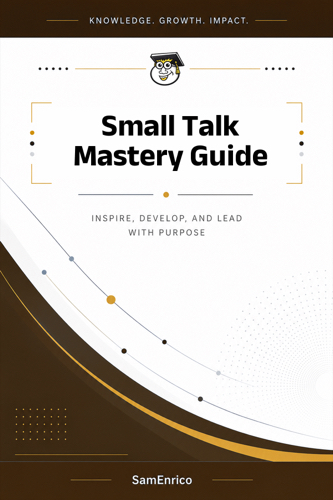
Non-FictionSelf-HelpCommunication Skills
Small Talk Mastery Guide eBook
Turn awkward silences into meaningful conversation
Turn awkward silences into meaningful conversation starters.
Formats
Free sample
Chapter 1: The Silence Trap--–- You are standing at a networking event, plastic cup of white wine sweating in your hand. The person across from you just finished a story about their weekend. You nod. They nod back. And then it happens.
The air thickens. Your brain, which was functioning perfectly fine three seconds ago, now resembles a stalled engine. You search desperately for something—anything—to say. The weather? Already mentioned.
Their job? Asked and answered. A joke? Too risky. The silence stretches like a rubber band about to snap.
You feel your face warm. You glance at your phone. They glance at their watch. And just like that, the conversation dies, not with a bang, but with a whimper of mutual relief.If this scenario makes you wince with recognition, you are not alone. In fact, you are part of the vast majority.
The fear of conversational silence is so universal that it has a clinical footprint in social anxiety research. But here is the paradox that will define everything you learn in this book: silence is not the problem. Your panic in response to silence is the problem. And that panic is entirely reversible.This chapter is called The Silence Trap because that is precisely what most of us fall into—a trap baited with the false belief that silence equals failure. We have been conditioned to treat every pause as a gap that must be filled, every lull as a leak that must be plugged.
But what if silence were not a void but a vessel? What if the pause were not an awkward interruption of conversation but an integral part of it—like the rests between notes in a piece of music?Before you can master small talk, you must first master the one thing that terrifies you most: the quiet moment. By the end of this chapter, you will understand exactly why silence triggers a biological panic response, how long a “painful” pause actually lasts (and why it feels so much longer), and how to retrain your brain to stop treating quiet as a threat. You will learn the single most important distinction that separates confident communicators from socially anxious ones: the difference between reactive silence and intentional silence.Let us begin by dismantling the myth that has been ruining your conversations for years.The Awkwardness Myth The first thing to understand is that silence is not objectively awkward. It is subjectively interpreted as awkward.
This distinction is crucial. Imagine two people sitting in a coffee shop. They have been dating for two years. They stop talking for thirty seconds. One sips her latte.
The other looks out the window. Neither feels uncomfortable. Now imagine two strangers at that same coffee shop, seated at the same table for a blind date. Thirty seconds of silence passes. Both begin to sweat.
Same duration. Same environment. Radically different emotional responses.What changed? Not the silence. The expectations.
The first couple has an established relationship and implicit trust that silence is safe. The second couple has no history and is operating under the unspoken rule that conversation must be continuous or something has gone wrong. That rule is the Awkwardness Myth—the mistaken belief that silence is a social failure.This myth is reinforced everywhere. Television shows edit out pauses. Movies have characters who always know what to say.
In real life, however, conversations are not scripts. They breathe. They pause. They sometimes stop and restart. The most skilled conversationalists are not the ones who never experience silence.
They are the ones who do not panic when silence arrives.But why does panic feel so automatic? Why does a five-second pause trigger the same physical response as being chased by a predator? The answer lies deep in your brain’s wiring.The Biology of the Pause When you are in a conversation and silence falls, your brain does something remarkable and entirely unhelpful: it interprets the quiet as potential rejection. From an evolutionary perspective, this makes sense. Your ancient ancestors lived in tribes where social exclusion meant death.
If the group stopped talking to you, you might be cast out. If you were cast out, you would not survive the winter or the wolves. So your brain developed a hair-trigger response to social stillness. Silence became a threat.Today, you are not facing wolves or winter storms. But your brain does not know that.
When conversational silence hits, your amygdala—the brain’s alarm system—sends out a distress signal. Cortisol and adrenaline spike. Your heart rate increases. Your attention narrows. You stop listening and start strategizing.
You scan your mental files for any possible topic, any lifeline, any word at all to throw into the void. This is the fight-or-flight response, repurposed for cocktail parties.Here is the cruel irony: your desperate attempt to fill the silence usually makes things worse. You blurt out something irrelevant. You repeat a question you already asked. You say “so…” or “yeah…” or “um…”—verbal filler that signals to the other person that you are uncomfortable.
They, in turn, become uncomfortable. The silence that was neutral has now become awkward, not because of its duration, but because of your reaction to it.The good news is that you can break this loop. You can train your brain to stop treating silence as a predator. The first step is learning to see silence for what it actually is—not an emergency, but a neutral pause.The Four-Second Illusion Let us talk numbers. If you had to guess, how long does a “painful” silence last?
Five seconds? Ten? Most people guess much higher than reality. In controlled studies of conversational dynamics, researchers have found that the average silence that triggers discomfort lasts between four and six seconds. That is it.
You can hold your breath longer than that. You can tie your shoes in that time. You can scroll past two Instagram posts.But four to six seconds feels like thirty seconds when your amygdala is sounding the alarm. This is the Four-Second Illusion. Time perception is elastic under stress.
Have you ever noticed how a two-minute wait for test results feels like an hour? Or how a thirty-second plank exercise feels like an eternity? The same compression happens in conversation. A five-second pause, experienced through the lens of social anxiety, can feel like half a minute of excruciating silence.Why does this matter? Because once you know that the pause is short—objectively, measurably short—you can stop exaggerating it in your mind.
You can tell yourself: “This has been three seconds. I can wait two more.” And when you do, something interesting happens. Often, the other person fills the silence for you. Most people are also uncomfortable with pauses. If you simply wait, they will frequently jump in with a new topic, saving you the effort.The master communicator does not just wait, however.
The master communicator uses the pause.From Panic to Presence There is a fundamental difference between how anxious people use silence and how confident people use silence. The anxious person experiences silence as a vacuum that must be filled immediately. They speak without thinking. They grab the…
This is the end of the free sample. Get the eBook to keep going. Buy now
About this book
Details
- Author
- Dill Heriberto
- Publisher
- SamEnrico
- Language
- English
- Genre
- Non-Fiction, Self-Help, Communication Skills
- Released
- 2026-06-08
- Pages (approx.)
- 120
- Available as
- eBook, Audiobook

Read better in the ZLOADR app
Your eBooks on your phone or tablet. Sign in with your SamEnrico account and start reading.
More by Dill Heriberto
 Twelve Step Programs For Young People HandbookDill Heriberto$11.99
 Stress Inflammation Body GuideDill Heriberto$11.99
 The Listening Trance LogDill Heriberto$11.99
 Learning New Skills SeniorsDill Heriberto$11.99
 Achievement Hunter AddictionDill Heriberto$11.99
 Suicide Loss and Self CareDill Heriberto$11.99
 Parental Leave NegotiationDill Heriberto$11.99
 The Phantom of Dettingen: A Ghostly Prelude to the Seven Years' WarDill Heriberto$11.99
 The Oxford vs. Cambridge Boat Race: A Century of Rivalry and National PrideDill Heriberto$11.99
 How to Produce a Mine RailwayDill Heriberto$11.99
 A Collector's Handbook to the Plymouth Chrysler WimbledonDill Heriberto$11.99
 Cash Flow for High Growth BootstrappersDill Heriberto$12.99
You may also like
 Hong Kong Handover 1997Dunn Johnnie$11.99
 Zumba For Postnatal Recovery CourseNeal Christian$11.99
 Zumba for BeginnersLadner Nikia$11.99
 YouTube Comment Mining GuideHumes Pandora$12.99
 Worry Box MeditationCarlin Rudy$11.99
 Workplace Stress MeditationNguyen Lynn$11.99
 Workplace Stress and Sleep RepairHawley Ivory$11.99
 Workplace Perfectionism CureDelaney Jeffry$11.99
 Workplace Injustice Anger GuideWallen Isabelle$11.99
 Work Addiction and Burnout LinkGreenwood Ester$11.99
 Women in Yoga and WellnessBeattie Galina$11.99
 Women in Stand Up ComedyChun Evangeline$11.99