
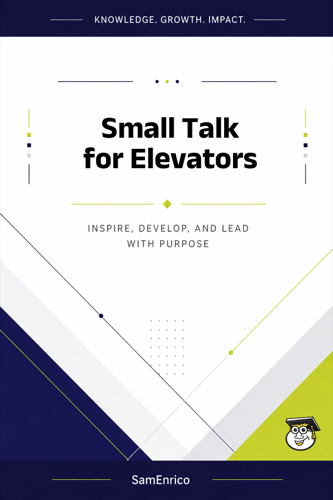
Small Talk for Elevators eBook
Brief openers for short shared rides.
Brief openers for short shared rides.
Formats
Free sample
Chapter 1: The 118-Second Truth--–- The first time I truly understood the power of an elevator, I was trapped between the 14th and 15th floors with a man who would later hire me. I didn’t know that at the time. At the time, I knew three things: the emergency alarm button was smaller than I expected, my phone had no signal, and the man standing six inches from my shoulder was holding a briefcase with his knuckles turning white. We had been silent for forty-seven seconds. Forty-seven seconds that felt like forty-seven years.
Then he exhaled—not a sigh, exactly, more like a surrender—and said something I have never forgotten. He said, “Well. This is inconvenient.” Not “Oh my God.” Not “We’re going to die.” Not even “Can you believe this?” Just: “Well. This is inconvenient.” And because he said it that way—calm, almost amused, utterly human—I stopped panicking. I laughed.
He laughed. By the time the maintenance crew pried the doors open twelve minutes later, I had learned that his name was Edward, that he was the regional director of a publishing house I’d been trying to get into for two years, and that he thought my panicked face was “refreshingly honest.” He offered me an internship before we reached the lobby. That internship became a job. That job became a career. And none of it would have happened if I had done what ninety-three percent of elevator passengers do: stare at the floor indicator in silence, pretending I was alone in a box with a stranger.This book is not about that story, exactly.
That story is an outlier. Most elevator rides do not end with job offers. Most do not involve entrapment. Most last fewer than thirty seconds, and most happen in buildings where nothing particularly dramatic ever occurs. But that story reveals something essential about the space we are about to explore.
The elevator is not a neutral environment. It is not simply a box that moves you from one floor to another. The elevator is a social pressure cooker with a timer you cannot see, filled with people who did not choose to be there together, who cannot leave until the doors open, and who will remember how you made them feel long after they have forgotten what you said. That is the 118-Second Truth: you have less time than you think, but more influence than you know.Let me say that again because it is the entire premise of this book. You have less time than you think.
The average elevator ride in a modern office building lasts between fifteen and one hundred eighteen seconds. That is not a typo. The range exists because buildings vary wildly—a two-floor ride in a walk-up takes about seven seconds per floor; a thirty-floor express ride in a skyscraper can stretch to nearly two minutes. But here is what matters more than the number: whatever time you have, it is shorter than your anxiety tells you. Your brain, when faced with a confined space and a stranger, stretches time like warm taffy.
Five seconds of silence feels like fifty. Ten seconds of eye contact feels like a job interview. This time-dilation effect is why elevators feel so awkward even when nothing goes wrong. Your nervous system is lying to you. The clock is not your enemy.
Your perception of the clock is.But here is the other half of the 118-Second Truth, the half that changes everything. You have more influence than you know. Research on thin-slicing—the psychological phenomenon by which people make rapid judgments based on very limited information—suggests that elevator-length interactions are precisely long enough to form lasting impressions. Not complete impressions, not deep assessments of character, but something more powerful: a judgment of safety. Within the first seven seconds of meeting someone, your brain decides whether that person is a friend or a threat.
Within the next seven seconds, it decides whether that person is competent. Within the final seconds of a typical elevator ride, it decides whether that person is someone you would want to see again. These judgments are not fair. They are not accurate in any objective sense. But they are real, and they happen whether you speak or not.That last part is crucial.
Whether you speak or not.Most people assume that silence is neutral. That if you say nothing, you have made no impression. This is catastrophically wrong. Silence in a confined space is not neutral. Silence is a statement.
It says: I am choosing not to engage with you. In some contexts—a library, a funeral, a crowded subway car—silence is appropriate and even kind. In an elevator, where two or three people share a box smaller than most bathroom stalls, silence is conspicuous. It is a presence in the room. And because humans are meaning-making machines, your fellow passenger will interpret your silence.
They will decide, in the absence of information, that you are standoffish, or shy, or rude, or anxious, or angry. They will be wrong most of the time. But they will not know they are wrong, and they will carry that impression with them when the doors open.I am not telling you this to make you more anxious. I am telling you this to liberate you. Because if silence is already making a statement—if you are already being judged whether you speak or not—then you have nothing to lose by speaking.
The worst-case scenario is not that you say something awkward and the other person judges you negatively. The worst-case scenario is already happening. The worst-case scenario is silence, misinterpretation, and missed connection. Speaking, even imperfectly, at least gives you a chance to shape the impression you are already making.This book will teach you how to take that chance.But before we go any further, I need to address a misunderstanding that has poisoned elevator discourse for decades. You have heard it a thousand times.
Maybe you have even practiced it in front of a mirror. The "elevator pitch." The thirty-second summary of who you are, what you do, and why someone should care. The idea that every ride is a networking opportunity, that every stranger is a potential client, that every closed door is a stage.Forget it.The elevator pitch is not only useless in an elevator—it is actively harmful. Here is why. An elevator pitch is designed for a captive audience.
It assumes that the other person wants to hear about you, that they have agreed to receive your message, that they are open to being persuaded. But in an actual elevator, none of those conditions apply. The other person did not choose to be there. They did not sign up for your presentation. They are going to the bathroom, or to a meeting they are already late for, or home to their family.
They are not thinking about your startup. They are thinking about their own life. When you launch into a pitch, you are not networking. You are holding someone hostage. And people do not respond well to hostage situations.
They smile, they nod, they say "interesting," and then they spend the rest of the ride calculating how to never…
This is the end of the free sample. Get the eBook to keep going. Buy now
About this book
Details
- Author
- Willett Fermin
- Publisher
- SamEnrico
- Language
- English
- Genre
- Non-Fiction, Self-Help, Etiquette
- Released
- 2026-06-07
- Pages (approx.)
- 141
- Available as
- eBook, Audiobook

Read better in the ZLOADR app
Your eBooks on your phone or tablet. Sign in with your SamEnrico account and start reading.
More by Willett Fermin
 Moving Without Goodbye ChildhoodWillett Fermin$11.99
 Dream Object JournalWillett Fermin$11.99
 Single Tasking For RemoteWillett Fermin$11.99
 Design Thinking for EntrepreneursWillett Fermin$11.99
 Whiteboard Collaboration GuideWillett Fermin$11.99
 Nodding CommunicationWillett Fermin$11.99
 Anger at Childs StealingWillett Fermin$11.99
 Loki’s Lost Gambit: The Trickster’s African ExileWillett Fermin$11.99
 Isadora Duncan: The Barefoot RevolutionWillett Fermin$11.99
 Video Editing Services BusinessWillett Fermin$11.99
 How to Produce Oil PaintWillett Fermin$11.99
 How to Produce Coats and JacketsWillett Fermin$11.99
You may also like
 The Thank You Note StrategyHaag Lynwood$11.99
 The Door Holding SignalMinton Jacquline$11.99
 Self Hypnosis for Manners HabitsGatewood Tayna$11.99
 Remote Meeting Etiquette GuideAnglin Monroe$11.99
 Small Talk for Celebrity EncountersFalk Kacey$11.99
 Cocktail Party Name RecallClifford Danelle$11.99
 Body Language for EtiquetteBingham Columbus$11.99