
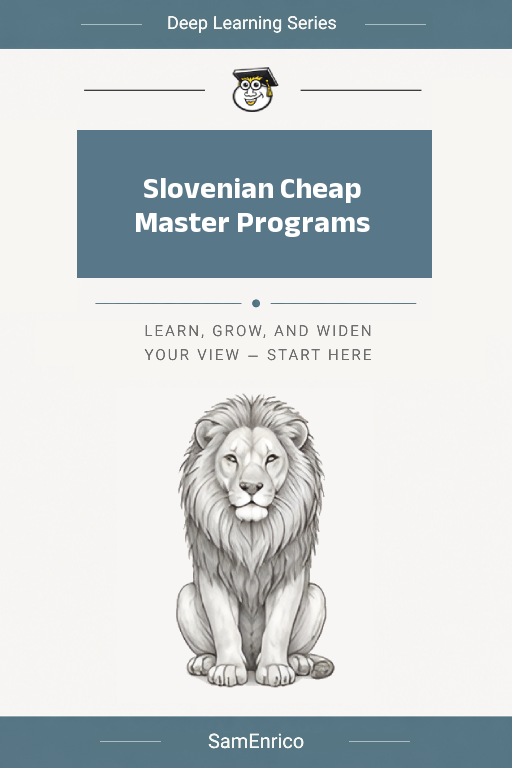
Slovenian Cheap Master Programs eBook
Find 3000 to 5000 euro master degrees in Ljubljana
by Pride Bette
Find 3000 to 5000 euro master degrees in Ljubljana with scholarships available for internationals.
Formats
Free sample
Chapter 1: The Debt Sentence--–- Let me tell you about Elena. She was twenty-three years old, freshly graduated with a bachelor's degree in economics from a respectable university in Mumbai, and she had done everything right. Good grades. Internships. A clear five-year plan.
When she received her acceptance letter for a one-year Master's in International Business from a mid-ranked university in the United Kingdom, she celebrated with her family. The tuition was £32,000 – approximately €38,000. Living expenses in London would add another £15,000. Total investment: nearly €55,000 for twelve months of education. She took out a loan from an Indian bank at 12% interest, cosigned by her father who mortgaged a portion of their family home.
Eighteen months later, Elena had graduated, returned to Mumbai, and discovered that her degree – from a university no employer had heard of – qualified her for the same entry-level jobs she could have gotten with her bachelor's. Her starting salary was €9,600 per year. Her monthly loan payment was €680. She would be paying until she was forty-one years old. This is not an unusual story.
This is, in fact, the standard narrative of international higher education in the twenty-first century. And this book exists to offer you an alternative.You are reading this because you want a master's degree – not because you need a piece of paper, but because you understand that advanced education opens doors, increases earning potential, and signals to employers that you possess the discipline and intelligence to complete a rigorous program. You are also reading this because you are not wealthy. Perhaps you come from a middle-class family in a developing economy. Perhaps you have saved for years from a modest salary.
Perhaps you are the first in your family to pursue graduate education overseas. Whatever your specific circumstances, you share one fundamental constraint: you cannot afford €55,000. You cannot afford €30,000. You are looking for something in the range of €3,000 to €5,000 per year for tuition – a price that makes international education possible without selling a kidney or bankrupting your parents.And you have been told, explicitly or implicitly, that such a thing does not exist. That good master's programs cost money.
That Europe is expensive. That scholarships are for geniuses and Olympians. That you should just take the loan, get the degree, and figure it out later. These are lies. They are lies propagated by a multibillion-dollar international education industry that profits from your fear and your desperation.
The truth is that there is a country in the heart of Europe – safe, modern, centrally located, and deeply committed to the principles of accessible public education – where you can earn a fully accredited master's degree for less than the cost of a used car. That country is Slovenia.The €55,000 Question Let us begin with a simple mathematical exercise. You are considering two paths. Path A: a master's degree from a popular destination – the United Kingdom, the United States, Australia, or Canada. Average international tuition for a one-year master's in the UK is €18,000 to €40,000.
Average tuition for a two-year master's in the US is €25,000 to €60,000. Add living expenses of €12,000 to €20,000 per year, and you are looking at a total investment of €40,000 to €80,000. Most international students finance these degrees through a combination of personal savings, family contributions, and private loans at interest rates ranging from 8% to 15%. The monthly payment on a €50,000 loan over ten years at 10% interest is approximately €660. Over fifteen years, approximately €540.
Over twenty years, approximately €480. These are not theoretical numbers. These are actual payments that real people make – payments that delay home ownership, prevent retirement savings, and create a permanent drag on financial freedom.Path B: a master's degree from a Slovenian public university. Tuition ranges from €2,800 to €5,000 per year for a two-year program. Total tuition: €5,600 to €10,000.
Living expenses in Ljubljana, the capital, range from €6,000 to €9,000 per year, including rent, food, transport, and health insurance. Total two-year investment: €11,600 to €19,000. This is not zero – but it is less than the cost of a single year in London or New York. If you work part-time during your studies (legally permitted up to twenty hours per week), you can earn €500 to €800 per month, covering half or more of your living expenses. If you win one of the scholarships described in Chapter 6 – including the €9,600 per year AD FUTURA living stipend – your net cost drops to near zero.
And if you are a citizen of Bosnia and Herzegovina, Montenegro, Kosovo, North Macedonia, or Serbia, your tuition is zero regardless of scholarships. Let me repeat that: zero euros. For a European master's degree.The difference between Path A and Path B is not merely financial. It is existential. Elena from Mumbai will spend her twenties and thirties working to pay off a degree that did not advance her career.
A student who chooses Slovenia will graduate debt-free, with the same legal right to work in the European Union, the same internationally recognized credits under the Bologna Process, and the freedom to choose a job based on interest rather than loan payments. This is not hyperbole. This is the arithmetic of smart educational investment.Why You Have Never Heard of Slovenia If Slovenia is such an incredible value, you might reasonably ask, why is it not overrun with international students? Why do your friends talk about studying in Germany, France, or the Netherlands but never mention Slovenia? The answer is simple: marketing budgets.
The United Kingdom spends hundreds of millions of euros annually promoting its universities through the British Council and international recruitment fairs. Germany has the DAAD (German Academic Exchange Service), a well-funded government agency with offices in sixty countries. France has Campus France, with nearly one hundred international branches. Slovenia has none of these. The Slovenian government's entire international education promotion budget for 2025 was less than the University of Manchester spends on a single recruitment trip to China.This is not a weakness.
It is your advantage. Low marketing budgets mean low international demand, which means low competition for admission and scholarships. While thousands of students fight for a single funded slot at a German university, Slovenian programs often accept qualified applicants with minimal competition. While German universities require the famously difficult APS certificate for Chinese and Indian applicants, Slovenian universities rely on simpler document verification. While French universities demand B2 or C1 French proficiency for most programs, Slovenia offers dozens of English-taught master's degrees across social sciences, humanities, engineering, and computer science.You have not heard of Slovenia because no one has spent millions of euros to tell you about it.
But the European Union has heard of Slovenia. The Bologna Process has heard of Slovenia. Employers at BMW, Airbus, Novartis, and thousands of other European companies have heard of Slovenia – and they hire Slovenian graduates every year. The question is not whether Slovenia is a legitimate destination for international education. The question is whether you are willing to look beyond the heavily marketed options to find the hidden gem.The Geography of Opportunity Slovenia is roughly the size of New Jersey, with a population of just over two million people.
It shares borders with Italy to the west, Austria to the north, Hungary to the east, and Croatia to the south. This location is not incidental. Within a four-hour drive from Ljubljana…
This is the end of the free sample. Get the eBook to keep going. Buy now
About this book
Details
- Author
- Pride Bette
- Publisher
- SamEnrico
- Language
- English
- Genre
- Non-Fiction, Student's Shortcut
- Released
- 2026-06-01
- Pages (approx.)
- 152
- Available as
- eBook, Audiobook

Read better in the ZLOADR app
Your eBooks on your phone or tablet. Sign in with your SamEnrico account and start reading.
More by Pride Bette
 Brainwriting Pool For TeamsPride Bette$11.99
 Public Speaking Stress ReductionPride Bette$11.99
 Fasting Growth Hormone SpikePride Bette$11.99
 Chess Opening Memory LociPride Bette$11.99
 Antwerp Heist Historical ImpactPride Bette$11.99
 Defensive Back Instincts TrainingPride Bette$11.99
 Retirement Assets and AnnuitiesPride Bette$11.99
 PMS Insomnia GuidePride Bette$11.99
 Lebanon Hostage CrisisPride Bette$11.99
 Neon Shadows: The Rise and Fall of the Bitcoin BoomPride Bette$11.99
 The Iron Discipline: Prussia's Pandemic DefensePride Bette$11.99
 The Heart Whisperer: How a Rebel Surgeon Redefined TransplantsPride Bette$11.99
You may also like
 Hong Kong Handover 1997Dunn Johnnie$11.99
 Zumba For Postnatal Recovery CourseNeal Christian$11.99
 Zumba for BeginnersLadner Nikia$11.99
 YouTube Comment Mining GuideHumes Pandora$12.99
 Worry Box MeditationCarlin Rudy$11.99
 Workplace Stress MeditationNguyen Lynn$11.99
 Workplace Stress and Sleep RepairHawley Ivory$11.99
 Workplace Perfectionism CureDelaney Jeffry$11.99
 Workplace Injustice Anger GuideWallen Isabelle$11.99
 Work Addiction and Burnout LinkGreenwood Ester$11.99
 Women in Yoga and WellnessBeattie Galina$11.99
 Women in Stand Up ComedyChun Evangeline$11.99