
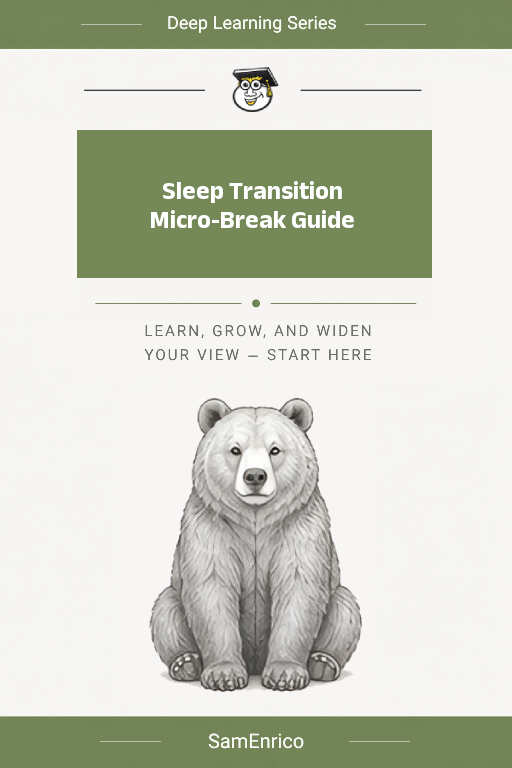
Non-FictionMental WealthSleep Hygiene
Sleep Transition Micro-Break Guide eBook
Use a five minute pre sleep routine of nervous sys
Use a five minute pre sleep routine of nervous system regulation to lower bedtime cortisol and improve sleep quality.
Formats
Free sample
Chapter 1: The Eight-Hour Lie--–- Sarah was doing everything right.That was the problem.At 42 years old, Sarah was a partner at a mid-sized law firm, a mother of two, and a woman who had optimized every corner of her life. She meal-prepped on Sundays. She used a standing desk. She drank seventy ounces of water daily. And when it came to sleep, she was a model citizen.She went to bed at 10:00 PM every night—sometimes 9:45 if she was feeling ambitious.
She owned blackout curtains so effective that her bedroom was visible only via infrared. She had a white noise machine that played something called "brown noise" (like white noise but deeper, supposedly more relaxing). She had traded her i Phone for an app that turned the screen red after sunset. She had even bought the expensive pillow—the one with the cooling gel and the cervical support curve.She also wore a sleep tracker. An Oura ring, specifically.
Every morning, she checked her stats like a day trader checking futures. Most days, the numbers were good. Sleep score: 85. Restfulness: Good. Deep sleep: 1 hour 47 minutes.
REM: 2 hours 12 minutes. Total time in bed: 8 hours 34 minutes.And every morning, Sarah woke up feeling like she had been hit by a truck.Not metaphorically. She described it to me in clinical terms: brain fog, muscle fatigue, a low-grade dread that sat in her chest like a cold stone. She needed two cups of coffee just to form sentences. By 2:00 PM, she was fantasizing about napping in her car.
By 8:00 PM, she was either exhausted but wired—too tired to think, too anxious to sleep.She came to me not because she believed I could help, but because she had run out of options. She had seen a sleep specialist, who ruled out sleep apnea. She had tried melatonin (worked for three nights, then stopped). She had tried CBD (gave her weird dreams). She had tried magnesium, glycine, valerian root, and a tea called "Nighty Night" that tasted like a compost heap.Nothing worked."I don't understand," she said, sitting in my office with her Oura ring data printed out on three sheets of paper.
"I'm doing everything right. Why can't I sleep?"I looked at her data. Then I looked at her. Then I asked a question that no one had asked her before."What are you doing in the ten minutes before you get into bed?"She blinked. "What do you mean?""I mean, what is the last thing you do before you turn out the light?"She thought about it.
"I check my email one last time. Just to make sure nothing exploded. Then I browse Instagram for a few minutes. Then I set my alarm and put my phone on the nightstand. Then I lie there and try to fall asleep.""How long does it take you to fall asleep?""Usually about ninety minutes.
Sometimes two hours.""And what happens in those ninety minutes?"She sighed. "My brain just... goes. It replays everything I did wrong that day. Every email I should have worded differently.
Every conversation I should have handled better. It makes lists of everything I need to do tomorrow. It comes up with worst-case scenarios about my kids, my cases, my marriage. It's like a radio station that only plays anxiety, and I can't find the off button."I nodded. "Sarah, you don't have a sleep problem.
You have a transition problem."She looked at me like I had just spoken in tongues.The Missing Variable Here is what the sleep industry has sold us for the past twenty years: a story about quantity and hygiene.The quantity story is simple. You need eight hours. That's the magic number. The National Sleep Foundation says so. Every wellness influencer says so.
Your Fitbit says so. If you sleep less than eight hours, you are a failure. You are slowly killing yourself. You are accumulating "sleep debt" that will eventually bankrupt your health.The hygiene story is also simple. You need a dark room, a cool temperature, no screens before bed, and a consistent schedule.
Do these things, and sleep will follow.These stories are not wrong. They are incomplete.Because Sarah had perfect sleep hygiene. She had a dark room. She had a consistent schedule. She had no screens in bed (technically—she used her phone before bed, but she put it down when she turned off the light).
And she was averaging eight and a half hours in bed every night.Yet she felt like a zombie.The missing variable—the one that every sleep book, every sleep tracker, and every sleep specialist had overlooked—is transition.Transition is the neurological gear shift from the sympathetic nervous system (your "fight or flight" mode) to the parasympathetic nervous system (your "rest and digest" mode). It is the process of convincing your brain that the workday is over, that there are no predators hiding in the bushes, and that it is safe to power down for the night.Here is the brutal truth that no one tells you: you cannot flick a switch from "Go" to "Sleep."Your nervous system does not work that way. It wasn't designed to work that way. For the vast majority of human evolutionary history, the transition from wakefulness to sleep was automatic. The sun went down.
The temperature dropped. The fire burned low. Your body received unambiguous signals that the day was over, and it responded by releasing melatonin, lowering cortisol, and easing you into rest.But you do not live in that world. You live in a world where the sun never sets—because you have overhead lighting, a laptop, and a phone that glows like a miniature star. You live in a world where the temperature never drops—because you have central heating.
You live in a world where the work never ends—because your email is always with you.Your nervous system is still running on ancient software, but you have updated the hardware. And the result is a system that cannot tell the difference between 10:00 PM and 8:00 AM.The Busy Brain Phenomenon Let me introduce you to a concept that will change how you think about your sleeplessness: the Busy Brain.The Busy Brain is not a diagnosis. It is not a medical condition. It is a description of a physiological state—specifically, a state of high cortical arousal.Here is what that means in plain English. Your brain has two major networks that compete for dominance.
The first is the Task Positive Network (TPN), also called the central executive network. This is the network you use when you are working, problem-solving, planning, paying attention, or making decisions. It is the "doing" network. When the TPN is active, your prefrontal cortex (the thinking part of your brain) is firing on all cylinders.The second is the Default Mode Network (DMN). This is the network that becomes active when you are not doing anything specific—when you are daydreaming, reflecting, or letting your mind wander.
The DMN is the "being" network. It is also, unfortunately, the network that generates self-referential thoughts: What did she mean by that? Did I…
This is the end of the free sample. Get the eBook to keep going. Buy now
About this book
Details
- Author
- Broyles Lurlene
- Publisher
- SamEnrico
- Language
- English
- Genre
- Non-Fiction, Mental Wealth, Sleep Hygiene
- Released
- 2026-06-01
- Pages (approx.)
- 150
- Available as
- eBook, Audiobook

Read better in the ZLOADR app
Your eBooks on your phone or tablet. Sign in with your SamEnrico account and start reading.
More by Broyles Lurlene
 Hinton Mail From SupportersBroyles Lurlene$11.99
 Road Rage De escalation PlanBroyles Lurlene$11.99
 The Fast Mover Safety StockBroyles Lurlene$11.99
 Overcoming Procrastination for EntrepreneursBroyles Lurlene$11.99
 Rani Lakshmibai Warrior QueenBroyles Lurlene$11.99
 Rapid Ideation Sprint GuideBroyles Lurlene$11.99
 Dream Journaling for TeensBroyles Lurlene$11.99
 British Empire Gulf ProtectoratesBroyles Lurlene$11.99
 The Hangman’s Last Supper: The Strange Case of François LesurquesBroyles Lurlene$11.99
 The First World Series: Ancient Greece’s Olympic Ball Game That Inspired the Modern GameBroyles Lurlene$11.99
 The Photographer's Guide to Candid PhotographyBroyles Lurlene$11.99
 How to Produce Dry ProductsBroyles Lurlene$11.99
You may also like
 Hong Kong Handover 1997Dunn Johnnie$11.99
 Zumba For Postnatal Recovery CourseNeal Christian$11.99
 Zumba for BeginnersLadner Nikia$11.99
 YouTube Comment Mining GuideHumes Pandora$12.99
 Worry Box MeditationCarlin Rudy$11.99
 Workplace Stress MeditationNguyen Lynn$11.99
 Workplace Stress and Sleep RepairHawley Ivory$11.99
 Workplace Perfectionism CureDelaney Jeffry$11.99
 Workplace Injustice Anger GuideWallen Isabelle$11.99
 Work Addiction and Burnout LinkGreenwood Ester$11.99
 Women in Yoga and WellnessBeattie Galina$11.99
 Women in Stand Up ComedyChun Evangeline$11.99