
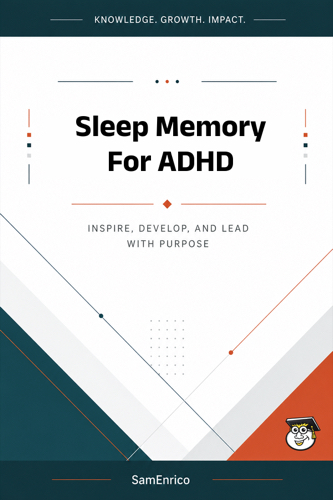
Sleep Memory For ADHD eBook
Manage attention deficits by optimizing rest.
by Wasson Trinh
Manage attention deficits by optimizing rest.
Formats
Free sample
Chapter 1: The Wired Night--–- The clock reads 2:47 AM. You have been in bed for nearly four hours. Your body is leaden with exhaustion, your eyes sting with every blink, and you have to be up for work in less than five hours. Yet here you are, wide awake, your mind racing through an endless loop of intrusive thoughts. Did I send that email?
What did she mean by that comment? I need to remember to call the dentist. Why is my heart beating so fast? I should just get up and do something. No, I need to stay in bed and try harder.
Why can’t I just sleep like a normal person?If you have ADHD, this scene is not a rare occurrence. It is the backdrop of your life. You have probably tried everything: meditation apps that made you more anxious, sleep teas that tasted like dirt and did nothing, white noise machines that became the soundtrack of your frustration, and the endless advice from well-meaning friends and family. “Just put down your phone.” “Have you tried melatonin?” “You need a consistent bedtime.” “Maybe you’re just not tired enough.”None of it worked. And you have spent years believing that the failure was yours.
That you lack discipline. That you are somehow broken in a way that other people are not.Here is the truth that will change everything: Your difficulty sleeping is not a character flaw. It is a predictable physiological consequence of how your ADHD brain is wired. The problem is not that you are trying too little. It is that you have been trying to solve the wrong problem with the wrong tools.
This chapter will reframe everything you thought you knew about your restless nights. We will explore why the ADHD brain gets stuck in a state of high alert, the hidden cycle of stimulants and sedatives that most people unknowingly use to worsen their sleep, and the first critical step toward breaking free. By the end, you will see your midnight brain not as an enemy to be conquered, but as a predictable system that can be understood, respected, and gently guided toward rest.The Two Gears of Your Nervous System To understand why you cannot sleep, you first need to understand how your nervous system is supposed to work. Your autonomic nervous system operates like a car with two pedals. The sympathetic nervous system is the accelerator.
It is your body’s built-in alarm system, designed to keep you alert, reactive, and ready for danger. When it is engaged, your heart rate increases, your pupils dilate, your digestion slows to a crawl, and stress hormones like cortisol and adrenaline flood your system. This is the “fight-or-flight” response, and it is a brilliant survival mechanism. It helped your ancestors outrun predators, and it helps you meet deadlines, handle emergencies, and wake up in the morning.The parasympathetic nervous system is the brake pedal. Often called the “rest and digest” system, it lowers your heart rate, stimulates digestion, constricts your pupils, and promotes a state of calm and recovery.
This is the state you need to fall asleep, stay asleep, and wake up feeling restored. In a healthy nervous system, the seesaw between these two systems moves fluidly. You wake with a sympathetic surge, shift into a balanced state during the day, and gradually tip toward parasympathetic dominance as evening approaches. By bedtime, your accelerator is barely pressed, and your brake is fully engaged.The ADHD brain does not move fluidly. It gets stuck.Research has shown that adults with ADHD have lower baseline levels of GABA—the brain’s primary inhibitory neurotransmitter, which acts as the chemical equivalent of the brake pedal.
Without enough GABA, your nervous system struggles to downshift from sympathetic arousal. You are not choosing to be wired at midnight; your brain literally lacks the chemical infrastructure to apply the brakes effectively. To make matters worse, the default mode network (DMN) —the brain’s “idle engine” that activates when you are not focused on anything in particular—is overactive in ADHD. The DMN is responsible for mind-wandering, self-referential thoughts, and internal chatter. In neurotypical brains, the DMN quiets down when you need to focus or sleep.
In ADHD brains, it often stays loud, generating a relentless stream of thoughts exactly when you need silence.The result is a nervous system that remains in a low-grade sympathetic state for hours after it should have shifted. You are not in full fight-or-flight—you would know it, with a pounding heart and sweaty palms. But you are not in true rest either. You are in a limbo that researchers call sympathetic dominance with parasympathetic insufficiency. In plain English: your accelerator is stuck slightly depressed, and your brake pedal is worn thin.The Willpower Trap Here is where most sleep advice goes catastrophically wrong for the ADHD brain.
Conventional wisdom tells you to “relax,” “clear your mind,” or “just breathe deeply.” These instructions assume a nervous system that is capable of following verbal commands. Yours is not.Telling an ADHD brain to “just relax” is like telling someone with a broken leg to “just walk it off.” The problem is structural and chemical, not motivational. You cannot think your way into parasympathetic dominance any more than you can think your way into lowering your blood pressure during a panic attack. The nervous system is largely automatic, governed by ancient brainstem circuits that do not respond to rational persuasion. You can no more “decide” to be calm than you can “decide” to digest your lunch faster.This is why you have likely tried every relaxation technique on the market—meditation apps, bedtime teas, lavender sprays, weighted blankets, white noise machines, progressive muscle relaxation, guided imagery, aromatherapy—and still found yourself staring at the ceiling at 2 AM.
It is not that those tools are useless. It is that you were applying them to the wrong problem. You were trying to calm a sympathetic nervous system that had not been given the sensory and behavioral cues it needs to downshift. You were fighting biology with willpower, and biology always wins.The good news is that you do not need more willpower. You need a different approach.
You need to stop trying to command your nervous system to calm down and start designing a physiological off-ramp from sympathetic arousal. This means using the body’s own sensory and behavioral levers—light, temperature, movement, sound, and timing—to manually engage the parasympathetic brake. You cannot tell your nervous system to relax, but you can trick it into relaxing by providing the right inputs. That is what the rest of this book will teach you to do.The Hidden Cycle: Stimulants and Sedatives Most people with ADHD unknowingly worsen their sleep problems through a common behavioral loop. Let me describe it, and see if it sounds familiar.Your morning starts with caffeine.
Coffee, tea, energy drinks, or soda—maybe multiple cups before noon. If you take prescription stimulants (such as methylphenidate or amphetamine salts), you take them with breakfast or even before getting out of bed. This is entirely reasonable. You need to function. The world expects you to…
This is the end of the free sample. Get the eBook to keep going. Buy now
About this book
Details
- Author
- Wasson Trinh
- Publisher
- SamEnrico
- Language
- English
- Genre
- Non-Fiction, Self-Help, ADHD
- Released
- 2026-06-06
- Pages (approx.)
- 152
- Available as
- eBook, Audiobook

Read better in the ZLOADR app
Your eBooks on your phone or tablet. Sign in with your SamEnrico account and start reading.
More by Wasson Trinh
 Self Doubt Networking GuideWasson Trinh$11.99
 Distraction Rehearsal Training GuideWasson Trinh$11.99
 Second Generation Cuisine FusionWasson Trinh$11.99
 Keto Brain Function GuideWasson Trinh$11.99
 Bessie Smith EmpressWasson Trinh$11.99
 Email Marketing Impact On ChurnWasson Trinh$11.99
 Tax Efficient Withdrawal OrderWasson Trinh$11.99
 The Vanishing of Flight 19: The Bermuda Triangle’s Final WitnessWasson Trinh$11.99
 The Silk Road Pioneers: Venice's Merchant Princes and the Birth of Global TradeWasson Trinh$11.99
 Understanding Fragile X-associated Tremor/ataxia Syndrome (Fxtas)Wasson Trinh$11.99
 How to Produce Skateboard TrucksWasson Trinh$11.99
 How to Produce Fruit MixesWasson Trinh$11.99
You may also like
 Hong Kong Handover 1997Dunn Johnnie$11.99
 Zumba For Postnatal Recovery CourseNeal Christian$11.99
 Zumba for BeginnersLadner Nikia$11.99
 YouTube Comment Mining GuideHumes Pandora$12.99
 Worry Box MeditationCarlin Rudy$11.99
 Workplace Stress MeditationNguyen Lynn$11.99
 Workplace Stress and Sleep RepairHawley Ivory$11.99
 Workplace Perfectionism CureDelaney Jeffry$11.99
 Workplace Injustice Anger GuideWallen Isabelle$11.99
 Work Addiction and Burnout LinkGreenwood Ester$11.99
 Women in Yoga and WellnessBeattie Galina$11.99
 Women in Stand Up ComedyChun Evangeline$11.99