
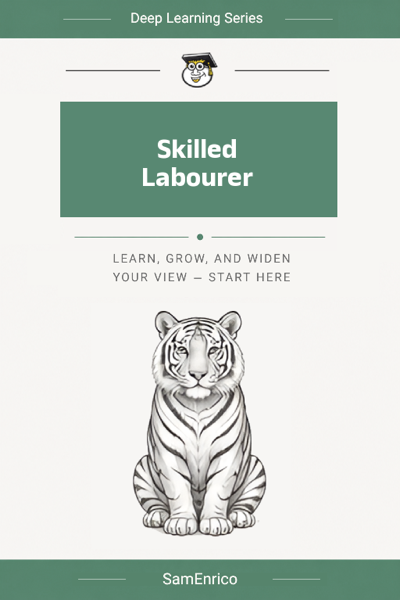
Non-FictionInformativeEducational
Skilled Labourer eBook
A Coursebook on Skilled Labourer
A Coursebook on Skilled Labourer
Formats
Free sample
Chapter 1: The Revaluation of Grit--–- The first time I watched a labourer solve a problem, I felt embarrassed about every spreadsheet I had ever been proud of. The man’s name was Carlos, and he was bent over a pump that had stopped working on a construction site outside Phoenix. The general contractor had already called a mechanic who wouldn’t arrive for three hours. The concrete truck was twenty minutes out. Carlos walked around the pump once, listened to the click it made when he tried the starter, then put his hand on the metal housing.
He did not have a diagnostic computer. He did not have a manual. He had his senses. “It’s the capacitor,” he said. He pulled a spare from his truck, swapped it in ninety seconds, and the pump turned over.
The concrete pour happened on schedule. The mechanic showed up three hours later and billed the contractor anyway. Carlos saved the day, and nobody gave him a bonus. Nobody even clapped. He just went back to work.
That moment stayed with me because it revealed something uncomfortable: we have been lied to about what counts as intelligent work.This chapter opens by confronting the cultural bias that desk jobs are inherently superior to manual work. It is a bias so deeply embedded in our education system, our parenting advice, and our social status markers that most people never stop to question it. We tell our children that the goal is to get a degree, find a clean office, and use our brains instead of our hands. We treat the skilled trades as a fallback—something you do if you aren’t smart enough for college or if you made bad choices somewhere along the way. This chapter argues the exact opposite: skilled labour is not a consolation prize.
It is a sophisticated, cognitively demanding, and deeply satisfying way to engage with the world. And the mass exodus from the trades—the so-called blue-collar drought—has left both our economy and our individual lives poorer than they need to be.The Great Disappearance Let us begin with a number: between 1985 and 2015, high school vocational education enrollment in the United States dropped by nearly forty percent. At the same time, four-year college enrollment nearly doubled. The message was clear—go to university or be left behind. School counsellors, parents, and popular culture all converged on the same script: a bachelor’s degree is the ticket to the middle class, and anything less is settling.
The result was a generation of young people pushed into university classrooms, often accumulating debt for degrees that delivered neither skills nor satisfaction. Meanwhile, the trades aged. The average age of a skilled construction worker in the United States is now forty-three years old. The average age of a plumber is forty-four. The average age of an electrician is forty-two.
These are not young fields anymore, and tens of thousands of experienced tradespeople retire every year with no one to replace them.This is the blue-collar drought. It is not a myth. It is not a temporary fluctuation. It is the predictable outcome of a thirty-year campaign to devalue manual work. And it has created a paradox: at the very moment that we have more people with college degrees than ever before, we have a desperate shortage of people who can actually build, fix, or maintain anything.
A recent survey of contractors found that ninety percent had trouble finding skilled labour. Wages in the trades have risen sharply as a result, but the pipeline remains empty because the cultural message has not changed. Parents still flinch when their child says they want to be an electrician. High schools still cut shop class to make room for Advanced Placement courses. We have created a world where we look down on the very people who keep our lights on, our water running, and our roofs from collapsing.The Cognition of the Hands The central argument of this chapter—and, in many ways, of this entire book—is that skilled labour requires a form of intelligence that is not inferior to abstract thinking but merely different.
And in many situations, it is more demanding. Consider the difference between manipulating symbols on a spreadsheet and diagnosing a malfunctioning engine. The spreadsheet operates in a closed system. The rules are known. The formulas are consistent.
There is no wind, no vibration, no variable temperature, no worn part that has drifted out of spec over years of use. The engine, by contrast, operates in an open system. It has been subjected to heat, moisture, dirt, and the unpredictable behaviour of previous mechanics. When it fails, the cause could be one of fifty things, and many of those things produce symptoms that look identical to an untrained eye. The skilled mechanic must interpret sound, smell, vibration, temperature, and sometimes even taste (coolant sweetness, for example) to narrow down the possibilities.
This is not rote repetition. This is diagnostic reasoning of a very high order.Matthew Crawford made this argument powerfully in his best-selling book Shop Class as Soulcraft. Crawford, who holds a Ph D in political philosophy but also runs a motorcycle repair shop, writes about the cognitive richness of manual work. He describes how a motorcycle engine that won’t start presents a problem that cannot be solved by following a flowchart alone. The mechanic must understand the machine as a system, generate hypotheses, test them with limited information, and adapt to the particular history of that specific engine.
This is the same kind of reasoning that a doctor uses when diagnosing a patient. We call it intelligence when it happens in a white coat. We call it manual labour when it happens in coveralls.The distinction between abstract thinking and mechanical thinking is not a hierarchy of difficulty. It is a difference in domain. Abstract thinking is powerful for certain kinds of problems—modelling financial systems, designing algorithms, analysing historical trends.
Mechanical thinking is powerful for other kinds—diagnosing physical systems, manipulating materials, responding to real-world feedback loops. Neither is intrinsically harder or more valuable. But we have built a culture that treats abstract thinking as the gold standard and mechanical thinking as something you do when you can’t handle abstraction. That is a mistake. And it is a mistake with consequences.Case Study: The Electrician Who Never Stops Learning Let me introduce you to Diane.
She is a master electrician in Oregon, and she earns more than most of the lawyers in her town. Diane did not take a straight path to her trade. She started at a community college studying liberal arts, transferred to a four-year university, and lasted two semesters before she realized she was bored and in debt. She took a summer job as an electrician’s helper and never went back. Now, twenty years later, she runs her own small contracting business.
She works on residential, commercial, and solar installations. Her days vary wildly. One morning she might be bending conduit in a crawlspace. The next afternoon she might be calculating voltage drop for a new building. She has to know the electrical code, which updates every three years.
She has to understand building physics, load calculations, and the specific quirks of different brands of panels and breakers. She…
This is the end of the free sample. Get the eBook to keep going. Buy now
About this book
Details
- Author
- Duckett Tesha
- Publisher
- SamEnrico
- Language
- English
- Genre
- Non-Fiction, Informative, Educational
- Released
- 2026-06-02
- Pages (approx.)
- 126
- Available as
- eBook, Audiobook

Read better in the ZLOADR app
Your eBooks on your phone or tablet. Sign in with your SamEnrico account and start reading.
More by Duckett Tesha
 Trader Morning RoutineDuckett Tesha$11.99
 Strava Segment Comparison TrapDuckett Tesha$11.99
 The Arthritis Biologic GuideDuckett Tesha$11.99
 Remote Company Retreats For Pet OwnersDuckett Tesha$11.99
 The Ayurvedic Taste GuideDuckett Tesha$11.99
 The Unstoppable Comeback: How a Broken Record Made HistoryDuckett Tesha$11.99
 Fixed Rate Lock StrategiesDuckett Tesha$12.99
 Price Evaluation PreferenceDuckett Tesha$12.99
 How to Become a Poleyard SupervisorDuckett Tesha$11.99
 Understanding Short Stature Locking FingersDuckett Tesha$17.99
You may also like
 Hong Kong Handover 1997Dunn Johnnie$11.99
 Zumba For Postnatal Recovery CourseNeal Christian$11.99
 Zumba for BeginnersLadner Nikia$11.99
 YouTube Comment Mining GuideHumes Pandora$12.99
 Worry Box MeditationCarlin Rudy$11.99
 Workplace Stress MeditationNguyen Lynn$11.99
 Workplace Stress and Sleep RepairHawley Ivory$11.99
 Workplace Perfectionism CureDelaney Jeffry$11.99
 Workplace Injustice Anger GuideWallen Isabelle$11.99
 Work Addiction and Burnout LinkGreenwood Ester$11.99
 Women in Yoga and WellnessBeattie Galina$11.99
 Women in Stand Up ComedyChun Evangeline$11.99