
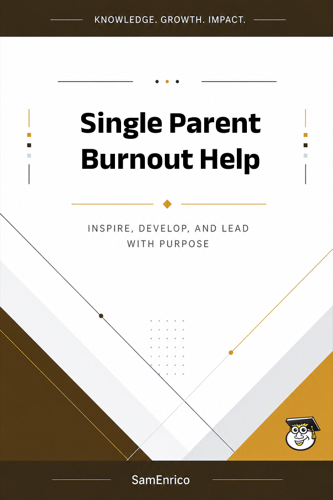
Non-FictionSelf-HelpSingle Parenting
Single Parent Burnout Help eBook
Juggles work and solo childcare.
Juggles work and solo childcare.
Formats
Free sample
Chapter 1: The Juggling Autopsy--–- The first thing you need to know about burnout is that it doesn't feel like a collapse. It feels like a slow leak. You don't wake up one morning unable to move. Instead, you wake up for the third time that night, check your phone to see if the school has canceled classes due to a snowstorm you haven't had time to look at, realize your child has crawled into your bed sometime after 2 AM, and notice that you are still wearing yesterday's clothes. You think: I just need to get through today.
And you do. And then you do it again tomorrow. And the day after that. And somewhere around the four hundredth consecutive day of this, you stop wondering why you're exhausted and start wondering if exhaustion has simply become your personality.This chapter is not about fixing anything. Not yet.
Before you can solve a problem you have to name it, and most single parents cannot name the specific shape of their exhaustion because they have never been given permission to look at it directly. Society tells you to be grateful. Well-meaning friends tell you that you're "so strong." Your children need you to be the stable one. So you compartmentalize, you push through, and you lose the ability to see that you are juggling fifteen invisible balls while everyone else is juggling seven or eight. The goal of this chapter is simple: to stop juggling long enough to see what you are actually holding.We are going to perform what I call a Juggling Autopsy.
It is not a pleasant exercise. It will not make you feel empowered in the moment. But it is the single most important diagnostic tool in this entire book, because you cannot treat burnout until you understand the specific tasks, worries, and hidden obligations that are draining you. And here is the truth that most self-help books avoid: the problem is not your time management. The problem is not your attitude.
The problem is the structural reality that you are doing the work of two parents, and no amount of positive thinking will change that fact. What we can change is your awareness of where your energy is going—and then, in later chapters, your willingness to drop some of those balls entirely.The Difference Between Tired and Depleted Before we dive into the autopsy, we need a vocabulary for what you're experiencing. Most single parents describe themselves as "tired," but that word covers everything from a mild lack of sleep to profound clinical exhaustion. The distinction matters because the solutions are different.Tired is what you feel after a night of broken sleep or a long week. Tired responds to rest.
One good night of sleep, one quiet Saturday morning, one evening when the children are with the other parent—these things cure tired. Tired is a temporary state.Depleted is what happens when tired becomes chronic and layers on top of emotional stress, financial anxiety, isolation, and the relentless pressure of sole responsibility. Depletion does not respond to a single night of sleep. Depletion responds to autonomy, to meaningful rest, to a reduction in the number of decisions you have to make each day, and to structural changes in your life. Depletion is not a state; it is a condition.Here is the test: If you won the lottery tomorrow and could hire a full-time nanny, a chef, and a housekeeper, would you still feel exhausted?
If the answer is yes, you are dealing with something deeper than tired. If the answer is no, your exhaustion is primarily situational—which is actually good news, because situations can be changed. But most single parents fall somewhere in the middle: some of their exhaustion is situational (too many tasks, not enough help) and some is internal (perfectionism, guilt, the inability to rest even when rest is available).The Juggling Autopsy will help you separate these threads. By the end of this chapter, you will have a list of the specific drains on your energy, ranked by how much they actually cost you. And you will have identified the three drains that are doing the most damage.
Those three will become your targets for the rest of this book.What You're Actually Juggling: The Hidden Labor Inventory When a married parent says they're busy, they are usually describing visible tasks: making dinner, driving to soccer practice, finishing a work project. When a single parent says they're busy, they are describing visible tasks plus an entire second layer of invisible work that couples split between two adults. I call this the Hidden Labor Inventory.Let me give you an example. A married mother of two wakes up and thinks: I need to pack lunches, sign the permission slip, and call the pediatrician. Her husband thinks: I need to start the car, get the kids dressed, and remember that today is picture day.
Between them, they cover everything. The mental load is distributed.A single mother wakes up and thinks: I need to pack lunches, sign the permission slip, call the pediatrician, start the car, get the kids dressed, remember picture day, check if I have enough gas, figure out what we're having for dinner, confirm that the after-school program is still on, email my boss about tomorrow's meeting, and also somehow find ten minutes to pay the electric bill before it's late. She does not have a husband to split this list with. She has herself. And here is the cruelest part: she has been doing this for so long that she no longer notices the length of the list.
It has become normal.The Hidden Labor Inventory includes:Emotional tracking: Remembering how your child feels about the upcoming test, the birthday party they weren't invited to, the fight they had with a friend. In two-parent households, this is often split. In single-parent households, you are the sole repository of your child's emotional history.Logistical memory: Knowing when the field trip form is due, when the dental appointment is scheduled, when the car needs an oil change, when the school has a half-day, when the library books are due, when the utility bill auto-pays. These are not tasks; they are reminders about tasks, and they occupy cognitive bandwidth whether you act on them or not.Contingency planning: Thinking through what happens if the child gets sick on a day you have a big presentation. Thinking through what happens if the car breaks down.
Thinking through what happens if you get the flu. Two-parent households have a built-in backup. You are your own backup, which means you are constantly running worst-case scenarios in the background of your mind.Solo decision-making: Every decision, from "what's for dinner" to "should we switch pediatricians" to "how do I handle this behavior problem," falls on you. Decision fatigue is real, and it accumulates over the course of the day until even small choices (paper or plastic? left or right?
chicken or fish?) feel exhausting.The silent to-do list: The things you are not doing but know you should be. The thank-you notes you haven't written. The closet you haven't organized. The friend you haven't…
This is the end of the free sample. Get the eBook to keep going. Buy now
About this book
Details
- Author
- Smallwood Nena
- Publisher
- SamEnrico
- Language
- English
- Genre
- Non-Fiction, Self-Help, Single Parenting
- Released
- 2026-06-06
- Pages (approx.)
- 126
- Available as
- eBook, Audiobook

Read better in the ZLOADR app
Your eBooks on your phone or tablet. Sign in with your SamEnrico account and start reading.
More by Smallwood Nena
 Musician Performance Sleep GuideSmallwood Nena$11.99
 Hooper TV MasterSmallwood Nena$11.99
 Vehicle Winter Emergency KitSmallwood Nena$11.99
 RLS And Sleep Apnea Connection GuideSmallwood Nena$11.99RLS And Sleep Apnea Connection GuideSmallwood Nena$11.99
 Female Rulers Communication Cipher CourseSmallwood Nena$11.99
 The Branch Davidian ExilesSmallwood Nena$11.99
 Number Memorization PalaceSmallwood Nena$11.99
 Cleopatra Last PharaohSmallwood Nena$11.99
 The Sugar Baroness of the Caribbean: Madame C.J. Walker's Sweet SuccessSmallwood Nena$11.99
 Orpheus: The Lyre That Shattered HadesSmallwood Nena$11.99
 Love in the Time of War: The Secret Letters of Vera Brittain and Roland LeightonSmallwood Nena$11.99
You may also like
 Hong Kong Handover 1997Dunn Johnnie$11.99
 Zumba For Postnatal Recovery CourseNeal Christian$11.99
 Zumba for BeginnersLadner Nikia$11.99
 YouTube Comment Mining GuideHumes Pandora$12.99
 Worry Box MeditationCarlin Rudy$11.99
 Workplace Stress MeditationNguyen Lynn$11.99
 Workplace Stress and Sleep RepairHawley Ivory$11.99
 Workplace Perfectionism CureDelaney Jeffry$11.99
 Workplace Injustice Anger GuideWallen Isabelle$11.99
 Work Addiction and Burnout LinkGreenwood Ester$11.99
 Women in Yoga and WellnessBeattie Galina$11.99
 Women in Stand Up ComedyChun Evangeline$11.99