
Non-FictionBiographySilverstone
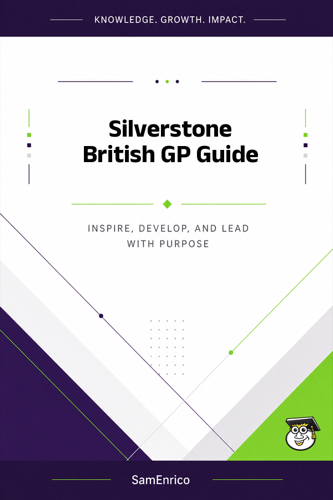
Silverstone British GP Guide eBook
Excel at the home of Formula One racing.
Excel at the home of Formula One racing.
Formats
Free sample
Chapter 1: From Bombers to Burnouts...--The sound that defines Silverstone today is a 1,000-horsepower V6 hybrid engine screaming past at 200 miles per hour. But eighty years ago, a very different noise echoed across these same fields: the deep, throaty rumble of Rolls-Royce Merlin engines powering Vickers Wellington and Avro Lancaster bombers. Royal Air Force Silverstone was never intended to host the world's most prestigious motor race. It was built for war. And yet, the concrete runways and perimeter roads that once launched young men into the night skies over occupied Europe would, within a decade, launch something entirely unexpected: the birthplace of Formula One.This chapter is not merely a history lesson.
It is the foundation upon which every subsequent chapter rests. Understanding how a wartime airfield transformed into the spiritual home of British motorsport transforms the way you watch a race. When you stand on the pit straight, you are standing on history. When you walk the perimeter track during the post-race invasion, your feet trace the same tarmac where bombers once queued for takeoff. And when you sit in the grandstands at Copse or Becketts, you occupy ground that saw the evolution of racing from the lethal, no-chicane glory days of the 1950s to the high-tech, safety-conscious Arena layout of today.
This is the story of that transformation—from bombers to burnouts.The Accidental Circuit: RAF Silverstone 1943-1945RAF Silverstone was constructed in 1943 as a satellite airfield for RAF Chipping Warden, part of the sprawling network of bomber command stations across Northamptonshire and Buckinghamshire. The site was chosen for its flat, open farmland—ideal for laying long concrete runways. By the time construction finished, the airfield boasted three runways: the main runway running roughly north-south at 2,000 yards, and two secondary runways crossing it in a classic "A" pattern. Surrounding these runways was a perimeter track of over three miles, designed to allow heavy bombers to taxi from their hardstands to the runways without clogging the main strip.The squadrons stationed here—first Vickers Wellingtons, later Avro Lancasters—flew missions against German industrial targets, including the notorious bombing of the Ruhr Valley. For the young airmen based at Silverstone, the perimeter road was simply a taxiway.
They had no idea they were driving on what would become the fastest racing circuit in the world.The war ended in 1945, and RAF Silverstone was gradually decommissioned. The runways fell silent. The control tower stood empty. The farmland reverted to grazing sheep. For three years, the airfield sat in limbo, awaiting a fate no one could have predicted.
That fate arrived in 1948, when the Royal Automobile Club (RAC) came looking for a place to stage a motor race.The First Race: 1948 RAC International Grand Prix Britain in the late 1940s was hungry for entertainment. The austerity of the post-war years had left the public desperate for spectacle, for speed, for excitement. Motor racing offered all three. The RAC had been running the British Grand Prix since 1926, alternating between circuits like Brooklands and Donington Park. But Brooklands had been damaged during the war, and Donington had fallen into disrepair.
They needed a new venue.Enter Silverstone. The RAC recognized that the airfield's runways and perimeter roads could be linked together to form a makeshift circuit. It was rough, it was unglamorous, and it was utterly brilliant. The layout was simple: cars would use the main runway for the start-finish straight, turn onto the perimeter track, then follow it around the entire airfield before returning to the runway. The result was a 3.67-mile high-speed loop with almost no chicanes, no barriers, and hay bales for protection.On October 2, 1948, the RAC International Grand Prix roared to life.
The race was not yet an official Formula One event—the World Championship would not launch until 1950—but it drew 50,000 spectators who lined the perimeter track, standing behind ropes and straw bales. The cars were pre-war Maseratis, ERAs, and Delages, driven by men who had survived the war and still carried its scars. The winner was Luigi Villoresi in a Maserati 4CL, but the real winner was Silverstone itself. The circuit had proven itself fast, safe enough by 1948 standards, and capable of hosting a major international event.The RAC took note. Two years later, Silverstone would host something far greater.The Birth of a Championship: 1950 British Grand Prix The FIA Formula One World Championship was conceived in 1949 and launched in 1950.
The inaugural season consisted of seven races, spread across Europe and the Indianapolis 500. The fifth round was the British Grand Prix, and it was awarded to Silverstone.May 13, 1950, dawned grey and damp. The paddock was a collection of temporary tents and transport trucks. The pit lane was a row of wooden sheds. The grandstands were hastily erected scaffolding.
None of it mattered. What mattered was that the world's best drivers and the world's most advanced racing cars had gathered in a Northamptonshire field to make history.The grid was extraordinary: Giuseppe Farina in an Alfa Romeo 158, Juan Manuel Fangio in another Alfa Romeo, Luigi Fagioli, Prince Bira, and a host of privateers in Maseratis, Talbots, and ERAs. The Alfas were dominant—supercharged straight-eights producing over 350 horsepower, which was staggering for 1950. They finished 1-2-3, with Farina taking the win ahead of Fangio and Fagioli.But the race was not just about the Alfas. It was about the circuit.
The drivers loved Silverstone's speed. The perimeter layout allowed them to stay flat-out for minutes at a time, with only a few gentle bends to break the monotony. The fastest corner was the right-handed sweep that would later be named Copse, taken flat-out at over 140 mph. The slowest section was the hairpin at the far end of the circuit, where drivers had to brake from 150 mph to 40 mph.The 1950 British Grand Prix was a success. The crowd was smaller than 1948—around 30,000—but the event established Silverstone as the permanent home of the British Grand Prix.
It would not be the only home—Aintree and Brands Hatch would later host the race in rotation—but Silverstone would always be the spiritual center.The Perimeter Years: 1950-1990For forty years, the British Grand Prix at Silverstone was run on variations of the original perimeter layout. The circuit changed slowly, incrementally, but its character remained constant: high speed, minimal braking, and immense courage.The 1950s saw the addition of the Woodcote chicane, a slow left-right sequence inserted before the start-finish straight to reduce speeds after a series of fatal accidents. The chicane was crude—just a few straw bales and a painted line—but it worked. The 1960s brought the construction of a permanent pit straight and the famous "Silverstone Wing" paddock complex, which replaced the wartime control tower. The 1970s saw the addition of proper barriers, catch fencing, and runoff areas, as safety became a paramount concern following the deaths of drivers like Jim Clark (at Hockenheim, not Silverstone) and the horrific 1973 crash of Andrea de Adamich.Through all these changes, the essence of Silverstone remained: fast corners, long straights, and a unique rhythm that rewarded bravery over finesse.
The drivers who mastered Silverstone were not necessarily the most technically gifted—they were the ones with the biggest hearts. Jim Clark won here…
This is the end of the free sample. Get the eBook to keep going. Buy now
About this book
Details
- Author
- Marshall Jaime
- Publisher
- SamEnrico
- Language
- English
- Genre
- Non-Fiction, Biography, Silverstone
- Released
- 2026-06-06
- Pages (approx.)
- 104
- Available as
- eBook, Audiobook

Read better in the ZLOADR app
Your eBooks on your phone or tablet. Sign in with your SamEnrico account and start reading.
More by Marshall Jaime
 Body Image for Facial Hair WomenMarshall Jaime$11.99
 Emotional Envy RegulationMarshall Jaime$11.99
 Craving Survival KitMarshall Jaime$11.99
 Charity Fundraising PersuasionMarshall Jaime$11.99
 Murder on Social MediaMarshall Jaime$11.99
 Divorce Post Traumatic GrowthMarshall Jaime$11.99
 Mendeleev Periodic Table PredictionsMarshall Jaime$11.99
 Love Letters from the Silver Screen: The Wartime Romance That Won the OscarMarshall Jaime$11.99
 The Enchanted Scores: Erich Wolfgang Korngold and the Birth of Hollywood's Golden AgeMarshall Jaime$11.99
 How to Produce Food Mixers and BlendersMarshall Jaime$11.99
 Understanding AgraphiaMarshall Jaime$17.99
 Ultimate Handbook Guide to Jamshedpur : (India) Travel GuideMarshall Jaime$11.99
You may also like
 Hong Kong Handover 1997Dunn Johnnie$11.99
 Zumba For Postnatal Recovery CourseNeal Christian$11.99
 Zumba for BeginnersLadner Nikia$11.99
 YouTube Comment Mining GuideHumes Pandora$12.99
 Worry Box MeditationCarlin Rudy$11.99
 Workplace Stress MeditationNguyen Lynn$11.99
 Workplace Stress and Sleep RepairHawley Ivory$11.99
 Workplace Perfectionism CureDelaney Jeffry$11.99
 Workplace Injustice Anger GuideWallen Isabelle$11.99
 Work Addiction and Burnout LinkGreenwood Ester$11.99
 Women in Yoga and WellnessBeattie Galina$11.99
 Women in Stand Up ComedyChun Evangeline$11.99