
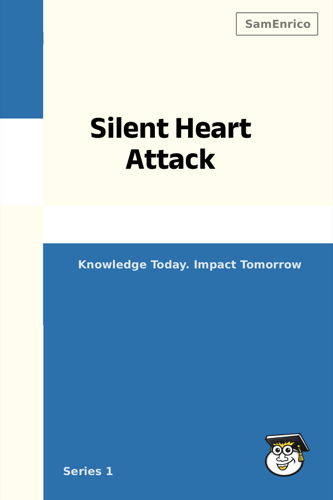
Non-FictionHealth & WellnessWomen
Silent Heart Attack eBook
Teaches atypical symptoms in women and diabetics.
Teaches atypical symptoms in women and diabetics.
Formats
Free sample
Chapter 1: The Great Masquerade...–- The call came in at 11:47 on a Tuesday morning. A 54-year-old woman, conscious and breathing, reported "bad indigestion" that had been bothering her since the previous evening. She was alert, talking normally, and specifically denied any chest pain. The paramedics noted her vital signs were stable. They transported her without lights or sirens.
In the emergency department, she waited forty-five minutes for a bed. Her EKG was read as "non-diagnostic." A resident noted her history of anxiety and prescribed antacids. She was discharged at 3:22 PM with instructions to follow up with her primary care physician.At 6:47 PM, her husband called 911. She was unresponsive on the kitchen floor. Despite resuscitation efforts, she was pronounced dead at 7:31 PM.
The autopsy revealed a massive myocardial infarction involving 40 percent of her left ventricle. The cause of death: a "silent" heart attack that had been evolving for nearly twenty-four hours while every medical professional she encountered assured her she was fine.This is not an unusual story. It is not a rare case. It is not medical malpractice in the sense that any single provider acted with gross negligence. It is, instead, a story that repeats itself thousands of times each year because of a fundamental misunderstanding that permeates both popular culture and medical training.
The misunderstanding is simple, seductive, and deadly: that a heart attack announces itself with crushing chest pain, that the absence of chest pain means the absence of a heart attack, and that a "normal" EKG in a stable patient rules out cardiac danger.Every part of that understanding is wrong.The Anatomy of a Dangerous Myth The image is burned into our collective consciousness. A middle-aged man—usually white, usually wearing a suit or a golf shirt—suddenly clutches his chest. His face contorts in agony. He staggers, gasps, and collapses. Someone yells "He's having a heart attack!" and heroic measures ensue.
This scene has been depicted thousands of times in movies, television shows, and even public health advertisements. It is the "Hollywood Heart Attack," and it has done incalculable damage to public health.The damage occurs not because the image is entirely fictional—some heart attacks do look exactly like that. The damage occurs because that image has become the only recognized face of a heart attack. When that image does not match a patient's experience, both the patient and their medical providers assume heart attack is off the table. This assumption kills.Research published in the Journal of the American Medical Association analyzed depictions of heart attacks in popular medical dramas over a fifteen-year period.
The study found that over 90 percent of portrayed heart attacks featured the classic chest-clutching collapse. Less than 5 percent showed any atypical symptom such as jaw pain, fatigue, or nausea. When atypical symptoms were shown, they were almost always in secondary characters who were explicitly identified as "unusual cases." The message, reinforced thousands of times across millions of viewing hours, is unambiguous: real heart attacks look one way, and everything else is something else.The consequences of this cultural conditioning are measurable and devastating. A 2018 study in Circulation tracked emergency department presentation patterns across 2,347 patients with confirmed myocardial infarction. Among male patients under sixty-five, 71 percent presented with chest pain as their primary symptom.
Among female patients under sixty-five, only 54 percent presented with chest pain. For patients over sixty-five with diabetes, the number dropped to 38 percent. Yet when researchers asked these same patients why they delayed seeking care, the most common answer—across all demographics—was some variation of "I didn't think it was a heart attack because I wasn't having chest pain."The patient herself had internalized the same myth that her doctors would later rely upon. She did not seek help sooner because she did not recognize herself in the Hollywood script. By the time she did seek help, she was already hours into an evolving infarction.
And when she arrived at the emergency department, the institutional version of the same myth—encoded in triage algorithms, EKG interpretation protocols, and physician training—continued to work against her.Silent Versus Atypical: A Critical Distinction Before we proceed further, a definitional clarification is essential. Throughout this book, you will encounter two related but distinct concepts: truly silent heart attacks and atypical heart attacks. Understanding the difference could save your life.A truly silent heart attack is exactly what the name implies: a myocardial infarction that occurs without any symptoms whatsoever. The patient feels nothing. There is no chest pain, no jaw pain, no fatigue, no nausea—no warning signs at all.
The heart muscle dies in complete silence. The patient may only discover the event months or years later when a routine EKG reveals Q waves, the electrical signature of old scar tissue. Approximately 20 to 30 percent of all heart attacks are truly silent, and the percentage is significantly higher among diabetics, who may lose cardiac pain sensation entirely due to autonomic neuropathy.An atypical heart attack, by contrast, produces symptoms—just not the classic chest pain symptom that triggers the Hollywood script. Atypical symptoms include crushing fatigue, indigestion that antacids cannot touch, jaw or back pain, shortness of breath without exertion, nausea and vomiting, flu-like achiness without fever, sleep disturbances, lightheadedness, and a vague sense of impending doom. These symptoms are real and often severe, but because they do not match the expected pattern, they are frequently dismissed by both patients and providers.Why does this distinction matter?
Because the detection strategy for each is different. For truly silent events, the patient cannot rely on symptoms at all; they must rely on risk factor assessment and appropriate screening tests. For atypical events, the patient must learn to recognize the "wrong" symptoms as potentially cardiac and must learn to advocate effectively when those symptoms are dismissed. This book will address both populations, and we will signal clearly when we are discussing one versus the other.For the remainder of this chapter, we will focus primarily on atypical presentations—the missed symptoms that patients feel but do not recognize as cardiac. We will return to truly silent events in Chapter 9, when we discuss the psychological and physical consequences of discovering damage you never knew occurred.The Male Phenotype Problem The Hollywood Heart Attack is not merely a media invention.
It is rooted in a biological reality—but only for a subset of the population. The classic presentation of myocardial infarction—sudden substernal chest pain, often radiating to the left arm or jaw, accompanied by shortness of breath and diaphoresis (sweating)—is what cardiologists call the "male phenotype" of heart disease. It is the way heart attacks most often present in middle-aged men with obstructive disease of the large coronary arteries.This phenotype exists because men typically develop plaque in the epicardial (large) coronary arteries. When these large vessels become obstructed, the ischemia affects a substantial territory of the heart, triggering a robust pain response via the sympathetic nervous system. The pain is intense, sudden, and unmistakable.
This is the pathology that was studied almost exclusively when heart disease research began in earnest in the mid-twentieth century—because the subjects were almost exclusively male.The Framingham Heart Study, which began in 1948 and has produced…
This is the end of the free sample. Get the eBook to keep going. Buy now
About this book
Details
- Author
- Wicks Modesta
- Publisher
- SamEnrico
- Language
- English
- Genre
- Non-Fiction, Health & Wellness, Women
- Released
- 2026-06-06
- Pages (approx.)
- 160
- Available as
- eBook, Audiobook

Read better in the ZLOADR app
Your eBooks on your phone or tablet. Sign in with your SamEnrico account and start reading.
More by Wicks Modesta
 Recording Anchoring ProtocolsWicks Modesta$11.99
 Stress Acne Breakout GuideWicks Modesta$11.99
 Step Six Character Defect Willingness WorkbookWicks Modesta$11.99
 Breath Control for Long TakesWicks Modesta$11.99
 Vitamin B12 and MemoryWicks Modesta$11.99
 Cash Flow for ManufacturingWicks Modesta$12.99
 Dog Loss Bereavement WorkbookWicks Modesta$11.99
 The Hollow Hill: Where the Trolls Still WhisperWicks Modesta$11.99
 The Gold of the Andes: The Great Lima Bank Heist of 1888Wicks Modesta$11.99
 How to Produce Mining and Quarrying EquipmentWicks Modesta$11.99
 How to Produce a Z-urcWicks Modesta$11.99
 Growing AnthuriumWicks Modesta$11.99
You may also like
 Hong Kong Handover 1997Dunn Johnnie$11.99
 Zumba For Postnatal Recovery CourseNeal Christian$11.99
 Zumba for BeginnersLadner Nikia$11.99
 YouTube Comment Mining GuideHumes Pandora$12.99
 Worry Box MeditationCarlin Rudy$11.99
 Workplace Stress MeditationNguyen Lynn$11.99
 Workplace Stress and Sleep RepairHawley Ivory$11.99
 Workplace Perfectionism CureDelaney Jeffry$11.99
 Workplace Injustice Anger GuideWallen Isabelle$11.99
 Work Addiction and Burnout LinkGreenwood Ester$11.99
 Women in Yoga and WellnessBeattie Galina$11.99
 Women in Stand Up ComedyChun Evangeline$11.99