
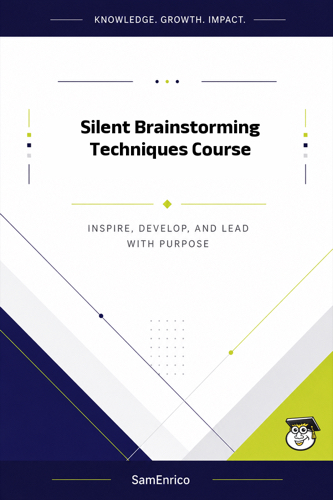
Non-FictionSelf-HelpIntrovert Inclusion
Silent Brainstorming Techniques Course eBook
Uses brainwriting and silent ideation to include i
Uses brainwriting and silent ideation to include introverts in group creativity.
Formats
Free sample
Chapter 1: The Loudness Trap--–- In a brightly lit conference room in Silicon Valley, twelve engineers, three product managers, and one very enthusiastic CEO spent ninety minutes shouting ideas at one another. The objective was to name a new software feature that would supposedly save the company from irrelevance. The extroverts dominated the first thirty minutes. The CEO spoke for fifteen of those minutes. The most senior engineer, a thoughtful man named David who had been with the company since its founding, said exactly zero words.
He sat near the back, notebook open, pen in hand, writing furiously. He filled three pages with ideas. He never raised his hand. No one asked for his input. At the end of the session, the team had a list of forty-three ideas, most of which came from the same four people.
They voted on the loudest proposal—a name that everyone secretly disliked but no one felt safe opposing because the CEO had smiled when it was suggested. The feature launched six months later. It failed. A post-mortem revealed that David had written the winning idea—the one that would have worked—on page two of his notebook. He had never been asked to share it.
He quit three weeks after the launch.This story is not unusual. It is not a cautionary tale from a dysfunctional startup. It is the standard operating procedure of the modern workplace. And it is destroying your organization's best ideas every single day.The Problem That No One Is Talking About Let us begin with a simple question. When was the last time you left a brainstorming session feeling genuinely energized, creatively fulfilled, and certain that the best idea in the room had been captured?
If you are like most professionals, the answer is somewhere between "rarely" and "never." But here is the more important question: when was the last time you left a brainstorming session feeling exhausted, frustrated, or invisible? For a significant portion of the workforce—between thirty and fifty percent, depending on which study you consult—that feeling is the norm.The problem is not that brainstorming is inherently broken. The problem is that the version of brainstorming most organizations practice was designed for only one type of thinker: the verbal processor. The person who thinks out loud. The person who thrives on rapid back-and-forth.
The person whose best ideas arrive in the heat of verbal sparring. This person exists, and their contributions are valuable. But they are not the only person in the room. And when we design creative processes exclusively for them, we systematically exclude everyone else.This book is about those "everyone else" people. It is about the Davids of the world—the quiet ones who fill notebooks with brilliant ideas while the loud ones fill the air with noise.
It is about the introverts, the deep thinkers, the processing-delayed, and the simply overwhelmed who have learned that raising a hand in a rapid-fire brainstorming session is an exercise in futility. By the time they have formulated a thoughtful response, the conversation has moved on. By the time they have found the courage to speak, three other people have already said something similar but worse. By the time they open their mouths, the room has already decided.The Extrovert Ideal and the Invention of "New Groupthink"To understand how we arrived at this situation, we must first understand a cultural force that psychologist and author Susan Cain has termed the "Extrovert Ideal." This is the pervasive, largely unexamined belief that the ideal self is gregarious, alpha, and comfortable in the spotlight. It is the assumption that the best leaders are the most talkative, the best salespeople are the most charming, and—crucially for our purposes—the most creative teams are the ones that generate the most verbal activity.The Extrovert Ideal did not always exist.
In the early twentieth century, American culture celebrated the "Man of Character"—someone reserved, dignified, and private. But by the 1920s, with the rise of big cities, mass marketing, and a new obsession with personality, the ideal shifted. The "Man of Personality" emerged: bold, charismatic, and publicly visible. Dale Carnegie's How to Win Friends and Influence People (1936) became the bible of this new ethos, teaching millions that success required talking, selling, and performing. By the time the modern corporation took its current form in the 1950s and 1960s, the Extrovert Ideal was fully entrenched.
Open floor plans replaced private offices. Team-based work replaced individual contribution. And brainstorming—invented by advertising executive Alex Osborn in 1942—became the default creative methodology of the white-collar world.Osborn's original rules for brainstorming were simple: generate as many ideas as possible, withhold criticism, combine and improve ideas, and encourage wild and unusual suggestions. These rules are not inherently bad. In fact, they are quite good.
The problem is not the rules themselves but the environment in which they are typically applied. Osborn assumed a room of equals, all equally willing and able to speak. He did not account for hierarchy, for personality differences, for the paralyzing fear of public judgment, or for the simple fact that some people process information more slowly than others. He designed a system for verbal processors and called it universal. That assumption—that what works for the talkers works for everyone—is the Loudness Trap.The Hidden Cost of the Loudness Trap The Loudness Trap has three distinct costs, each of which drains value from your organization in ways that are difficult to measure but impossible to ignore.Cost One: Lost Ideas The most obvious cost is the simplest: you are missing ideas.
Not bad ideas. Not average ideas. Your best ideas. Research consistently shows that the correlation between verbal dominance and idea quality is zero. Zero.
The person who speaks the most is not more likely to have the best idea. The person who speaks first is not more likely to have the correct solution. The person who interrupts the most is not more likely to be the creative genius of the group. But in a traditional verbal brainstorming session, these are exactly the people who drive the outcome. They speak more, so their ideas are heard more.
Their ideas are heard more, so they are discussed more. They are discussed more, so they are voted on more. And they are voted on more, so they are implemented more. Not because they are better ideas. Simply because they were audible.Consider a study conducted by researchers at the University of California, Berkeley.
They placed groups of strangers in a room and asked them to solve a complex problem. The groups were mixed: some members were told to speak as much as possible, others were told to listen and observe. The results were striking. The groups with high verbal activity produced more ideas, but the groups with high listening activity produced better ideas—measured by originality, feasibility, and long-term impact. The listeners, it turned out, were synthesizing information, connecting disparate concepts, and catching errors that the talkers steamrolled past.
But here is the catch: in a real-world setting, the listeners rarely get credit. Because they do not speak, they do not appear to contribute. Because they…
This is the end of the free sample. Get the eBook to keep going. Buy now
About this book
Details
- Author
- Saunders Kenneth
- Publisher
- SamEnrico
- Language
- English
- Genre
- Non-Fiction, Self-Help, Introvert Inclusion
- Released
- 2026-06-09
- Pages (approx.)
- 134
- Available as
- eBook, Audiobook

Read better in the ZLOADR app
Your eBooks on your phone or tablet. Sign in with your SamEnrico account and start reading.
More by Saunders Kenneth
 The Dubai Mobile Plan GuideSaunders Kenneth$11.99
 Phone Out of BedroomSaunders Kenneth$11.99
 Divorce EQ GuideSaunders Kenneth$11.99
 EV/EBITDA Multiples by IndustrySaunders Kenneth$11.99
 Self Hypnosis for GADSaunders Kenneth$11.99
 Massage For Back PainSaunders Kenneth$11.99
 Blood and Spears: The Zulus' Last Stand at UlundiSaunders Kenneth$11.99
 The Price of Blood: Toyotomi Hideyoshi's Forgotten Korean GambitSaunders Kenneth$11.99
 How to Produce Pharmaceutical PackagingSaunders Kenneth$11.99
 How to Produce Decorative NutcrackersSaunders Kenneth$11.99
 A Collector's Handbook to the Volkswagen-porsche Vw-porsche 916Saunders Kenneth$11.99
 Time Zone Management PlaybookSaunders Kenneth$12.99
You may also like
 Hong Kong Handover 1997Dunn Johnnie$11.99
 Zumba For Postnatal Recovery CourseNeal Christian$11.99
 Zumba for BeginnersLadner Nikia$11.99
 YouTube Comment Mining GuideHumes Pandora$12.99
 Worry Box MeditationCarlin Rudy$11.99
 Workplace Stress MeditationNguyen Lynn$11.99
 Workplace Stress and Sleep RepairHawley Ivory$11.99
 Workplace Perfectionism CureDelaney Jeffry$11.99
 Workplace Injustice Anger GuideWallen Isabelle$11.99
 Work Addiction and Burnout LinkGreenwood Ester$11.99
 Women in Yoga and WellnessBeattie Galina$11.99
 Women in Stand Up ComedyChun Evangeline$11.99