
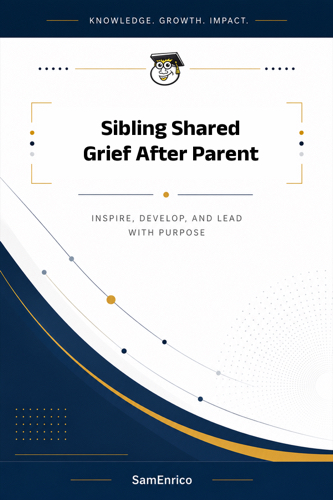
Non-FictionSelf-HelpFamily Dynamics
Sibling Shared Grief After Parent
Navigate different grieving styles and potential c
by Hurst Deedra
Navigate different grieving styles and potential conflicts with brothers and sisters.
Formats
About this book
Free sample
Chapter 1: The Axis Shifted...–– The call came at 2:14 AM. You know exactly where you were. You know exactly what you said. And you know exactly which sibling called you versus which sibling you had to hear about secondhand. That map of information—who called whom, who was left out, who made the decisions before you even knew there were decisions to make—that map is the first fault line.
It is not the grief itself. It is the collision.Your parent just died. You expect to feel shattered. You do not expect to feel furious at your brother. You do not expect to feel judged by your sister.
You do not expect to spend the first hour after the most devastating news of your life debating who gets to tell the neighbors or whether to publish an obituary before the autopsy is complete. But here you are. And here is the secret that no one tells you at 2:14 AM: the parent's death did not create this conflict. It just removed the lid.The Shared History Illusion You grew up in the same house. You ate at the same table.
You watched the same television shows. You have the same last name. So you assume, reasonably enough, that you and your siblings lost the same parent. That assumption is wrong. Devastatingly, relationship-endingly wrong.Your parent was not one person.
Your parent was a different person to each child. The father who taught you to throw a baseball may have been the same father who missed your sister's violin recital because of work. The mother who held you when you were sick may have been the same mother who criticized your brother's grades relentlessly. You and your siblings did not have the same childhood. You had overlapping childhoods.
The overlap is smaller than you think.This is not about blame. Parents are not machines. They have favorites, whether they admit it or not. They have blind spots. They have different relationships with different children because children are different.
The child who needed extra help got extra time. The child who was independent got less attention. The child who…
This is the end of the free sample. Get the eBook to keep going. Buy now
Contents
- Chapter 1
- Chapter 2
- Chapter 3
- Chapter 4
- Chapter 5
- Chapter 6
- Chapter 7
- Chapter 8
- Chapter 9
- Chapter 10
- Chapter 11
- Chapter 12
Details
- Author
- Hurst Deedra
- Publisher
- SamEnrico
- Language
- English
- Genre
- Non-Fiction, Self-Help, Family Dynamics
- Released
- 2026-06-06
- Pages (approx.)
- 140
- Available as
- eBook, Audiobook

Read better in the ZLOADR app
Your eBooks on your phone or tablet. Sign in with your SamEnrico account and start reading.
More by Hurst Deedra
 The Nutrigenomics HandbookHurst Deedra$11.99
 Pitching To Corporate Partners CourseHurst Deedra$11.99
 Paleo For Athletes RecoveryHurst Deedra$11.99
 The Lavender Field RestHurst Deedra$11.99
 The Desert Whisperers: How Bedouin Guides Unlocked the Mysteries of the Arabian PeninsulaHurst Deedra$11.99
 The Silk Road's Last Heist: The Lost Library of AlexandriaHurst Deedra$11.99
 Understanding Ghose–sachdev–Kumar SyndromeHurst Deedra$17.99
 Global Organic Textile StandardHurst Deedra$12.99
 Anita Roddick Cash Principles PrimerHurst Deedra$12.99
 Firewall EngineerHurst Deedra$11.99
 How to Start a Brocade Weaving Business (Beginners Guide)Hurst Deedra$11.99
You may also like
 Hong Kong Handover 1997Dunn Johnnie$11.99
 Zumba For Postnatal Recovery CourseNeal Christian$11.99
 Zumba for BeginnersLadner Nikia$11.99
 YouTube Comment Mining GuideHumes Pandora$12.99
 Worry Box MeditationCarlin Rudy$11.99
 Workplace Stress MeditationNguyen Lynn$11.99
 Workplace Stress and Sleep RepairHawley Ivory$11.99
 Workplace Perfectionism CureDelaney Jeffry$11.99
 Workplace Injustice Anger GuideWallen Isabelle$11.99
 Work Addiction and Burnout LinkGreenwood Ester$11.99
 Women in Yoga and WellnessBeattie Galina$11.99
 Women in Stand Up ComedyChun Evangeline$11.99