
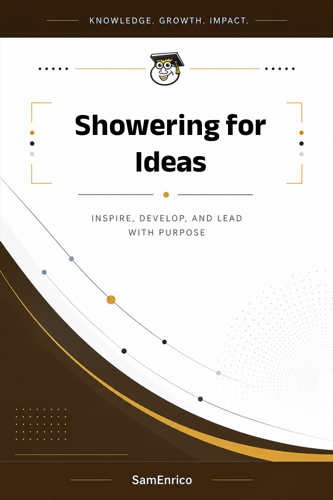
Non-FictionSelf-HelpIncubation
Showering for Ideas eBook
Uses daily hygiene as creative incubator.
by Kelly Simon
Uses daily hygiene as creative incubator.
Formats
Free sample
Chapter 1: The Wet Mind...--–- You have had at least forty-seven brilliant ideas in the shower this year. You remember exactly zero of them.This is not a guess. This is not a motivational exaggeration designed to make you feel seen. This is a statistical projection based on the average number of showers taken annually by adults in developed countries (roughly 280 to 300) and the peer-reviewed finding that approximately one in every six showers produces a moment of creative insight—what scientists now call the "Shower Effect." Do the math. Forty-seven is the conservative estimate.That number—forty-seven lost ideas per year per person—represents an epidemic of forgotten innovation.
It is the unwritten novel that died in the steam. The business solution that evaporated with the towel. The apology you should have made, the sentence you should have written, the problem you should have solved, all swirling down the drain because you did not know—could not have known—what was actually happening inside your skull when the hot water hit your skin.This book exists to change that. Not by teaching you to "think harder" or "focus better" or any of the other cruel prescriptions that productivity culture has been feeding you. Those prescriptions fail because they misunderstand the fundamental neurology of insight.
You cannot force a Eureka moment any more than you can force a seed to sprout by pulling on the stem. But you can understand the soil. You can understand the water. You can understand the light.And then you can build a system.This chapter is the foundation of that system. It will explain, in clear and practical terms, what actually happens inside your brain when you step under the spray.
You will learn about Alpha waves, the Default Mode Network, and the strange neurology of the "Aha" moment. You will discover why staring at a blank screen makes you less creative, not more. You will understand why the shower—of all places—has become the unlikely headquarters of human ingenuity. And you will begin to see that your daily hygiene routine is not a break from creativity. It is creativity, operating in its most natural and powerful form.But first, a confession.The Shower Confession Every writer who has ever tackled this topic has to face a moment of vulnerability.
Here is mine.For years, I believed that my best ideas came to me in spite of the shower, not because of it. I treated the shower as a necessary inconvenience—a warm, wet interval between real thinking. I would step under the water, lather, rinse, and spend the entire time mentally rehearsing my to-do list or replaying yesterday's argument with my spouse. Then, occasionally, inexplicably, a solution would arrive. A plot hole would close.
A business problem would untangle. A memory I had been searching for would surface unbidden.I would leap out of the shower, dripping water across the bathroom floor, grab a towel, and immediately forget everything.This pattern continued for nearly a decade. I assumed it was random. I assumed I had no control over it. I assumed that creativity was a lightning bolt—beautiful, powerful, and completely unpredictable.Then I discovered the research.In 2022, a team of cognitive scientists published a landmark study in the journal Psychology of Aesthetics, Creativity, and the Arts.
They asked hundreds of participants to engage in various activities—resting, walking, showering, working intently—and then tested their creative problem-solving abilities. The results were unambiguous. People who had just engaged in "moderately engaging activities" (showering, walking, driving) solved significantly more creative problems than those who had been doing nothing (boring) or working intently (stressful). The researchers gave this phenomenon a name: the Shower Effect.But here is what fascinated me most. The study did not just prove that showers work.
It revealed why they work. The answer had nothing to do with water, soap, or bathroom tile. It had everything to do with brain waves.The Alpha State Your brain is not a single machine running at a constant speed. It is a dynamic system that cycles through several distinct electrical states, each associated with a different frequency of neural oscillation. These frequencies are measured in Hertz (Hz), or cycles per second.
The faster the frequency, the more alert and focused you are. The slower the frequency, the more relaxed and diffuse your attention becomes.Most of your waking life is spent in Beta waves (14–30 Hz). Beta is the frequency of active concentration, problem-solving, decision-making, and—unfortunately—anxiety. When you are staring at a spreadsheet, stuck in traffic, or replaying a stressful conversation, your brain is humming in Beta. Beta is useful.
Beta keeps you alive in meetings. But Beta is terrible at creativity.Why? Because Beta is narrow. It focuses your attention on a single point, like a flashlight beam in a dark room. You can see that one spot very clearly, but everything else—the periphery, the connections, the remote associations—remains invisible.
When you are locked in Beta, you are solving the problem in front of you, not the problem behind it. You are optimizing, not imagining.Then there are Alpha waves (8–12 Hz). Alpha is the frequency of relaxed alertness. It is what your brain produces when you are daydreaming, when you are driving a familiar route, when you are lying on the couch with your eyes closed but not quite asleep. Alpha is broader than Beta.
It illuminates the whole room, not just the flashlight beam. And crucially, Alpha is the frequency at which the brain makes remote associations—connecting two seemingly unrelated ideas to form something new.This is not metaphor. This is measurable neuroscience. When researchers place electrodes on the scalps of people having creative insights, they consistently observe a burst of Alpha waves in the right hemisphere approximately 0.3 seconds before the "Aha" moment. The insight does not create the Alpha.
The Alpha creates the insight.Here is what this means for you, standing in your shower: the warm water, the white noise, the absence of screens and demands and decisions—these conditions do not just feel relaxing. They are neurologically specific. They down-regulate your Beta activity and up-regulate your Alpha activity. The shower is, quite literally, an Alpha wave machine. It is the most accessible, most reliable, most affordable creativity technology ever invented.And you have been using it wrong.The Two-Gear Model Before we go any further, we need to resolve a contradiction that has plagued creativity advice for decades.
You have probably heard two completely opposite instructions:"Always state your problem clearly before you begin.""Never force your thinking. Let the answer come to you."Both are correct. Both are also incomplete. The missing piece is context.There is no single "right way" to shower for ideas. There are two right ways.
I call this the Two-Gear Model, and it will serve as the organizing framework for the entire book.Gear One: The Focused Shower You bring a specific problem. You state it aloud before the water hits. You set an intention: "I will have a solution by the time the hot water runs out." You use the timer as a forcing function. You actively seek…
This is the end of the free sample. Get the eBook to keep going. Buy now
About this book
Details
- Author
- Kelly Simon
- Publisher
- SamEnrico
- Language
- English
- Genre
- Non-Fiction, Self-Help, Incubation
- Released
- 2026-06-05
- Pages (approx.)
- 142
- Available as
- eBook, Audiobook

Read better in the ZLOADR app
Your eBooks on your phone or tablet. Sign in with your SamEnrico account and start reading.
More by Kelly Simon
 The Growth Mindset for ParentingKelly Simon$11.99
 Vitamin D Deficiency Solutions GuideKelly Simon$11.99
 Breaking Into Voice ActingKelly Simon$11.99
 Transition Success StoriesKelly Simon$11.99
 Covenant Testing FrameworksKelly Simon$11.99
 Pelvic During HysterectomyKelly Simon$11.99
 L Arginine ED SupplementKelly Simon$11.99
 Huldra's Hollow: The Enigmatic Allure of the Forest BrideKelly Simon$11.99
 The Invisible Architect: How a Forgotten Woman Designed the Future of ComputingKelly Simon$11.99
 How to Produce PapayasKelly Simon$11.99
 Giant Schnauzers: Working BreedKelly Simon$11.99
 Bonus and Commission Pitfalls WorkbookKelly Simon$12.99
You may also like
 Hong Kong Handover 1997Dunn Johnnie$11.99
 Zumba For Postnatal Recovery CourseNeal Christian$11.99
 Zumba for BeginnersLadner Nikia$11.99
 YouTube Comment Mining GuideHumes Pandora$12.99
 Worry Box MeditationCarlin Rudy$11.99
 Workplace Stress MeditationNguyen Lynn$11.99
 Workplace Stress and Sleep RepairHawley Ivory$11.99
 Workplace Perfectionism CureDelaney Jeffry$11.99
 Workplace Injustice Anger GuideWallen Isabelle$11.99
 Work Addiction and Burnout LinkGreenwood Ester$11.99
 Women in Yoga and WellnessBeattie Galina$11.99
 Women in Stand Up ComedyChun Evangeline$11.99