
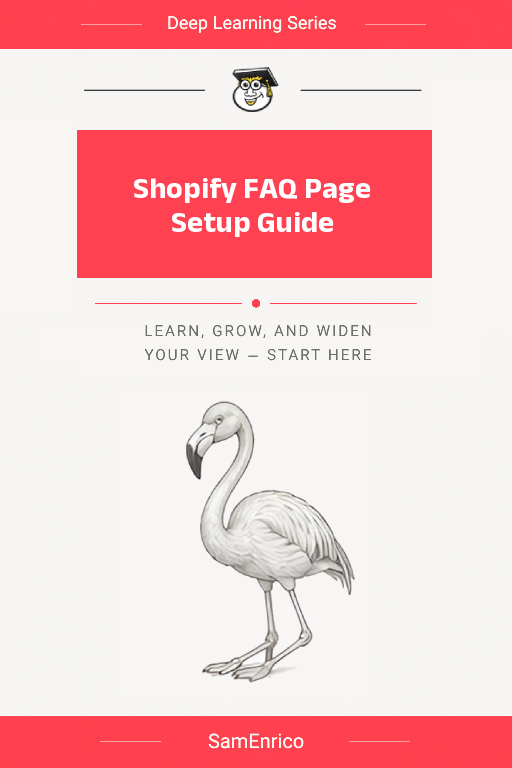
Shopify FAQ Page Setup Guide eBook
Build an FAQ page to reduce customer service ticke
Build an FAQ page to reduce customer service tickets for free.
Formats
Free sample
Chapter 1: The Ticket Trap--– Every support ticket is a confession. Not from your customer—from you. When someone clicks “send” on a question like “Where is my order?” or “Do you ship to Canada?” they are not just asking for information. They are silently reporting that your website failed them. The best-selling book Hug Your Haters makes this painfully clear: customers don’t wake up excited to email support.
They wake up wanting to buy, receive, and enjoy your product. Every detour through your inbox is a detour away from a sale. Yet most Shopify store owners treat support tickets as an unavoidable cost of doing business—like rent or merchant fees. This chapter will dismantle that belief completely. You will learn why the most profitable stores in e-commerce spend less on support, not more, and how a simple FAQ page built with free tools can become your highest-ROI asset.
By the end of this chapter, you will never look at a customer question the same way again.The Broken Compass: Why Customers Ask Instead of Buy Let us start with a simple exercise. Open your Shopify admin right now. Go to your support inbox—whether it is the native Shopify Inbox, Gmail, or a third-party help desk. Scroll back through the last one hundred customer messages. Count how many questions fall into these categories: shipping timelines, return policies, product dimensions, compatibility checks, or order status.
In almost every store, these five categories account for seventy to eighty percent of all tickets. Here is the painful truth: every single one of those questions could have been answered before the customer ever hit “send.” They asked because your website did not provide the answer at the exact moment they needed it.Consider a customer named Sarah. She finds your product on Instagram, clicks through, and lands on your product page. She loves the ceramic planters you sell. But she has two questions before she can feel comfortable buying: “Are these planters waterproof?” and “How long does shipping take to Austin, Texas?” She scans your product description.
No mention of waterproofing. She checks your footer. No shipping policy link. She hovers over your contact page, hesitates, then opens a support ticket. By the time you reply six hours later, Sarah has bought from a competitor who answered both questions on their product page.
You lost a sale not because your product was inferior, but because your information was invisible.This is what the Customer Effort Score (CES) reveals. Research from the Corporate Executive Board (now Gartner) found that ninety-four percent of customers with a low-effort service experience will buy again, while eighty-one percent of customers with a high-effort experience will bad-mouth the company. Notice the word “effort.” Not “friendliness.” Not “speed.” Effort. Customers do not want amazing support. They want no support.
Every ticket you receive is a tax on your customer’s patience and your own profitability.The Math of Self-Destruction: Calculating Your Cost-Per-Ticket Before we build anything, you need to understand exactly how much money is leaking out of your business through your inbox. Most store owners have no idea. They see support as a cost center—something to minimize by hiring cheaper agents or outsourcing overseas. But the real solution is not cheaper humans; it is fewer tickets.Let us calculate your true cost-per-ticket. Include four components:Labor cost: Take the hourly wage of whoever answers tickets (including yourself).
Add thirty percent for benefits, taxes, and overhead. Divide that hourly rate by the number of tickets that person can handle per hour. A realistic range for e-commerce support is four to six tickets per hour if answers require any research. At twenty dollars per hour plus overhead, each ticket costs roughly four to five dollars in labor alone.Software cost: Divide your monthly help desk, chat, or ticketing system fees by your average monthly ticket volume. For many small stores using free tools, this is zero.
But if you pay for Gorgias, Zendesk, or Re:amaze, your per-ticket software cost can add another one to two dollars.Emotional toll cost: This is the invisible expense. Every repetitive question grinds down your team’s morale. High-support stores experience burnout rates three times higher than low-support stores. Assign a conservative value of one dollar per ticket for the cost of hiring, training, and retaining support staff.Lost sales cost: This is the largest and most hidden expense. A percentage of customers who open tickets never convert.
Industry data suggests that for every ten support tickets opened, one potential sale is abandoned entirely. If your average order value is fifty dollars, each ticket carries a five-dollar “shadow cost” of lost revenue.Add these together. A typical small Shopify store spends between eight and fifteen dollars per ticket when you account for everything. Now multiply that by your monthly ticket volume. If you receive five hundred tickets per month at ten dollars each, you are spending five thousand dollars per month on support—sixty thousand dollars per year.
And most of those tickets are about shipping times, return policies, and product dimensions.The 20% Solution: Where to Start Deflecting Here is the good news. You do not need to eliminate all tickets to see massive savings. You just need to eliminate the easiest twenty percent. The most common questions—the ones that require no judgment, no escalation, no refund approval—are the lowest hanging fruit. “Do you ship to my country?” “What is your return window?” “How do I track my order?” These questions can be answered by a well-designed FAQ page with zero human involvement.Let us run the math on a realistic scenario.
Suppose your store currently receives five hundred tickets per month at an average cost of ten dollars each. Your monthly support cost is five thousand dollars. You build an FAQ page following the methods in this book. You deflect twenty percent of those tickets—one hundred questions per month that never become tickets because customers found the answer themselves. Your monthly support cost drops to four thousand dollars.
You save twelve thousand dollars per year. And you built the FAQ page for zero dollars using free Shopify tools and apps. That is a twelve-thousand-dollar return on a zero-dollar investment. If that sounds too good to be true, you have not been paying attention to how modern e-commerce works.One of the most successful case studies in the self-service space comes from a mid-sized apparel brand (which we will call “Threads Co.” for confidentiality). Before building their FAQ page, they received over eight hundred tickets per month.
Sixty percent were about sizing, returns, and shipping estimates. They implemented a comprehensive FAQ page with size charts, video return guides, and a shipping estimator. Within ninety days, their ticket volume dropped to four hundred per month. They did not hire anyone. They did not buy expensive software.
They simply made information available at the moment of need. Their annual savings exceeded thirty thousand dollars.The Mindset Shift: From Firefighter to Architect Most store owners operate in firefighting mode. A ticket comes in. They answer it. Another ticket comes in.
They answer it. This reactive cycle feels productive because you are always busy. But busy is not the same as…
This is the end of the free sample. Get the eBook to keep going. Buy now
About this book
Details
- Author
- Isaacs Angelique
- Publisher
- SamEnrico
- Language
- English
- Genre
- Non-Fiction, First 30 Days
- Released
- 2026-05-30
- Pages (approx.)
- 154
- Available as
- eBook, Audiobook

Read better in the ZLOADR app
Your eBooks on your phone or tablet. Sign in with your SamEnrico account and start reading.
More by Isaacs Angelique
 Anger in Neurodiverse LoveIsaacs Angelique$11.99
 Handling Conflict At WorkIsaacs Angelique$11.99
 Body Image For AcneIsaacs Angelique$11.99
 IBS Probiotic Strain GuideIsaacs Angelique$11.99
 Geo Arbitrage for AgenciesIsaacs Angelique$11.99
 Benzo Recovery Sensory Sensitivities CourseIsaacs Angelique$11.99
 Postpartum Anxiety Exposure TherapyIsaacs Angelique$11.99
 Pelvic Floor TipsIsaacs Angelique$11.99
 The Illegitimate Child PrimerIsaacs Angelique$11.99
 The Last Dance of the Soviet Cosmonauts: How the Fall of the USSR Stranded Men in SpaceIsaacs Angelique$11.99
 The Massacre of Saint Bartholomew: Blood in the Streets of ParisIsaacs Angelique$11.99
 The Hollow Men of the Sidhe: Ireland's Forgotten Fairy KingsIsaacs Angelique$11.99
You may also like
 Hong Kong Handover 1997Dunn Johnnie$11.99
 Zumba For Postnatal Recovery CourseNeal Christian$11.99
 Zumba for BeginnersLadner Nikia$11.99
 YouTube Comment Mining GuideHumes Pandora$12.99
 Worry Box MeditationCarlin Rudy$11.99
 Workplace Stress MeditationNguyen Lynn$11.99
 Workplace Stress and Sleep RepairHawley Ivory$11.99
 Workplace Perfectionism CureDelaney Jeffry$11.99
 Workplace Injustice Anger GuideWallen Isabelle$11.99
 Work Addiction and Burnout LinkGreenwood Ester$11.99
 Women in Yoga and WellnessBeattie Galina$11.99
 Women in Stand Up ComedyChun Evangeline$11.99