
Non-FictionHealth & WellnessPharmacotherapy
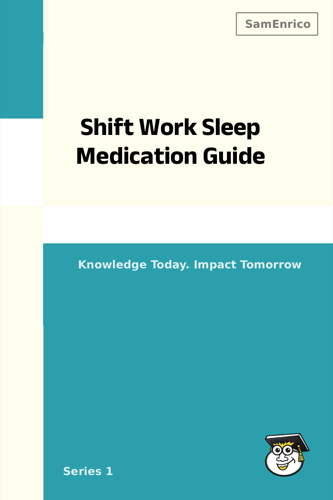
Shift Work Sleep Medication Guide eBook
Compare prescription sleep aids and their risks fo
Compare prescription sleep aids and their risks for shift workers.
Formats
Free sample
Chapter 1: The Body Betrayed--–- The fluorescent lights of the emergency room hummed at 3:47 AM, casting their familiar sterile glow on Sarah’s exhausted face. She had been a nurse for twelve years, working the night shift for eight of them. For the past three years, she had been convinced she was developing early-onset dementia. She forgot patient names mid-sentence. She nearly administered the wrong medication twice last month.
Her short-term memory had become a sieve, and she had started leaving sticky notes on her own refrigerator to remind herself to eat. Her doctor ran a full neurological workup—MRI, blood panels, cognitive assessments. Everything came back normal. “You’re just tired,” the doctor said. “Get more sleep.” Sarah wanted to scream.
She was trying to sleep. She was taking Ambien. She was drinking valerian tea. She had blackout curtains so expensive they cost more than her car payment. And still, every morning at 8 AM when she crawled into bed, her brain refused to shut down.
Her body would lie there, heart racing, mind spinning, while the sun rose outside her sealed windows. She would finally drift off around 11 AM, only to be jolted awake by the lawnmower at 1 PM, or the garbage truck at 2 PM, or simply by her own internal clock screaming that it was daytime and she should be awake. By 5 PM, she would drag herself out of bed feeling like she had been hit by a truck. By 7 PM, she would clock back in for another twelve-hour night shift. This was her life.
This is the life of nearly one in three night shift workers. And Sarah was not broken. She was not demented. She was not lazy or weak-willed or making poor choices. She was fighting a war against a billion years of evolution—and she was losing because no one had ever explained to her what she was actually fighting.The Clock You Cannot See Every living creature on Earth that has existed for more than a few hundred million years carries inside its cells a clock.
Not a metaphorical clock—a literal, biological, molecular timekeeping mechanism. In humans, this clock is located in a tiny cluster of brain cells called the suprachiasmatic nucleus, or SCN, buried deep in the hypothalamus. This cluster contains approximately 20,000 neurons, and each one of those neurons has its own intrinsic rhythm. They fire electrical signals in waves that rise and fall approximately every 24 hours and 11 minutes. That extra eleven minutes is important, because your brain corrects it every day using the most powerful timekeeper in the known universe: the sun.When light enters your eyes—specifically, a specialized class of photoreceptors called intrinsically photosensitive retinal ganglion cells, which contain a photopigment called melanopsin—a signal travels along the retinohypothalamic tract directly to your SCN.
That signal tells your master clock: “It is daytime. Reset yourself.” Your SCN then sends signals throughout your body, synchronizing every organ, every tissue, every cell. Your liver knows what time it is. Your heart knows. Your kidneys, your gut, your skin, your fat cells—they all have their own peripheral clocks that receive marching orders from the SCN.
This is why your body temperature rises in the morning and falls at night. This is why your blood pressure dips while you sleep. This is why your digestive system slows down after dark. This is why you feel hungry at lunchtime even if you didn’t look at a clock. This is your circadian rhythm, and it is not a suggestion.
It is a command.Your circadian rhythm orchestrates the release of hormones with surgical precision. Cortisol begins rising around 3 AM, peaking at approximately 8 AM, giving you the energy to wake up. Melatonin begins rising around 9 PM, peaking in the middle of the night, telling every cell in your body that it is time to sleep. Growth hormone is released in pulses during deep sleep, repairing your tissues. Leptin and ghrelin—the hormones that control hunger and satiety—cycle throughout the day, telling you when to eat and when to stop.
Your immune system follows a circadian pattern, with certain immune cells being released into your bloodstream during the day and others at night. Even your gut microbiome has a circadian rhythm, with different bacterial species becoming more or less active depending on the time of day.This system is not a luxury. It is not an optional feature that you can override with willpower. It is the operating system of your body. And shift work forces you to run that operating system in reverse.The 27 Percent Let me give you a number that should shock you: 27 percent.
That is the percentage of night shift workers who meet the full diagnostic criteria for Shift Work Disorder (SWD). Not “feel a little tired.” Not “have trouble sleeping sometimes.” Meet the full clinical criteria for a recognized medical disorder. For comparison, only 7 percent of day workers meet the criteria for any sleep disorder. That means night shift workers are nearly four times more likely to have a clinically significant sleep disorder than people who work during the day.But here is what those numbers do not capture. Shift Work Disorder is not simply “insomnia plus fatigue.” It is a specific condition defined by the International Classification of Sleep Disorders, Third Edition (ICSD-3), and it has four diagnostic criteria that must all be met.
First, the patient must have symptoms of insomnia or excessive sleepiness that are directly related to a work schedule that overlaps with the typical sleep period. Second, these symptoms must have persisted for at least three months. Third, the patient must have a documented reduction in total sleep time relative to their age-adjusted norm. Fourth, and most critically, the symptoms cannot be better explained by another sleep disorder, medical condition, or substance use.That last criterion is where most shift workers get misdiagnosed. Sarah, the nurse we met at the beginning of this chapter, had been told she had generalized anxiety disorder, major depressive disorder, adjustment disorder, chronic fatigue syndrome, and even “possible early cognitive decline.” Not one of those diagnoses was correct.
She had Shift Work Disorder. Her anxiety was a symptom of sleep deprivation, not the cause. Her depression was a consequence of living in a state of perpetual jet lag, not a primary mood disorder. Her cognitive decline—the forgetting, the confusion, the near-mistakes—was the predictable result of a brain that had not experienced restorative sleep in years.This misdiagnosis epidemic has real consequences. When a doctor diagnoses depression and prescribes an SSRI, that SSRI will do nothing for the circadian disruption.
When a doctor diagnoses anxiety and prescribes a benzodiazepine, that benzodiazepine will fragment sleep architecture and make the problem worse. When a doctor says “just practice better sleep hygiene,” that advice fails because sleep hygiene assumes your circadian rhythm is functioning normally. For a shift worker, normal sleep hygiene is like putting a bandage on a bullet wound. It is not wrong—dark rooms and no screens are helpful—but it completely misses the fundamental problem. The problem is not your environment.
The problem is your clock.The Two Faces of Shift Work Disorder One of the most important distinctions in this entire…
This is the end of the free sample. Get the eBook to keep going. Buy now
About this book
Details
- Author
- Scroggins Gwenda
- Publisher
- SamEnrico
- Language
- English
- Genre
- Non-Fiction, Health & Wellness, Pharmacotherapy
- Released
- 2026-06-09
- Pages (approx.)
- 158
- Available as
- eBook, Audiobook

Read better in the ZLOADR app
Your eBooks on your phone or tablet. Sign in with your SamEnrico account and start reading.
More by Scroggins Gwenda
 Labeling Judgments Anger GuideScroggins Gwenda$11.99
 The Mother's Celebrity AffairScroggins Gwenda$11.99
 Failure Shame Detox GuideScroggins Gwenda$11.99
 Thermic Effect TrackingScroggins Gwenda$11.99
 Money Anxiety Coping HandbookScroggins Gwenda$11.99
 The Visionary: How Mo Ibrahim Built Africa's First Sports EmpireScroggins Gwenda$11.99
 Midnight in Monaco: The Phantom of the Grand PrixScroggins Gwenda$11.99
 How to Produce Probes and FindersScroggins Gwenda$11.99
 How to Produce Electric Riding VehiclesScroggins Gwenda$11.99
 EU Trade Preference Programs GuideScroggins Gwenda$12.99
 Alibaba Negotiation vs Amazon Fixed Price WorkbookScroggins Gwenda$12.99
 Peach: Freestone & ClingstoneScroggins Gwenda$11.99
You may also like
 Hong Kong Handover 1997Dunn Johnnie$11.99
 Zumba For Postnatal Recovery CourseNeal Christian$11.99
 Zumba for BeginnersLadner Nikia$11.99
 YouTube Comment Mining GuideHumes Pandora$12.99
 Worry Box MeditationCarlin Rudy$11.99
 Workplace Stress MeditationNguyen Lynn$11.99
 Workplace Stress and Sleep RepairHawley Ivory$11.99
 Workplace Perfectionism CureDelaney Jeffry$11.99
 Workplace Injustice Anger GuideWallen Isabelle$11.99
 Work Addiction and Burnout LinkGreenwood Ester$11.99
 Women in Yoga and WellnessBeattie Galina$11.99
 Women in Stand Up ComedyChun Evangeline$11.99