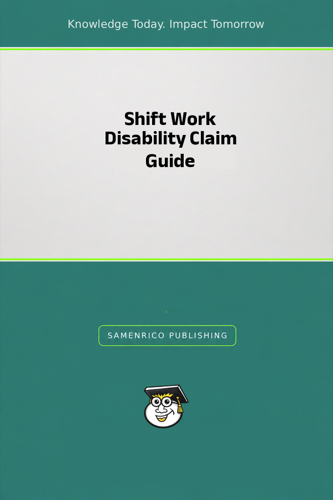
Shift Work Disability Claim Guide eBook
Apply for benefits if shift work sleep disorder di
Apply for benefits if shift work sleep disorder disables you.
Formats
Free sample
Chapter 1: The 3 AM Wake-Up--The cardiac monitor screamed first.Nurse Melissa R. had worked the night shift in the same intensive care unit for eleven years. She knew every alarm, every drip rate, every subtle change in a patient's breathing pattern. She had been named Nurse of the Year twice. She could start an IV in the dark, which was good, because on a rotating shift schedule, half her workweek was darkness.At 3:17 AM on a Tuesday that felt like no day at all, Melissa was hanging a bag of potassium chloride when she noticed something strange.
The text on the bag was blurry. Then it doubled. Then she realized she was not actually looking at the bag anymore. She was looking at the floor. Her knees had buckled.
She had no memory of bending. She had no memory of the fall.She had experienced a microsleep while standing upright. Duration: approximately eight seconds. She had been fully unconscious, eyes open, hands still gripping the IV bag, while her brain performed a forced reboot.The patient was fine. Melissa was not.Three weeks later, she was fired for "failure to maintain patient safety standards." Her supervisor suggested she "get more sleep" and "drink less coffee." Her family doctor told her she probably had anxiety and prescribed an antidepressant.
No one mentioned shift work sleep disorder. No one mentioned that her circadian rhythm, after eleven years of rotating between days, nights, and swing shifts, had been physiologically destroyed.Melissa applied for disability benefits. She was denied. She appealed. She was denied again.
The insurance company's doctor wrote that she had "no objective findings" and "subjective complaints of tiredness common to all shift workers." He did not order actigraphy. He did not review her sleep logs. He spent twelve minutes with her.She lost her house eighteen months later.This book exists because Melissa's story is not unusual. It is the rule.The Invisible Injury If you broke your back on the job, you would have an X-ray. If you lost your hearing in a factory accident, you would have an audiogram.
If you developed carpal tunnel syndrome from years of repetitive motion, you would have a nerve conduction study. The legal system for disability benefits is designed around visible, measurable, objective injuries.Shift work sleep disorder offers none of these things on the surface.You look tired. That is what everyone says. You look tired. Your spouse says it.
Your coworkers say it. Your boss says it, usually with a sigh of disappointment. You look tired. As if tiredness were a cosmetic problem, like a wrinkled shirt or a smudge on your glasses. As if tiredness were simply the price of being a responsible adult with a difficult job.But you are not tired.
You are disabled.The distinction matters more than you can imagine. Tired people drink coffee and go for walks and take a nap on their day off. Disabled people fall asleep while driving. Disabled people make catastrophic errors because their brain stopped forming memories for fifteen seconds. Disabled people cannot sustain the basic functions of employment – showing up on time, staying awake, remembering instructions, regulating their emotions – not because they lack willpower but because their biology has been systematically dismantled by years of working against their own internal clock.This chapter will teach you the difference between fatigue and disability.
It will give you the language to describe your experience in terms that judges and insurance examiners are required to take seriously. And it will include a self-assessment checklist to help you determine whether your case has merit before you invest months of emotional energy into a claim.By the end of this chapter, you will stop telling yourself "I'm just tired" and start recognizing the clinical reality: you may have a recognized, compensable medical disorder.What Shift Work Sleep Disorder Actually Is Let us start with the official definition.Shift work sleep disorder (SWSD) is classified under the International Classification of Diseases, 10th Revision (ICD-10) as code G47.26. It falls under the broader category of circadian rhythm sleep disorders, which are neurological conditions involving a mismatch between an individual's internal biological clock and the external demands of their environment.The diagnostic criteria, as established by the American Academy of Sleep Medicine, require all of the following:A primary complaint of insomnia or excessive sleepiness that temporally overlaps with a work schedule that overlaps the typical sleep period.The symptoms have persisted for at least three months.Polysomnography or actigraphy (discussed in detail in Chapter 3) demonstrates a disruption of the circadian timing system.The disturbance is not better explained by another sleep disorder, medical condition, mental disorder, medication use, or substance use disorder.Notice what is not in these criteria. There is no requirement that you feel "very" tired. There is no requirement that you have missed a certain number of work days.
There is no requirement that a doctor "believes you." The criteria are clinical and measurable.The Circadian Biology in Plain English Deep inside your brain, above the spot where your optic nerves cross, sits a cluster of cells called the suprachiasmatic nucleus. It is your master clock. It receives signals from your eyes about light and darkness, and it sends signals to the rest of your body about when to release melatonin (the sleep hormone), when to raise cortisol (the wake-up hormone), when to raise body temperature, when to slow digestion, and when to sharpen cognitive function.This clock is not a suggestion. It is a biological fact. It runs on a cycle of approximately 24 hours and 15 minutes, reset daily by morning light.
It evolved over hundreds of millions of years. No amount of willpower, discipline, or caffeine can override it permanently.When you work nights, you are asking your suprachiasmatic nucleus to reverse its polarity. You want to be awake when it wants you to sleep. You want to sleep when it wants you to be alert. The result is not merely discomfort.
It is a state of chronic, low-grade physiological conflict that damages every system in your body.The American Academy of Sleep Medicine has published research showing that shift workers sleep an average of one to four hours less per 24-hour period than day workers. But the problem is not just quantity – it is quality. Night shift sleep is lighter, more fragmented, and lacks the same proportion of restorative slow-wave and REM sleep. You may spend eight hours in bed after a night shift, but you are not getting eight hours of sleep. You are getting perhaps five or six hours of biologically inferior rest.After enough nights of this, the sleep debt becomes overwhelming.
Your brain begins to force microsleeps – brief, involuntary lapses of consciousness – as a protective mechanism against total collapse. This is not a moral failing. It is a neurological inevitability.The Microsleep: Your Brain's Emergency Brake Let us pause here to define a term that will appear throughout this book. You need to understand it completely because it will become the central piece of evidence in your claim.What Exactly Is a Microsleep?A microsleep is an unintended episode of loss of consciousness lasting between three and thirty seconds.…
This is the end of the free sample. Get the eBook to keep going. Buy now
About this book
Details
- Author
- Hardesty Belia
- Publisher
- SamEnrico
- Language
- English
- Genre
- Non-Fiction, Health & Wellness, Disability
- Released
- 2026-06-10
- Pages (approx.)
- 134
- Available as
- eBook, Audiobook

Read better in the ZLOADR app
Your eBooks on your phone or tablet. Sign in with your SamEnrico account and start reading.
More by Hardesty Belia
 Peg System for Memorizing Flight NumbersHardesty Belia$11.99
 Home Equity Conversion TacticsHardesty Belia$11.99
 Body Image for Cerebral Palsy CourseHardesty Belia$11.99
 The Freelance NetworkerHardesty Belia$11.99
 The Silent Storm: The Untold Story of the 1915 Gallipoli TunnellersHardesty Belia$11.99
 The Alchemists of Mesopotamia: Birth of Industrial Chemistry in the Fertile CrescentHardesty Belia$11.99
 Understanding Experimental Allergic EncephalomyelitisHardesty Belia$17.99
 Onsite ManagerHardesty Belia$11.99
 Executive Summary Frameworks for Strategy DocumentsHardesty Belia$12.99
 Procurement Policy ComplianceHardesty Belia$12.99
 How to Become a Monument SetterHardesty Belia$11.99