
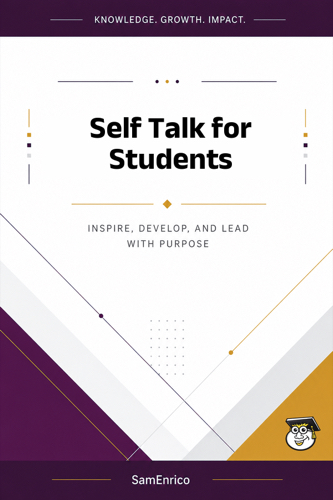
Non-FictionSelf-Help / Education
Self Talk for Students eBook
Rewires academic anxiety and test fear with capabl
Rewires academic anxiety and test fear with capable inner dialogue.
Formats
Free sample
Chapter 1: The Loudest Voice--The most dangerous person in your classroom is not the bully in the back row, the teacher who never calls on you, or the classmate who somehow finishes every test in twenty minutes. The most dangerous person in your classroom is sitting directly behind your eyes, and they never stop talking.You cannot hear them with your ears, but you cannot escape them either. They comment on everything you read, every answer you consider, every mistake you make. They have opinions about your intelligence, your preparation, your belonging, and your future. They were there when you walked into school this morning, and they will be there when you lie in bed tonight replaying everything you said in class.
They are the voice inside your head, and for most students, this voice is not a coach. It is a critic. Sometimes it is a tyrant.This chapter is about one thing only: hearing that voice for what it actually is. Not what it claims to be. Not what you fear it might be telling the truth about.
But what it actually is—a collection of learned scripts, automatic reactions, and habitual phrases that can be identified, examined, and ultimately rewritten.Before we go any further, let me ask you something uncomfortable. Think about the last time you sat down to study something difficult. Maybe it was a math problem that would not solve. Maybe it was an essay introduction that would not come together. Maybe it was a set of flashcards for a subject that makes your stomach tight.
Now answer this: what did you say to yourself in the minute before you gave up, got distracted, or started feeling that familiar wave of dread?If you are like most students, you said something like one of these: "I'm just not good at this." "Why am I so slow?" "Everyone else gets it." "There's no point in trying." "I'm going to fail this class." "What's wrong with me?"Here is the unsettling truth. You said those things to yourself automatically, without deciding to, and you probably believed them without question. That is the power of the inner voice. It speaks with such familiarity that we mistake it for truth. It uses our own tone, our own vocabulary, our own fears.
It sounds like us, so we assume it is us. But it is not. It is a voice—one voice among many possible voices—and it has been trained by years of stress, comparison, and high-stakes pressure to speak in a particular way. The good news is that voices can be retrained. But first, you have to hear them.The Myth of the Quiet Classroom Walk into any classroom during a test, and what do you notice?
Silence. Pencils scratching. Papers shuffling. The occasional sigh. A teacher watching from the front.
By all external measures, the room is quiet. But inside the head of every single student in that room, there is a conversation happening. Some of those conversations are productive. Some are neutral. And some are absolute chaos.The myth of the quiet classroom is one of the most destructive illusions in education.
It suggests that learning happens in silence, that concentration is the absence of noise, and that a student who appears calm is calm. None of these things are true. The busiest place in any school is not the cafeteria at lunch. It is the space between a student's ears during a pop quiz.Psychologists call this internal conversation "inner speech." It is the verbal thinking we do when we are not speaking aloud. Inner speech is not inherently good or bad.
It is simply a tool that the brain uses to regulate behavior, solve problems, and make meaning. When inner speech is working well, it sounds like this: "Let me read that question again. Okay, I remember this formula. I'll start with step one." That voice is calm, task-focused, and helpful. It sounds like a reliable teammate.But when inner speech is working poorly—when it has been hijacked by anxiety, past failures, or social comparison—it sounds entirely different.
It sounds like this: "I don't know this. I never know this. Why am I even here? Everyone is going to see how stupid I am." That voice is not calm. It is not task-focused.
And it is not helpful. It sounds like an enemy who has taken up residence in your own head.Here is the distinction that will matter for every chapter that follows. Productive inner speech comments on the task. Catastrophic inner speech comments on the self. Productive inner speech says, "This problem is hard." Catastrophic inner speech says, "I am stupid because this problem is hard." Productive inner speech says, "I need to check my work." Catastrophic inner speech says, "I always make careless mistakes because I am a careless person." The first voice keeps you engaged.
The second voice makes you want to flee, hide, or give up.The goal of this book is not to silence your inner voice. That is impossible, and it would also be unwise. The goal is to transform it—to shift the balance of power from the catastrophic voice to the productive voice, from the critic to the coach, from the voice that paralyzes to the voice that guides. But transformation begins with awareness. You cannot change a voice you have never truly heard.The Two Voices: A Side-by-Side Comparison Let me make this distinction concrete.
Below are five common academic situations. For each one, I have written what the Productive Inner Voice sounds like and what the Catastrophic Inner Voice sounds like. Read both. Notice which one sounds more familiar. Notice which one you have been listening to.Situation 1: You are stuck on a math problem for more than two minutes.Productive Voice: "This problem is taking longer than I expected.
Let me read it again and look for what I might be missing."Catastrophic Voice: "I'm so bad at math. I'll never get this. I should just skip it and pretend I didn't see it."Situation 2: You finish a test and immediately realize you might have made a mistake.Productive Voice: "I noticed something. Let me go back and check that question if I have time."Catastrophic Voice: "I blew it. I always make stupid mistakes.
This is going to ruin my grade."Situation 3: The teacher calls on you when you are not sure of the answer.Productive Voice: "I'm not completely sure, but I can say what I do know and go from there."Catastrophic Voice: "Everyone is looking at me. They can tell I don't know. I'm going to sound so stupid."Situation 4: You get a grade back that is lower than you wanted.Productive Voice: "This isn't what I hoped for. Let me look at what I missed and figure out what I need to study differently."Catastrophic Voice: "I knew it. I'm not smart enough for this class.
What's the point of even trying?"Situation 5: You see a classmate finish an assignment long before you.Productive Voice: "They work at a different speed. I'm going to focus on my own paper and use all the time I need."Catastrophic…
This is the end of the free sample. Get the eBook to keep going. Buy now
About this book
Details
- Author
- Dewitt Felton
- Publisher
- SamEnrico
- Language
- English
- Genre
- Non-Fiction, Self-Help / Education
- Released
- 2026-06-07
- Pages (approx.)
- 155
- Available as
- eBook, Audiobook

Read better in the ZLOADR app
Your eBooks on your phone or tablet. Sign in with your SamEnrico account and start reading.
More by Dewitt Felton
 The Pomodoro MasteryDewitt Felton$11.99
 Cathedral Silence GuideDewitt Felton$11.99
 Stress Pregnancy ComplicationsDewitt Felton$11.99
 Child Development Flow GuideDewitt Felton$11.99
 Cabin Porch Swing GuideDewitt Felton$11.99
 Archer's Self HypnosisDewitt Felton$11.99
 ABCDE for FreelancersDewitt Felton$11.99
 The Vanishing of the Shanghai Princess: A Prohibition-Era MysteryDewitt Felton$11.99
 Crowfoot’s Shadow: A Blackfoot Spy’s GambitDewitt Felton$11.99
 How to Produce Digital CamerasDewitt Felton$11.99
 White Rhinoceroses: Second LargestDewitt Felton$11.99
 How to Produce a Plant ProtectorDewitt Felton$11.99
You may also like
 Hong Kong Handover 1997Dunn Johnnie$11.99
 Zumba For Postnatal Recovery CourseNeal Christian$11.99
 Zumba for BeginnersLadner Nikia$11.99
 YouTube Comment Mining GuideHumes Pandora$12.99
 Worry Box MeditationCarlin Rudy$11.99
 Workplace Stress MeditationNguyen Lynn$11.99
 Workplace Stress and Sleep RepairHawley Ivory$11.99
 Workplace Perfectionism CureDelaney Jeffry$11.99
 Workplace Injustice Anger GuideWallen Isabelle$11.99
 Work Addiction and Burnout LinkGreenwood Ester$11.99
 Women in Yoga and WellnessBeattie Galina$11.99
 Women in Stand Up ComedyChun Evangeline$11.99